← On a small screen, scroll the diagram horizontally. →
01 /
Your first round
Become declarer by winning the auction, choose or reveal trumps and play alone against two temporary defenders. Win more tricks than either defender individually. With nine tricks, 5 always succeeds; 4 succeeds only at 4–3–2. Card ranks decide tricks, but cards have no counting values.
02 /
Cards, seats and the deal
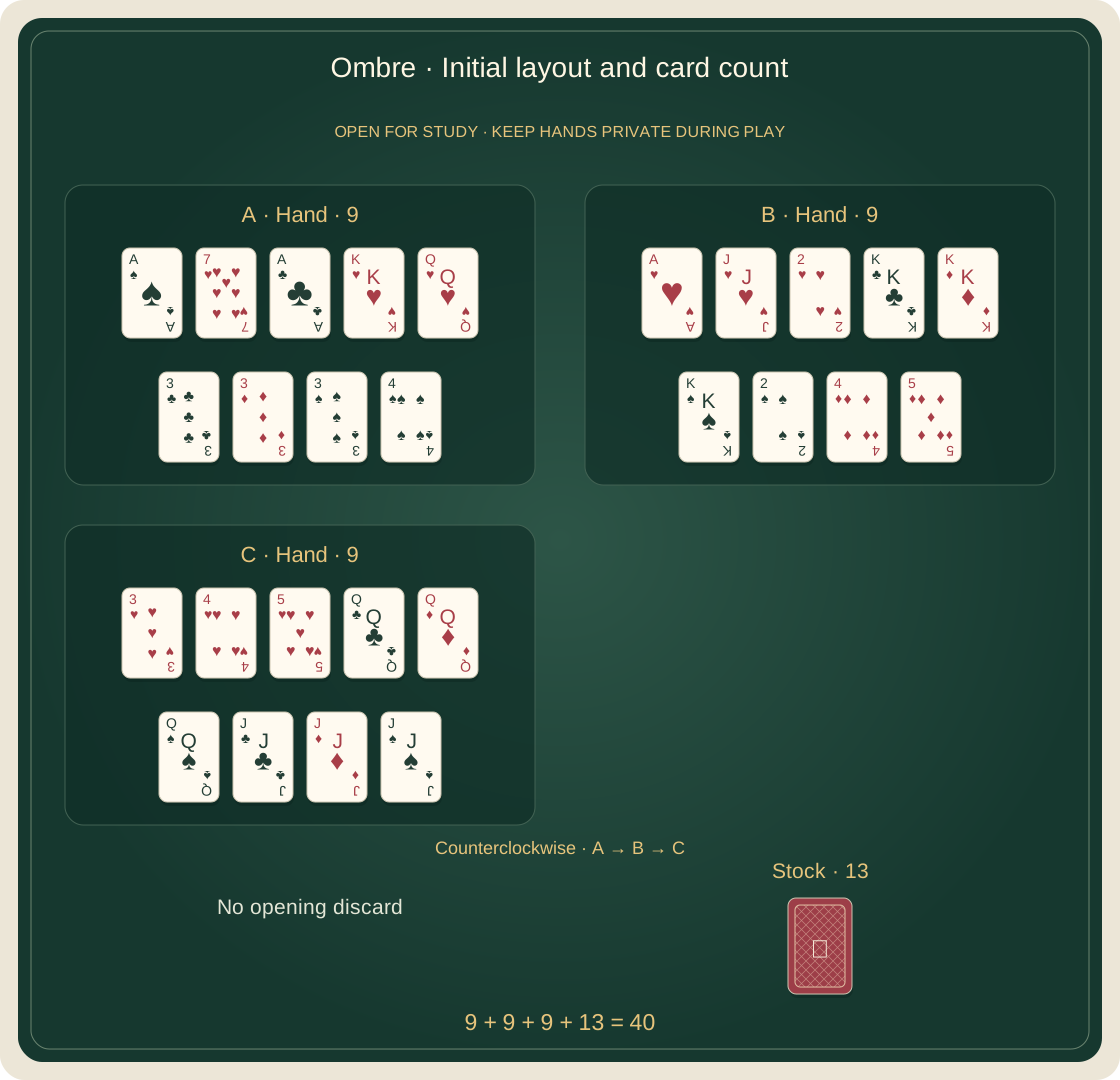
Remove every 8, 9 and 10 from an ordinary pack: 40 cards remain. Choose the first dealer by agreement. Deal and play counterclockwise, starting at dealer’s right, in three packets of 3: 9 each, with 13 face-down stock cards. Thus 27 + 13 = 40. Eldest means the first receiver, not the oldest person. Dealer rotates right after each deal.
03 /
Auction and positional priority
Speak from eldest in play order. Entrada is lowest: choose trumps and exchange. Vuelta is higher: the exposed stock top fixes trumps, then exchange. Solo is highest here: choose trumps, without declarer’s exchange. Bid higher or pass; after passing, do not return. An earlier hand may hold an equal bid just made by a later hand, which must raise or withdraw. When the others pass, the surviving bidder plays at least the retained level. All pass means redeal with the next dealer; the existing pool stays.
04 /
Exchange before the first lead
In Entrada announce trumps before discarding. Set aside 0–9 cards face down, then draw exactly that many; nobody may inspect the discards. In our Vuelta procedure, expose the stock top, use its printed suit, discard at least 1 and count the exposed card as the first replacement. Next, the defender at declarer’s right chooses to exchange first or offers that privilege to the other. They draw only what remains; in Solo the first defender may take at most 8. No discards return to stock and there is no drawing during tricks.
05 /
Matadors and the four rank orders
A♠ is spadille, always highest; A♣ is basto, always third. Manille, between them, is the 2 of a black trump suit or 7 of a red one. These cards belong to trumps, not their printed suits. A red trump ace is fourth, called punto, without matador privilege. The table runs strongest to weakest.
| Colour | Role | Order |
|---|---|---|
| ♠ / ♣ | Trump | A♠ · 2 · A♣ · K · Q · J · 7 · 6 · 5 · 4 · 3 |
| ♥ / ♦ | Trump | A♠ · 7 · A♣ · A · K · Q · J · 2 · 3 · 4 · 5 · 6 |
| ♠ / ♣ | Plain suit | K · Q · J · 7 · 6 · 5 · 4 · 3 · 2 |
| ♥ / ♦ | Plain suit | K · Q · J · A · 2 · 3 · 4 · 5 · 6 · 7 |
06 /
What happens on your turn
Eldest leads, even when someone else is declarer. Follow the effective led suit if you can; when void, any card is allowed, with no duty to trump or overtrump. Highest trump wins; otherwise highest in the led suit. The winner leads next. Collect each player’s tricks separately: the defenders’ combined total cannot decide whether declarer has won.
07 /
When a matador may be retained
When ordinary trump is led, a matador may be kept if you have no ordinary trump to follow with. But a higher matador led to the trick forces a lower matador when there is no ordinary-trump alternative. Spadille can never be forced; manille can be forced only by a spadille lead. A higher matador played second does not create this obligation. This is a defined privilege, not permission to ignore a plain suit you hold.
08 /
Scoring and settlement
Use paper counters, not money. Dealer contributes 5 to the common pool before each deal. Let P be the pool after that contribution; let b be 5 for Entrada, 7 for Vuelta or 8 for Solo. Sacada: declarer collects P and b from each defender. Puesta: if the highest trick total is tied, declarer adds P + 2b to the pool. Codille: if a defender has the unique most, declarer pays that defender P + 2b directly; the pool stays. These base payments omit all optional extras.
09 /
When the round and match end
Our teaching session is 9 deals, including passed-out deals, so each player deals equally often. Record balances including pool contributions; do not erase a loss by redealing. Finish all nine tricks without a vole bonus, even if success is already certain. At session end share any remaining pool equally and compare net balances; fractions may be recorded. Other historical sessions continue until the pool is won or reserve large puestas; agree on that separately.
10 /
A complete worked example
Seats A–B–C are in counterclockwise play order; C deals and puts 5 in an empty pool. A is eldest, wins Entrada, chooses hearts and exchanges no cards. Both defenders also decline an exchange. The 13 stock cards remain unused. This is a legal teaching line, not a claim of best defence.
Player A
A♠ 7♥ A♣ K♥ Q♥ 3♣ 3♦ 3♠ 4♠
Player B
A♥ J♥ 2♥ K♣ K♦ K♠ 2♠ 4♦ 5♦
Player C
3♥ 4♥ 5♥ Q♣ Q♦ Q♠ J♣ J♦ J♠
| Step | Leader | Player A | Player B | Player C | Winner |
|---|---|---|---|---|---|
| 1 | A | A♠ | A♥ | 3♥ | A |
| 2 | A | 7♥ | 2♥ | 4♥ | A |
| 3 | A | A♣ | J♥ | 5♥ | A |
| 4 | A | K♥ | 2♠ | J♣ | A |
| 5 | A | Q♥ | 4♦ | J♠ | A |
| 6 | A | 3♣ | K♣ | Q♣ | B |
| 7 | B | 3♦ | K♦ | Q♦ | B |
| 8 | B | 3♠ | K♠ | Q♠ | B |
| 9 | B | 4♠ | 5♦ | J♦ | C |
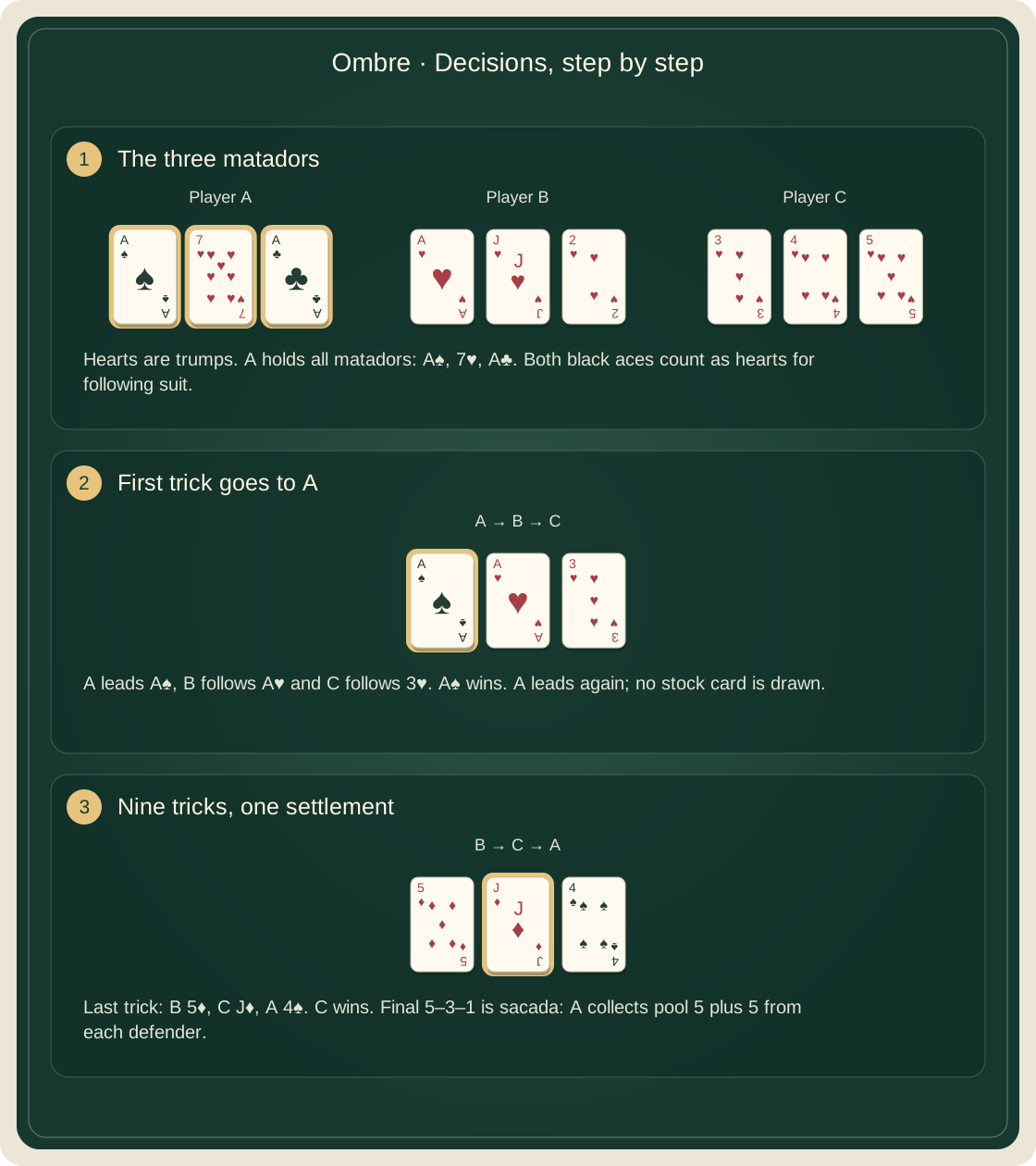
A wins the first 5 with trumps, even though A♠ and A♣ look like other suits. B wins tricks 6–8 with kings. On the last diamond lead J♦ beats 5♦, while 4♠ is off-suit, so C wins. Result 5–3–1: sacada. A collects pool 5 plus 5 from B and 5 from C. Including C’s ante, balances are A +15, B −5, C −10; sum 0. A hypothetical 4–4–1 instead requires a 15 payment into the pool; 3–4–2 requires 15 directly to B.
← On a small screen, scroll the diagram horizontally. →
11 /
Check your understanding
Separate position: hearts trump, a spade is led; you hold A♠ and 4♠. Which follows?
Reveal the answer
4♠. A♠ is trump, not a plain spade. You cannot cut while holding a real card of the led plain suit.
Only A♣ and K♦ remain; hearts trump and K♥ is led. May you save A♣?
Reveal the answer
Yes, discard K♦ under the matador privilege. If A♠ had been led instead, the lower matador A♣ would be forced.
12 /
History and other versions
Ombre grew from Spanish Hombre and spread through European courts during the seventeenth century. It was known in England by 1660, so a simple story crediting its arrival solely to the royal marriage of 1662 is insufficient. Later English and continental rules diverged. Oros, honours, primeras, surrender and a challenge to take every trick are real historical options, but adding them changes this article’s stated profile.
13 /
Mistakes to avoid
Do not treat a red plain ace as highest: it lies below J and above 2. Do not follow the printed spade or club on a black ace: both are trumps. A 4–4–1 finish with declarer on 4 is puesta, not a win. At 3–4–2 declarer on 3 suffers codille; this is different from equal 3–3–3.
14 /
A reminder for the table
Set the pool and dealer; deal, bid, fix trumps, exchange without seeing discards. Check the four rank orders. Eldest leads, matador exceptions apply, and trick ownership stays separate. Classify the final split before paying. Record the pool, rotate the dealer and return every discarded or unused card before shuffling.
Common questions
Are the two black aces still in their printed suits?+
No. Both belong to trumps in every contract. They cannot satisfy a plain spade or club obligation.
Must a void player trump?+
No. When void you may discard or trump. Holding the led plain suit normally obliges you to follow it.
Why keep the defenders’ tricks separate?+
Because a dominant individual total, a tie and a defender’s individual majority produce different settlements. A combined defensive pile hides that distinction. Even 1–4–4 with declarer on 1 is puesta: the maximum is shared.