← On a small screen, scroll the diagram horizontally. →
01 /
The patience with a late rescue cell
Miss Milligan belongs to the printed two-pack patience tradition and later became a regular computer-solitaire game. Its named person is not securely identified here; a title alone is not evidence of a biographical story. The distinctive feature is waiving, also called weaving: temporary storage becomes available only after the stock is exhausted. Millie removes that privilege, while Imperial Guards relaxes the empty-column restriction. This guide keeps the classic king-only spaces and a single late reserve, not those easier or harder relatives.
02 /
Eight exposed cards, ninety-six in stock
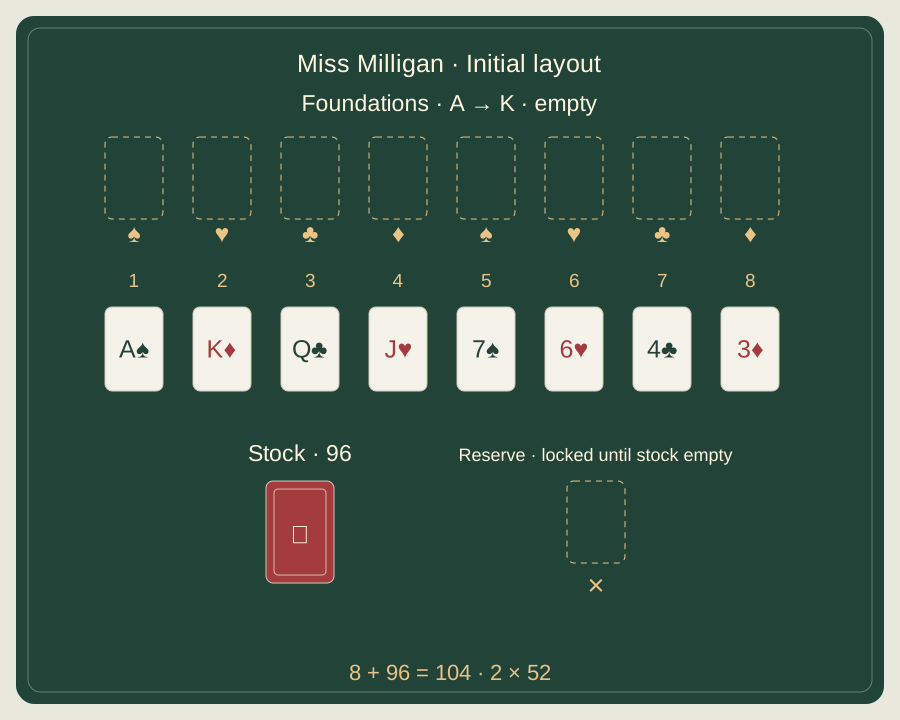
One player uses 2 ordinary packs without jokers: 104 cards. Shuffle together. Deal 8 face up in separate columns, 1 per column; no initial hidden layers. Put remaining 96 face down as stock. Leave 8 empty foundations, 2 per suit, plus an empty reserve that is unavailable for now. Column cards overlap vertically but retain enough visible rank to inspect their order. Aces are low, kings high, with no wrap between them. The whole pack is in the tableau and stock; no private hand or discard pile.
03 /
Descending columns, ascending foundations
Move an exposed column-end card onto a card exactly 1 rank higher of the opposite colour. Red means hearts/diamonds; black spades/clubs. A correctly descending alternating-colour end sequence may move together, whole or in part. Cards above an incorrectly ordered join cannot be carried with it. An empty column accepts only K or a valid packet headed by K. Exposed aces start foundations; add the next rank of the same suit until K. Each suit has 2 separate foundations; identical copies may go to either legal one. Move foundation cards individually, never a whole run.
04 /
A new row covers every column
When desired, deal the next 8 stock cards face up, 1 onto each column left to right. Dealing is allowed while other moves exist. Deal into empty columns too: the king-only restriction governs manual moves, not the random deal. Each new card may break an ordered run, so inspect useful transfers first. After the original row, stock supplies 12 additional rows and then is empty. No waste, no choosing destinations for dealt cards, no recycling the stock or redealing. A covered face-up card is known but unavailable until all cards beyond it are removed.
05 /
Waiving begins only after the stock ends
With stock empty, move 1 exposed card or valid end sequence to the empty reserve, regardless of its starting rank. Only one packet may be stored; do not add a second packet onto it. This guide returns the whole stored packet to a legal column destination, or plays exposed reserve-end cards individually to foundations. Do not rearrange the stored order or take foundation cards back. Once reserve becomes empty it can be reused without a limit. It is temporary storage, not a ninth foundation or a way to conceal cards. Before lifting a packet, plan a legal exit for it.
06 /
Win with all cards on the foundations
Win only when all 104 cards occupy the 8 completed foundations. Moving everything out of the tableau but leaving reserve cards is not a win. If stock is empty and no legal sequence of transfers can advance the position, the deal is lost; moving the same packet to reserve and back is not progress. For a personal record, count foundation cards on a loss and wins across independently shuffled deals. There is no required time score or penalty tariff. Correct a handling mistake by restoring its exact previous position rather than using it to change a hidden stock order.
07 /
Lift the run, free the diamond, return it
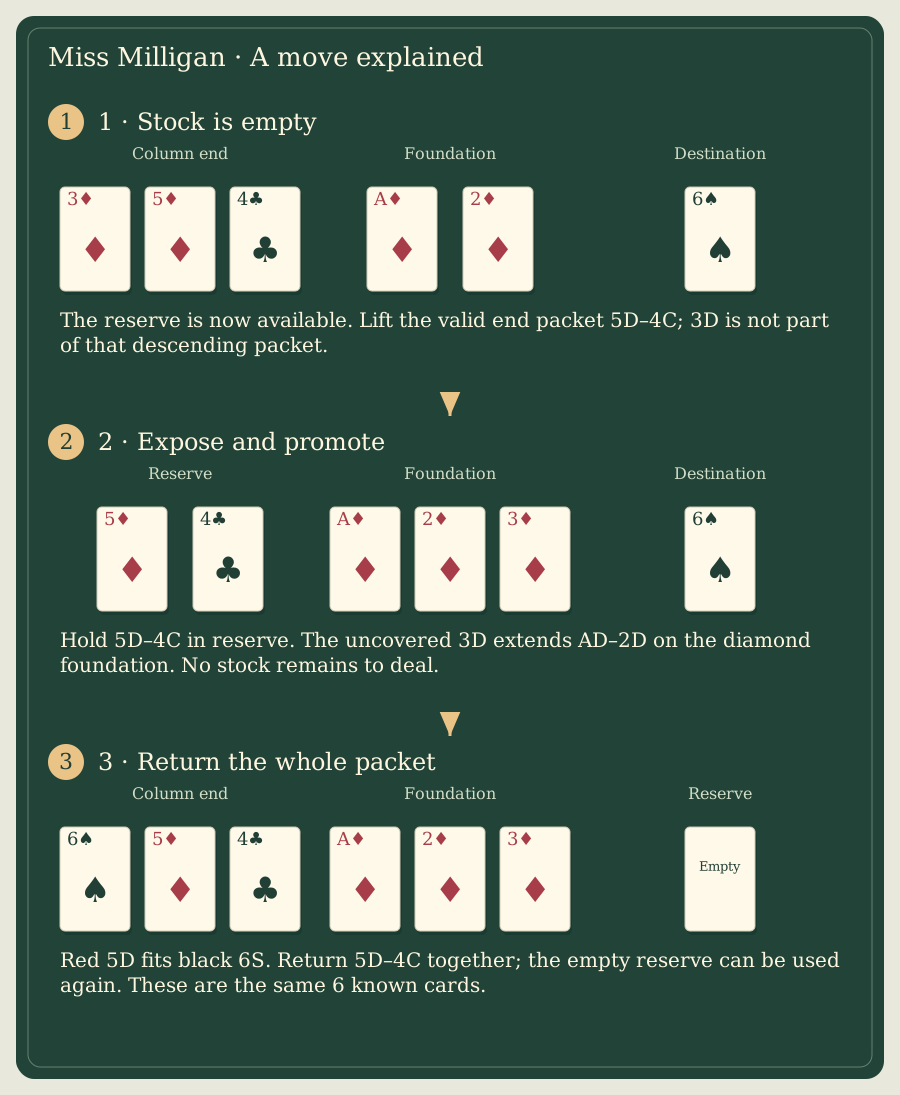
Stock is empty. A column ends 3♦ 5♦ 4♣, with 4♣ exposed; a diamond foundation has A♦ 2♦, and another column ends 6♠. Move the valid suffix 5♦ 4♣ to reserve; the 3♦–5♦ join was not a movable sequence. Send uncovered 3♦ to its foundation. Now return the whole reserve 5♦ 4♣ onto black 6♠. Reserve is empty again. Before stock exhaustion the same reserve move would be illegal. This is a local late-game example, not an initial deal, and it preserves all the shown physical cards.
← On a small screen, scroll the diagram horizontally. →
Common questions
Can reserve be used early?+
No, it opens only when the stock has run out.
Does a dealt row fill empty columns?+
Yes, the king-only rule restricts moves, not stock dealing.
Can I redeal the stock?+
No, there is a single pass through the stock.