← On a small screen, scroll the diagram horizontally. →
01 /
Cards and deal
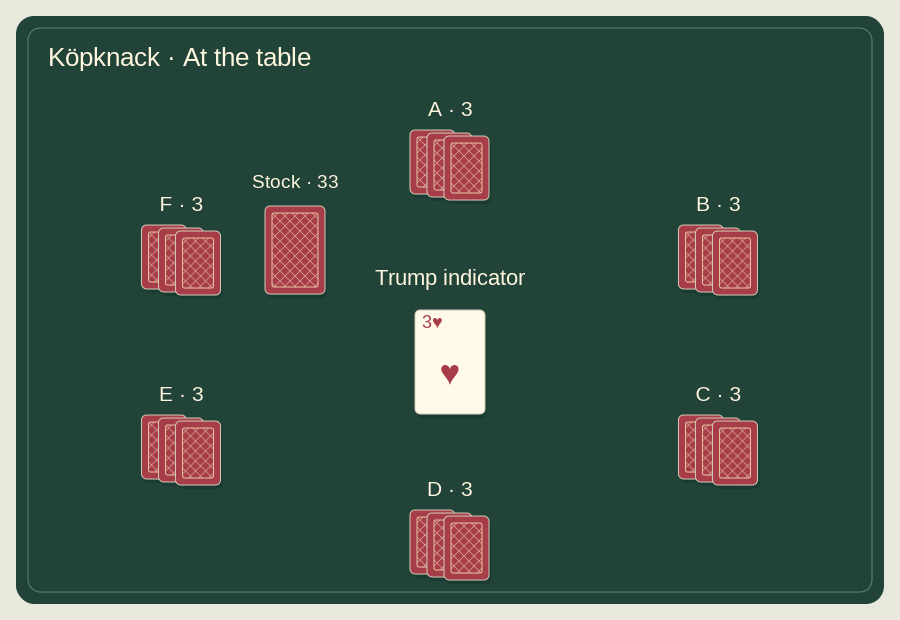
Seat 6 to 8 individuals with 52 cards, ace high, then king through two. Use counters, with a dealer’s stake divisible by three. After the right-hand neighbour cuts, deal clockwise in packets of 2 then 1. Turn the next card face up for trump and set the remainder face down as stock.
02 /
Opening decisions
Beginning on the dealer’s left, knock to stay or return your hand face down to fold. A sole entrant takes the pot immediately; if everyone else folds the dealer collects. Starting at the left, active players may stand or discard any number for as many replacements. Go round twice. Once the stock ends, exchanges stop.
03 /
Playing a turn
The first active player on dealer’s left leads any card. Follow suit whenever possible. On the first trick, if free of suit and able to win with trump, you must do so. On the second, the winner must lead trump if holding one; when void, trump if possible and overtrump if able. On the last trick each has only one card. Highest trump wins, otherwise highest in the led suit. The trick winner leads again. When trump itself is led on either of the first two tricks, follow with a higher trump if you can.
04 /
A deal from first card to settlement
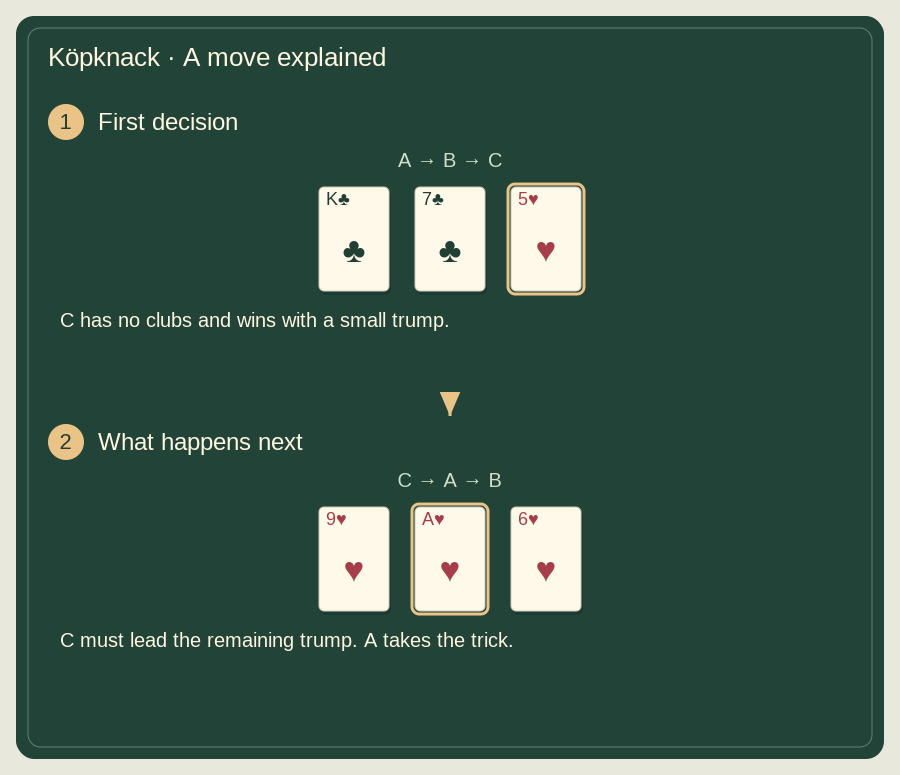
Of six players only A, B and C knock. Hearts are trumps. A starts K♣; B follows 7♣; C is void and must cut with 5♥. This wins, so C must now lead the remaining 9♥. A’s A♥ takes it. The opening cut won C a share of the pot but also forced out C’s other trump. Before the opening lead A exchanged the 2♦ for the top card, A♠. B and C kept their hands.
Reveal the original deal
- A · K♣ · A♥ · 2♦
- B · 7♣ · 6♥ · Q♠
- C · 5♥ · 9♥ · J♦
- D · 10♠ · 2♥ · 9♣
- E · 10♥ · 3♦ · 6♦
- F · 2♠ · 8♣ · 3♠
- Trump indicator · 3♥
- Stock, top first · A♠ · 4♣ · 8♠ · 6♣ · 7♦ · J♣ · J♥ · 2♣ · 5♦ · A♦ · 10♦ · K♥ · 3♣ · Q♥ · Q♦ · 7♥ · 9♦ · J♠ · 10♣ · 4♦ · 5♣ · A♣ · 4♥ · 5♠ · 9♠ · 6♠ · 7♠ · 8♥ · K♦ · Q♣ · K♠ · 8♦ · 4♠
Follow every play
| Trick | Cards in play order | Winner |
|---|---|---|
| 1 | A K♣ · B 7♣ · C 5♥ | C |
| 2 | C 9♥ · A A♥ · B 6♥ | A |
| 3 | A A♠ · B Q♠ · C J♦ | A |
After the knock A exchanges 2♦ for A♠. B and C stand, D through F fold. A wins two tricks and C one. With 9 in the pot that pays A 6 and C 3. B owes 6 to the next pot on the agreed stake of 3.
← On a small screen, scroll the diagram horizontally. →
05 /
Scoring and winning
Divide the current pot in thirds, one per trick. An entrant who took none puts double the agreed stake into the next pot. A folded player pays no such penalty. With stake 3 and pot 9, two tricks earn 6 and one earns 3; a trickless entrant pays 6. Pass the deal left. Finish after equal turns as dealer, comparing the counters gained.
06 /
History and local practice
Swedish Knack games were popular in the nineteenth century. Köpknack added a draw before the tricks. The Swedish rulebook Kortspelsregler till tidsfördriv och nöje described it in 1941. Keep it distinct from Svängknack, where the process of choosing trumps is different.
Common questions
May I keep all my cards?+
Yes, on either exchange round.
Why must C lead a heart?+
The first winner must lead a trump to the second trick if able.
Does a folded player pay a penalty?+
Only entrants who finish trickless owe the double stake.