← On a small screen, scroll the diagram horizontally. →
01 /
Cards and deal
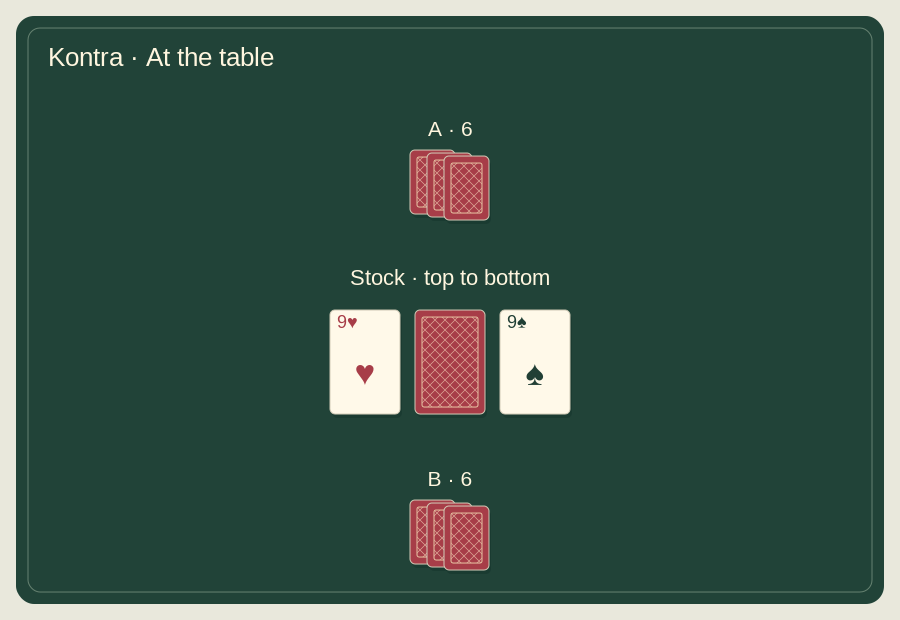
Use 52 cards without jokers for 2 or 3 individuals. Cut for the first dealer: ace high, then ten, and cut again on a tie. Deal clockwise in batches of 3 until each has 6. Expose the top card and turn the bottom card crosswise face up beneath the stock.
02 /
Opening decisions
With different ranks showing, dealer leads from hand or plays either exposed card. Only this opening permits taking the bottom card early. Equal ranks lock the stock. Whoever holds a third card of that rank must lead it; dealer has priority, then the player on dealer’s left. If nobody can unlock it, dealer leads from hand and the stock stays untouched for all 6 tricks.
03 /
Playing a turn
Play one card each, clockwise, in any suit. The last card matching the lead rank wins; if nobody matches, the lead wins. With an open stock, refill immediately after playing from hand. Alternatively play the top card straight to the trick when at least 3 cards remained at its start. Never inspect that card and then choose another.
04 /
When the stock runs down
Before gathering an ordinary trick the winner must show an extra card from hand or stock and add it to the winnings. Refill if it came from hand. The winner leads again. When only 1 stock card remains with two players, or 2 with three, both the blind play and refill stop. Award the remainder to the winner of that next trick, then play out the last five without extras.
05 /
A deal from first card to settlement
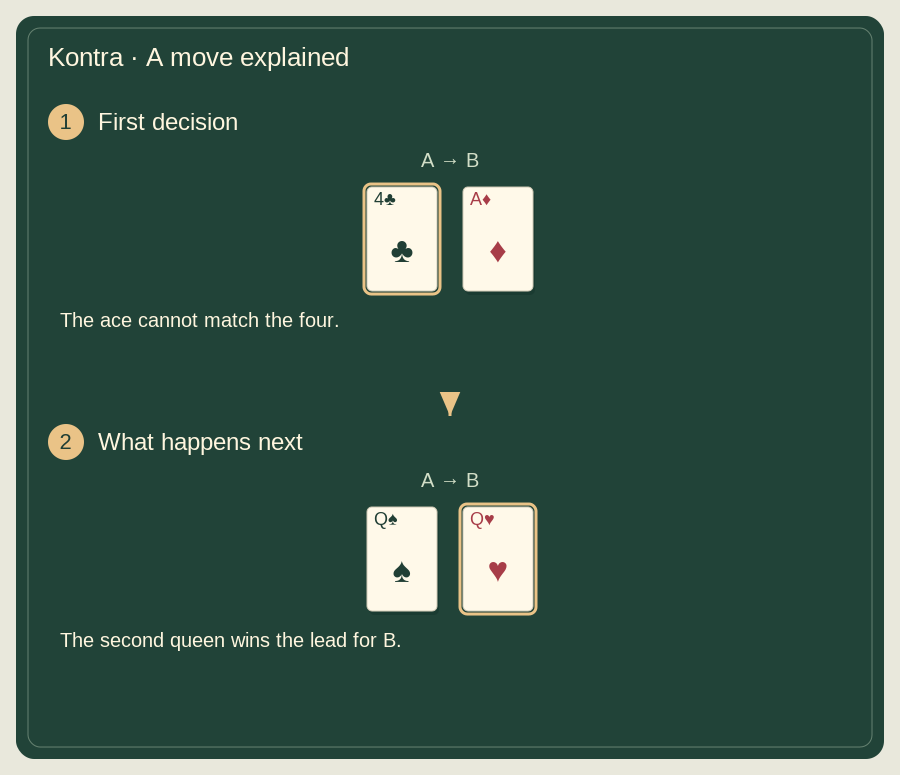
A deals. Both ends show nines and neither player holds a nine. Leave the entire stock in place. A opens 4♣, B answers A♦. A takes the ace because its rank differs from the lead. On the next lead B can turn the tables with a matching queen.
Reveal the original deal
- A · 4♣ · Q♠ · 10♥ · 7♥ · J♣ · 2♣
- B · A♦ · Q♥ · 4♠ · 7♠ · K♠ · 5♦
- Stock, top first · 9♥ · 3♦ · J♠ · 6♠ · K♥ · 10♣ · 8♣ · 4♦ · Q♦ · K♣ · 8♦ · 6♣ · 7♦ · 7♣ · K♦ · 5♣ · 3♣ · 5♥ · 4♥ · 9♣ · Q♣ · 10♠ · J♥ · 2♥ · 2♦ · 2♠ · 8♠ · J♦ · 3♠ · 3♥ · 6♥ · 5♠ · A♣ · 10♦ · 6♦ · A♠ · 8♥ · 9♦ · A♥ · 9♠
Follow every play
| Trick | Cards in play order | Winner |
|---|---|---|
| 1 | A 4♣ · B A♦ | A |
| 2 | A Q♠ · B Q♥ | B |
| 3 | B K♠ · A 2♣ | B |
| 4 | B 7♠ · A 7♥ | A |
| 5 | A 10♥ · B 4♠ | A |
| 6 | A J♣ · B 5♦ | A |
A takes 23 points, B takes 10. Only A qualifies to deal next. The face-up nines and the other stock cards score for nobody.
← On a small screen, scroll the diagram horizontally. →
06 /
Scoring and winning
Count A=11, ten=10, K=4, Q=3, J=2, others zero. An unlocked pack offers 120 points. Compare individual totals. For the next deal choose the lowest scorer who reached 21. Cut on a qualifying tie, or if the locked pack left everybody below 21. Agree how many deals to play if keeping a cumulative score.
07 /
History and local practice
The rules recorded by Cristian Seres come from a family in Nokia near Tampere. The game is also associated with Tyrvää. Unlike the partnership game Ristikontra, everyone keeps a separate pile. A wartime origin in Helsinki is a suggestion rather than a documented starting date.
Common questions
Can an ace lose to a four?+
Yes. A different rank never displaces the lead.
May I keep the blind card?+
It goes directly to the trick once you choose it.
Who opens a locked stock?+
Lead another card of the exposed rank, with priority from the dealer clockwise.