← On a small screen, scroll the diagram horizontally. →
01 /
The pack, the ranks and their values
The 22 permanent trumps run from I to XXI with Sküs above them. In black suits the order is king, queen, knight, jack, 10, 9, 8, 7. In red suits the same courts precede 1, 2, 3, 4. Kings, I, XXI and Sküs are worth 5 each, queens 4, knights 3, jacks 2, everything else 1. Count in packets: deduct 2 from each triple and 1 from a leftover single or pair. Thus a king, a knight and a pip give 5 + 3 + 1 − 2 = 7 card points.
The Trull consists of the Pagat (I), the Mond (XXI) and the Sküs.
02 /
The deal and the middle pile
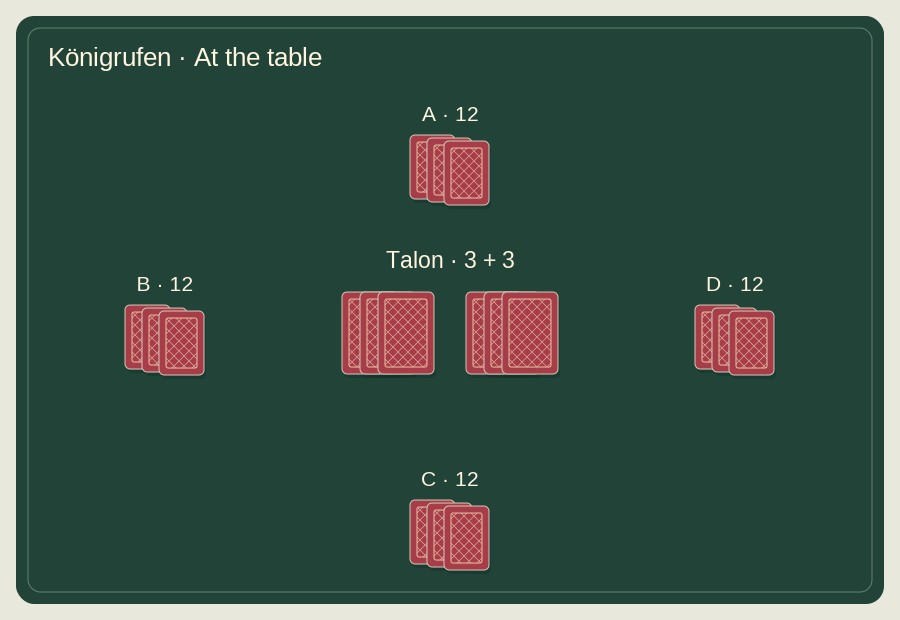
Deal anticlockwise, beginning on the right. After the cut give each player 6 cards, deal 6 face down to the middle and give each player another 6. Four hands of 12 and the talon account for all 54. With five at the table the dealer sits out. If the cutter knocks, put the talon down first and offer the players their choice of whole packets in turn.
03 /
Who gets to declare?
Forehand may reserve with Mein Spiel. Others pass for good or name a contract from the ladder. A later seat must raise, an earlier seat can hold the same bid. After three consecutive passes the standing bidder declares. If only Mein Spiel was heard, forehand may choose any contract, including the three reserved ones. To practise the call, use Rufer when the reservation stands.
04 /
The contract ladder
| Contract | Game points | From talon | Objective |
|---|---|---|---|
| Rufer | 1 | 3 | Call a king |
| Trischaken | 1 | — | Fewest card points |
| Sechserdreier | +2 / −4 | 6 | Alone |
| Piccolo | 2 | 0 | Exactly 1 trick |
| Zwiccolo | 2 | 0 | Exactly 2 tricks |
| Solo | 2 | 0 | Call a king |
| Bettel | 3 | 0 | Exactly 0 tricks |
| Besserrufer | 1 + ★ | 3 | Call a king and announce a bird |
| Farbendreier | 3 | 3 | Alone, colour game |
| Dreier | 4 | 3 | Alone |
| Piccolo Ouvert | 5 | 0 | Exactly 1 trick |
| Bettel Ouvert | 6 | 0 | Exactly 0 tricks |
| Farbensolo | 6 | 0 | Alone, colour game |
| Solodreier | 8 | 0 | Alone |
In Trischaken everyone plays alone. Add one talon card to each of the first 6 tricks after determining its winner. The two highest counts each pay 1 to a lower scorer. A player without a trick also receives 2 from each rival; a player with 36 or more also pays 2 to each. In Sechserdreier take the whole talon privately and discard six. In Solo the hidden talon belongs to defence unless it contains the called king, when it belongs to the lone declarer. In Besserrufer a called king found in the talon allows surrender for 3.
05 /
What you can keep and discard
Name the suit of the king before opening the talon. Its holder stays silent. Calling your own king, or finding it in the talon, leaves you alone against the other three. On a three-card exchange reveal the two packets separately, take one intact and credit the other to defence. Put three discards with your tricks. Never discard a king, I, XXI or Sküs. Discard other trumps only if forced and show them. In Farbendreier reverse this last priority: discard ordinary trumps first and expose any forced suit discard.
Holding three kings, you may call “the fourth king” without naming a suit.
06 /
Playing and winning a trick
Forehand leads in positive games. Follow suit if possible, otherwise trump, otherwise discard. A trump lead demands a trump. Highest trump wins, otherwise highest of the led suit; the winner leads again. In the two colour contracts an off-suit trump cannot win and you may lead a trump only with a hand entirely of trumps. In negative games beat the winning card if legally possible and keep I until it is your only trump. Declarer opens Piccolo, Zwiccolo and Bettel; their talon is untouched. For an open contract expose hands after the lead to the second trick.
07 /
Announcements and bonuses
Starting with declarer, announce bonuses or say pass until three passes in succession. Kontra doubles the game or a named announcement separately; Rekontra and Subkontra double it again. Each bird must itself win its target trick: I last, II next to last, III third from last, IIII fourth from last. Silent values are 1, 2, 3, 4 respectively, announced values twice that. Keep an announced bird to its trick if legally possible. Failure costs the bonus, even for a silent bird played to its target trick and beaten.
Taking all four kings or all three Trull cards earns 1, or 2 if announced. Capturing the enemy XXI or the called king earns 1. King Ultimo earns 1, announced 2: the called king must be in the last trick won by its side. Valat means all tricks and pays 4 times the contract, announced 8 times. Double bonuses in Solo and Solodreier. In Farbensolo only Valat applies.
08 /
A deal at the table
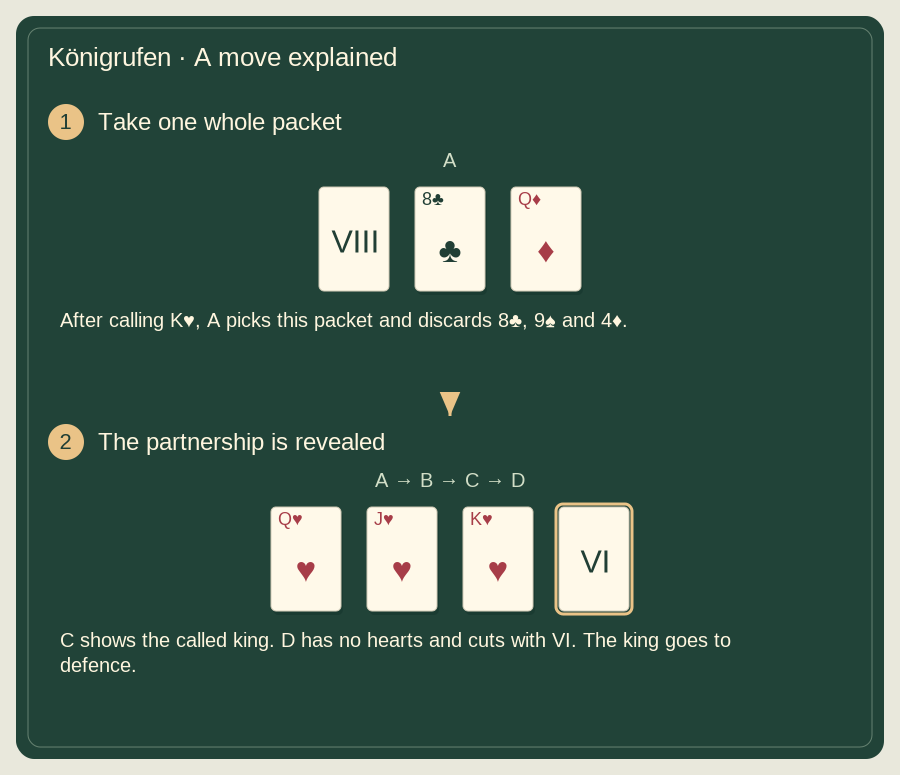
A reserves, everyone passes and A chooses Rufer, calling the king of hearts. The two packets show VIII, 8♣, Q♦ and XVII, 7♠, J♣. A takes the first packet, discards 8♣, 9♠ and 4♦, then leads Q♥. B follows with J♥. C holds K♥ and plays it. D has no hearts and cuts with VI. D leads next. C is still A’s partner although the defence captured the called king.
Open the sample deal
C = knight. A–D are seats in anticlockwise order. Reveal these hands only for the example.
- A · Q♥ · 9♠ · 4♦ · 3♥ · 1♥ · 4♥ · C♥ · 1♦ · K♣ · IX · 2♦ · XXI
- B · J♥ · XV · 9♣ · 10♠ · IV · XVI · XII · II · J♦ · 10♣ · 2♥ · I
- C · K♥ · XIV · C♦ · K♠ · V · Q♣ · Sküs · XI · 3♦ · XX · VII · XIII
- D · VI · 8♠ · III · Q♠ · 7♣ · J♠ · C♣ · K♦ · XVIII · X · XIX · C♠
- Middle · VIII · 8♣ · Q♦ / XVII · 7♠ · J♣
Play through the deal
| Trick | Cards in play order | Winner |
|---|---|---|
| 1 | A Q♥ · B J♥ · C K♥ · D VI | D |
| 2 | D Q♠ · A VIII · B 10♠ · C K♠ | A |
| 3 | A 3♥ · B 2♥ · C XIII · D XIX | D |
| 4 | D K♦ · A Q♦ · B J♦ · C C♦ | D |
| 5 | D C♠ · A XXI · B II · C XI | A |
| 6 | A IX · B XII · C Sküs · D III | C |
| 7 | C 3♦ · D X · A 2♦ · B XVI | B |
| 8 | B 10♣ · C Q♣ · D 7♣ · A K♣ | A |
| 9 | A 1♥ · B I · C XIV · D XVIII | D |
| 10 | D C♣ · A C♥ · B 9♣ · C V | C |
| 11 | C XX · D J♠ · A 4♥ · B IV | C |
| 12 | C VII · D 8♠ · A 1♦ · B XV | B |
← On a small screen, scroll the diagram horizontally. →
09 /
From card points to the final score
Count tricks and the assigned talon or discards together. The positive contract needs 36 of 70. Score the contract and bonuses independently. In our Rufer suppose A and C finish with 38. Each earns 1 for the game and loses 1 for the captured king: net 0 without other bonuses. At 34 they would lose both, writing −2 each, while B and D write +2 each. A lone player settles with every opponent. After the agreed rounds the highest total wins.
10 /
Where this version is played
The earliest written rules of Königrufen date to 1827. In 2024 the Austrian Commission for UNESCO included the living practice in Austria’s national inventory of intangible cultural heritage. Regional cups preserve different bidding menus, especially the negative games and bird announcements.
Common questions
What if I call my own king?+
You play alone. The other three share the defensive score.
Can the Sküs excuse a failure to follow?+
No. It is a permanent trump subject to the same duty to follow.
Can my partner win the Pagat bonus for me?+
The I must win the last trick itself. A partner winning over it does not earn the bird.