← On a small screen, scroll the diagram horizontally. →
01 /
The pack, the ranks and their values
Use 48 cards. Each suit contains two copies of A, 10, K, Ober, Unter and 7, in that order. Their values are 11, 10, 4, 3, 2 and 0, for 240 in the pack. With French-suited cards use Q for Ober and J for Unter. In the diagrams ♥ means hearts, ♦ bells, ♣ acorns and ♠ leaves. There are no jokers.
02 /
The deal and the middle pile
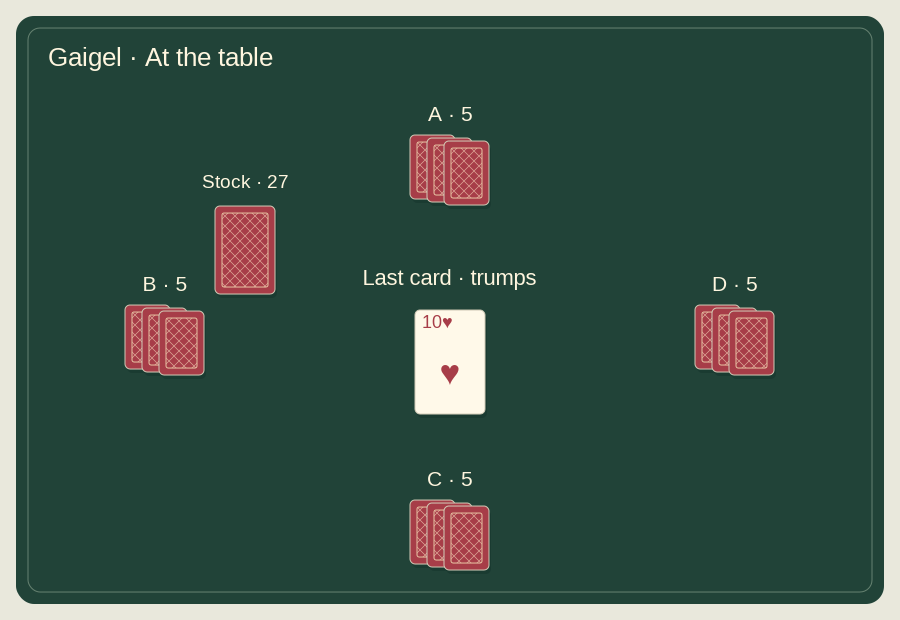
Seat partners opposite. The player to the left cuts, then deal anticlockwise, starting on your right, 3 and then 2 to each player. Turn up the next card to set trumps and lay the other 27 crosswise on it. The upcard is the last draw. A tap instead of a cut calls for single packets of 5. Pass the deal to the right.
03 /
Three ways to open the first trick
Forehand chooses the opening. Show a plain ace (Ge-Elfen) and it wins outright. Or lead a hidden plain ace (Zweite Alte): only the other copy can take it. Or lead a hidden plain card below the ace (Tauchen): highest of the led suit wins, earlier copy first in a tie. All followers play face down on a hidden lead. Nobody plays trump on this trick unless holding only trumps, which may be checked. A forced trump cannot beat a plain lead. If forehand has only trumps, lead one openly; a second all-trump hand can beat it with a higher trump.
04 /
Playing and winning a trick
After every trick the winner draws first. Continue to the right until everyone has five again. The winner leads. While the stock lasts, play any card on subsequent tricks. The highest trump takes it, otherwise the highest card of the led suit. Equal cards favour the earlier play. After the last draw you must follow suit, or trump if void, and within those duties beat the current winner whenever possible. Discard freely only when you have neither suit nor trump.
05 /
Pairs and the trump seven
Once your side has secured a trick, show a king and Ober of one suit together in your own hand. Score 20, or 40 in trumps. Neither card can score twice. With a trick to your side, a trump seven can reserve the upcard: slide it under the stock. Your partner can take over the exchange with the other seven. Simultaneous opposing claims go to whoever drew first. A seven drawn in the last four cards is too late.
06 /
A deal at the table
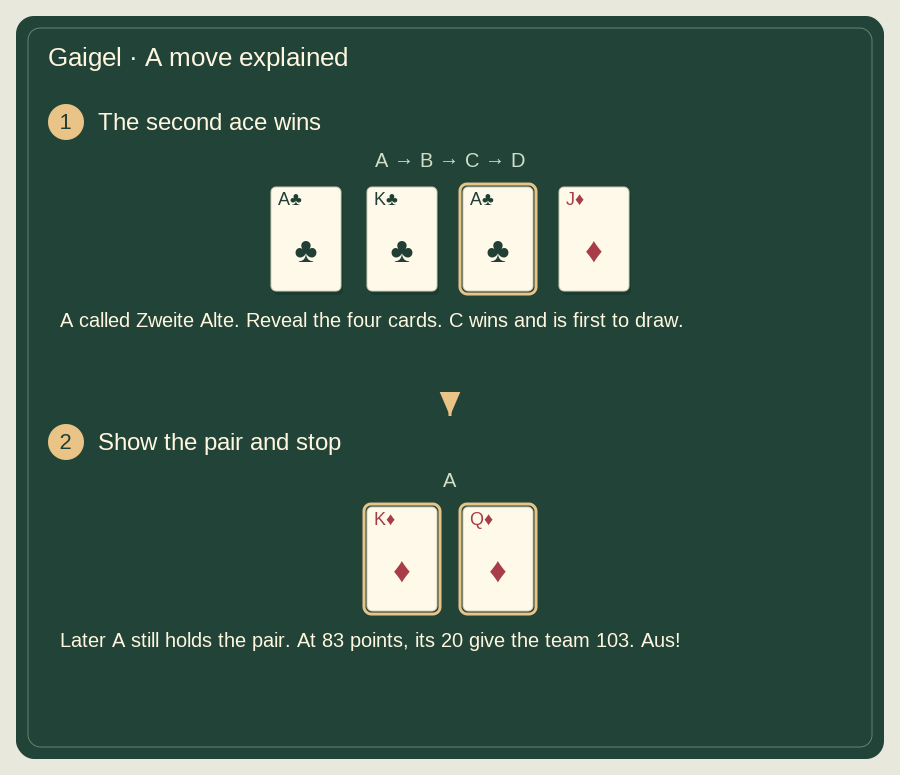
Hearts are trumps. A opens with A♣ face down and calls Zweite Alte. B lays K♣, C the other A♣ and D J♦, all face down. Expose the cards: C wins 11 + 4 + 11 + 2 = 28 for partners A and C, then draws first. Later in the same deal their running total reaches 83. A shows K♦ and Q♦ still in hand. Bells are plain: 83 + 20 = 103. Call Aus now, before playing on.
Open the sample deal
The stock runs from top to bottom. The last heart is face up; other hands and the stock are shown for study only.
- A · A♣ · K♦ · Q♦ · 10♠ · 7♥
- B · K♣ · Q♣ · K♠ · A♥ · A♥
- C · A♣ · K♥ · J♥ · 10♣ · J♠
- D · J♦ · A♠ · K♦ · 10♦ · K♠
- Middle · A♦ · Q♥ · 10♠ · J♣ · 7♣ · Q♠ · Q♥ · J♠ · A♦ · 7♠ · J♣ · 7♥ · K♥ · 7♣ · 7♦ · 7♠ · 10♥ · Q♣ · Q♠ · K♣ · A♠ · 10♦ · J♦ · 7♦ · J♥ · Q♦ · 10♣ · 10♥
Play through the deal
| Trick | Cards in play order | Winner | Draw after the trick | Card points A+C / B+D |
|---|---|---|---|---|
| 1 | A A♣ · B K♣ · C A♣ · D J♦ | C | C A♦ · D Q♥ · A 10♠ · B J♣ | 28 / 0 |
| 2 | C K♥ · D 10♦ · A 10♠ · B K♠ | C | C 7♣ · D Q♠ · A Q♥ · B J♠ | 56 / 0 |
| 3 | C J♠ · D K♦ · A 10♠ · B Q♣ | A | A A♦ · B 7♠ · C J♣ · D 7♥ | 75 / 0 |
| 4 | A A♦ · B J♠ · C 10♣ · D Q♥ | D | D K♥ · A 7♣ · B 7♦ · C 7♠ | 75 / 26 |
| 5 | D Q♠ · A Q♥ · B 7♠ · C J♣ | A | — | 83 / 26 |
← On a small screen, scroll the diagram horizontally. →
07 /
From card points to the final score
At 101 or more, stop the deal with Aus. Winning costs the other side one mark, or two if they have taken no trick. A false claim below 101 loses two. If a side already on 101 plays into the next trick, opponents who catch the error win two. For a match put ten tokens in the middle. First give tokens to the losing sides, then when the pool is empty return tokens for wins. If only one remains to distribute, that deal costs one. The first side to clear its tokens in the return phase wins.
08 /
Where this version is played
Gaigel belongs to the Swabian family of ace-ten games related to Sixty-Six. The local pack is sold for both Gaigel and Binokel. A session with Württemberg players in Leinfelden in 2018 documented the opening choices used here. Some circles also allow a win for collecting five sevens.
Common questions
Which identical ace wins?+
Usually the first. Only the special Zweite Alte opening gives priority to the second ace.
Can partners combine a king and Ober?+
Both cards must be in the same hand when declared.
Must I trump while the stock lasts?+
After the special opening you may discard freely until the final draw.