← On a small screen, scroll the diagram horizontally. →
01 /
Players and cards
This patience for 1 player uses 52 cards without jokers. Move every card to 4 suited foundations from A to K. Select classic Flower Garden with tableau rearrangement: columns build downward regardless of colour or suit. This is not a restricted variant allowing only foundation transfers.
02 /
Deal and opening
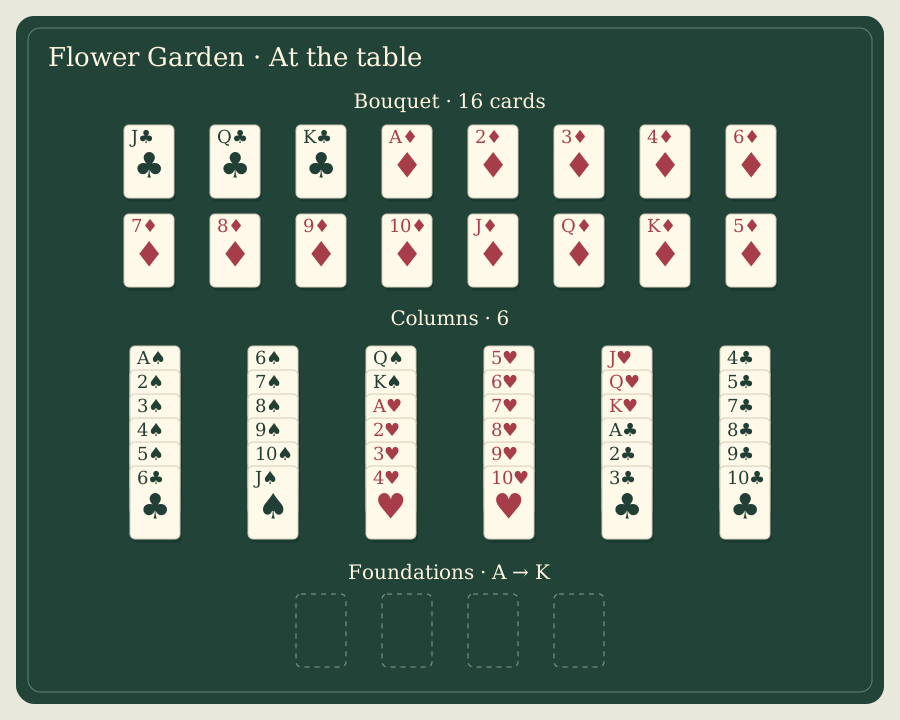
Shuffle and deal 6 face-up columns of 6 cards, overlapping within each. The last card of each column is available. Spread the other 16 as a separate bouquet with every card readable: any bouquet card is available, not only an end card. Foundations begin empty. There is no stock, drawing or hidden card; the bouquet is an open reserve, not a waste pile.
03 /
Playing a turn
Move one available card at a time. A column accepts the rank immediately below its top: 5♦ may go on 6♣, 6♥ or another six. Suit and colour do not matter. A column top or any bouquet card may go to a column or foundation. Never extract an interior tableau card or transfer a group without decomposing it into legal single moves. Never return cards to the bouquet or add new ones there.
04 /
Foundations and empty columns
Any available card may fill an empty column, not only K. A foundation starts with A and builds in suit A–2–3–4–5–6–7–8–9–10–J–Q–K. Neither tableau nor foundation wraps K–A. This profile does not return foundation cards. A column may remain empty; bouquet refilling is not compulsory. To free a covered card, legally remove those above it first.
05 /
Scoring
No score table is required: success means completing the foundations. For a personal record count foundation cards out of 52 and record time and undos separately. This is an optional progress measure. Emptying the bouquet alone does not win; every column must also empty.
06 /
Ending the game
Win with all 52 cards on foundations. Without a useful legal move the attempt is blocked. There is no redeal or random bouquet refresh: a new shuffle starts a new attempt. Undo may separately be allowed while studying a layout, but it does not legalise a group transfer lacking intermediate spaces. A solo attempt has no draw result.
07 /
History and selected variant
Flower Garden is also known as Bouquet, Garden and The Garden. The names describe the beds and accessible bouquet rather than separate rules. Semicolon publishes the classic version with descending rearrangement regardless of suit. Checked sources do not establish an exact inventor or date. CardRules+’s claim of no rearrangement is not adopted here.
08 /
Worked example
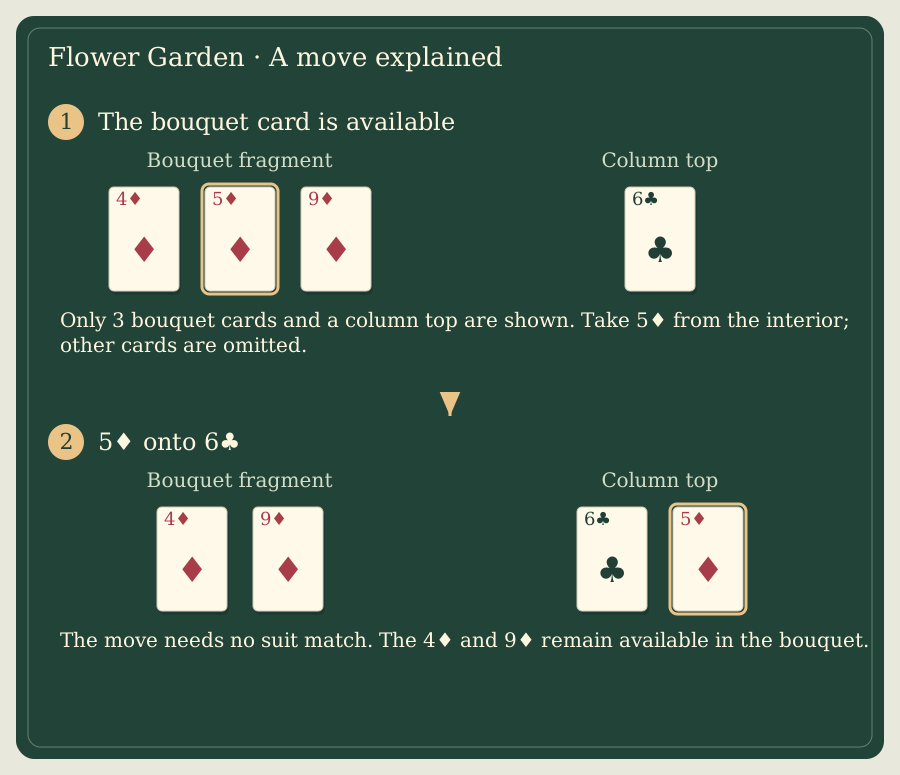
The bouquet includes 4♦, 5♦, 9♦ and a column exposes 6♣. Choose 5♦ directly from the bouquet’s interior and place it on 6♣: differing suits are legal. The 4♦ and 9♦ remain available despite the gap. On a later action 4♦ may go on 5♦. The diagram omits the empty foundations and lower column cards; the actual game has no hidden cards.
← On a small screen, scroll the diagram horizontally. →
Common questions
Is only the bouquet’s end available?+
No, any bouquet card may be taken directly.
Must colours alternate?+
No, a column requires only the next lower rank.
Only kings in a space?+
No, any available card.