← On a small screen, scroll the diagram horizontally. →
01 /
The pack, the ranks and their values
The 22 permanent trumps run from I to XXI with Gstieß above them. In black suits the order is king, queen, knight, jack, 10, 9, 8, 7. In red suits the same courts precede 1, 2, 3, 4. Kings, I, XXI and Gstieß are worth 5 each, queens 4, knights 3, jacks 2, everything else 1. Count in packets: deduct 2 from each triple and 1 from a leftover single or pair. Thus a king, a knight and a pip give 5 + 3 + 1 − 2 = 7 card points.
The examples use Roman numerals for trumps. Cego packs usually print Arabic numerals.
02 /
The deal and the middle pile
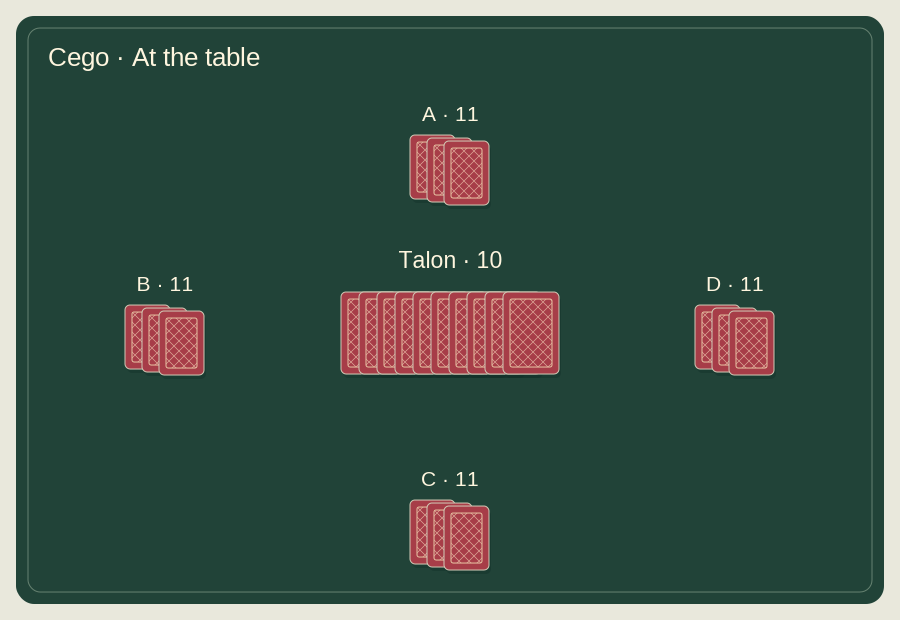
Shuffle 54 cards. The player on the dealer’s left cuts. Set the first 10 face down in the centre, then give each player 11 together, starting on the right. Nobody draws during play. The dealer moves one seat to the right after the hand.
03 /
Who gets to declare?
Forehand sits to the dealer’s right. Go round once asking for Solo or Ulti. Say Fort to pass. Ulti closes the auction immediately. After four passes forehand must open Cego, Piccolo or Bettel. Piccolo and Bettel stop the bidding, with earlier seat priority if both are claimed. If nobody raises Cego, forehand may switch to Räuber.
Challenge one seat at a time and climb one rung at a time. The incumbent can hold with Selbst or retire with Gut. The survivor meets the next challenger. After a Solo, start instead at Gegensolo, an ordinary Cego exchange at a higher tariff. The Solo bidder has first right to hold, followed by forehand. Piccolo and Bettel cannot interrupt this auction.
04 /
What you can keep and discard
Solo leaves the 10 centre cards untouched. In Cego keep 2 of your 11, discard 9, take the 10 and discard 1 more. In Eine keep just 1 and take all 10. In Eine Leere keep a face-up pip and lead it or another of its suit. In Zwei Leere keep 2 pips of one suit, take the talon, show and discard its lowest trump, then lead that suit twice. In Zwei Verschiedene retain 2 pips of different suits, discard the highest trump from the talon and lead the exposed cards themselves. In Der kleine Mann retain trump I alone and lead it.
05 /
Playing and winning a trick
Declarer leads. Follow suit, otherwise trump, otherwise discard freely. Highest trump wins, or highest of the led suit if there is no trump. The winner leads next. An exposed empty card cannot win, even when played later. If no matching pip is available designate a court as empty. For the two exposed leads put both tricks out together. Each defender answers both. The winner with the stronger winning card leads next; break equal ranks by ♣, ♠, ♥, ♦.
06 /
A deal at the table
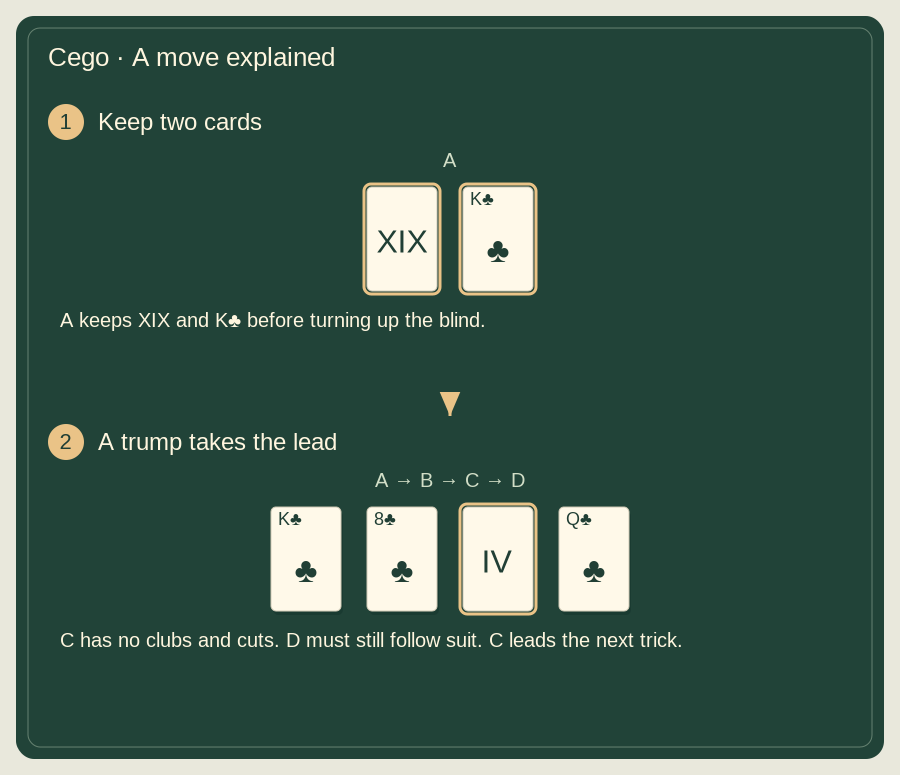
A wins Cego, keeps trump XIX and K♣ and picks up the talon. The new cards include Q♥ and 7♠. A discards 7♠ and leads K♣. B follows with 8♣. C has no clubs and cuts with IV. D must still follow with Q♣. C wins and leads next. A later wins a trick and finishes with 43 card points including the discard. At ordinary Cego the margin is 8, rounded up to 10 per defender: A records +30.
Open the sample deal
C = knight. A–D are seats in anticlockwise order. Reveal these hands only for the example.
- A · XIX · K♣ · C♣ · 7♣ · 9♣ · J♣ · XVII · I · XIII · 1♥ · J♦
- B · 8♣ · 10♣ · VI · XX · II · 2♥ · XV · 4♥ · J♥ · C♦ · XIV
- C · IV · Q♦ · K♥ · XVIII · XVI · VIII · 9♠ · XXI · J♠ · K♠ · XI
- D · Q♣ · 4♦ · Q♠ · 1♦ · C♠ · X · 3♥ · V · 3♦ · VII · Gstieß
- Middle · Q♥ · 7♠ · XII · IX · III · K♦ · C♥ · 2♦ · 10♠ · 8♠
Play through the deal
| Trick | Cards in play order | Winner |
|---|---|---|
| 1 | A K♣ · B 8♣ · C IV · D Q♣ | C |
| 2 | C XI · D VII · A XII · B XIV | B |
| 3 | B VI · C VIII · D Gstieß · A III | D |
| 4 | D V · A XIX · B XV · C XXI | C |
| 5 | C XVIII · D X · A IX · B XX | B |
| 6 | B II · C XVI · D 4♦ · A 10♠ | C |
| 7 | C J♠ · D C♠ · A 8♠ · B 4♥ | D |
| 8 | D 1♦ · A K♦ · B C♦ · C Q♦ | A |
| 9 | A 2♦ · B J♥ · C K♥ · D 3♦ | A |
| 10 | A C♥ · B 2♥ · C 9♠ · D 3♥ | A |
| 11 | A Q♥ · B 10♣ · C K♠ · D Q♠ | A |
← On a small screen, scroll the diagram horizontally. →
07 /
From card points to the final score
To win a point contract, take a trick and reach 36 of 70 with the set-aside cards. With no tricks the entire reserve goes to defence. Multiply the distance from 35 by the contract factor and round upwards to a multiple of 5. Each defender pays or receives that amount. At exactly 35 the declarer owes each 5. Solo uses factor 2 won, 1 lost. In ladder order Cego to kleiner Mann use factors 1–6, or 2–7 over Solo.
08 /
Special contracts
Ulti wins 80 per opponent for winning the last trick with I. Piccolo wins 30 for exactly one trick, Bettel 30 for none. Failure reverses the payment. In Räuber ignore the talon: the highest individual count pays the others 30 each. Forehand pays 60 if highest, even when tied. Other tied losers each pay the remaining players. To close a session announce “der Gstieß gibt ab”; identify the Gstieß holder on the following deal and stop after that player next deals.
For Ulti, Piccolo, Bettel and Räuber, leave the blind closed and play the original hands. In an exchange contract you may look back at your discards until the first trick ends.
09 /
Where this version is played
Cego developed in Baden in the early nineteenth century. Its unusually large blind hand distinguishes it from Austrian Tarock. The inn game in Bräunlingen was documented in 1997. The modern Black Forest championship has its own regulations.
Common questions
May I inspect the blind before bidding?+
No. Decide which original cards to keep before touching the blind.
Can a strong discard win on its own?+
You must take a trick to claim the discard.
Does the three-player deal change?+
Yes. Remove 7♣, 7♠ and 4♦. Deal 13 to each player and 12 to the blind.