← On a small screen, scroll the diagram horizontally. →
01 /
Context and deal
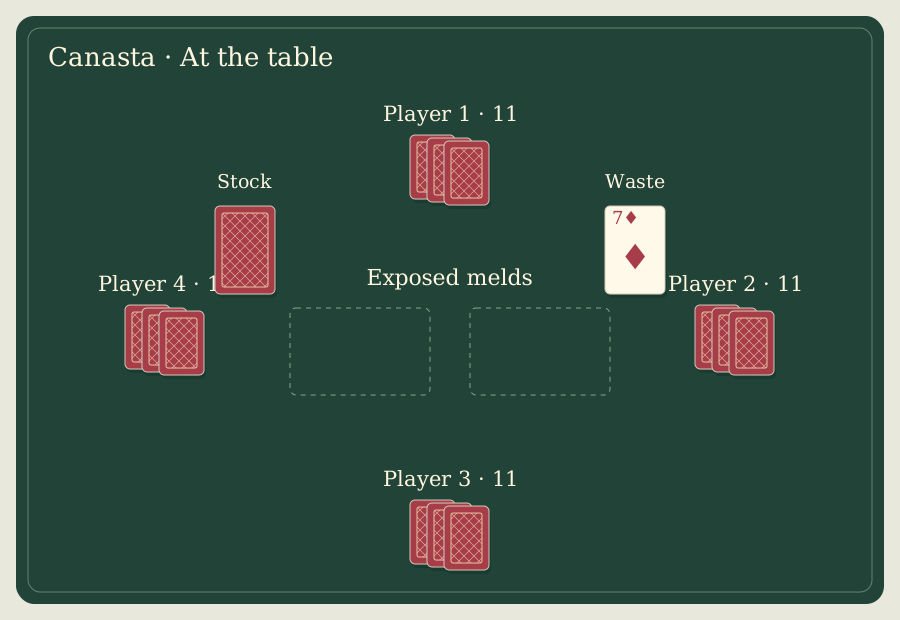
Canasta spread from Uruguay through Argentina and became internationally fashionable around 1950. This guide uses the classic partnership form. Shuffle two 52-card packs plus four jokers:108 cards. Choose the first dealer randomly, then rotate clockwise. Deal 11 each; the rest is stock. Turn one card to start the discard pile; cover jokers, twos or red threes until another card appears, marking the pile frozen. Start left of dealer. Expose red threes from hands immediately and replace them from stock.
02 /
Melds and opening minimum
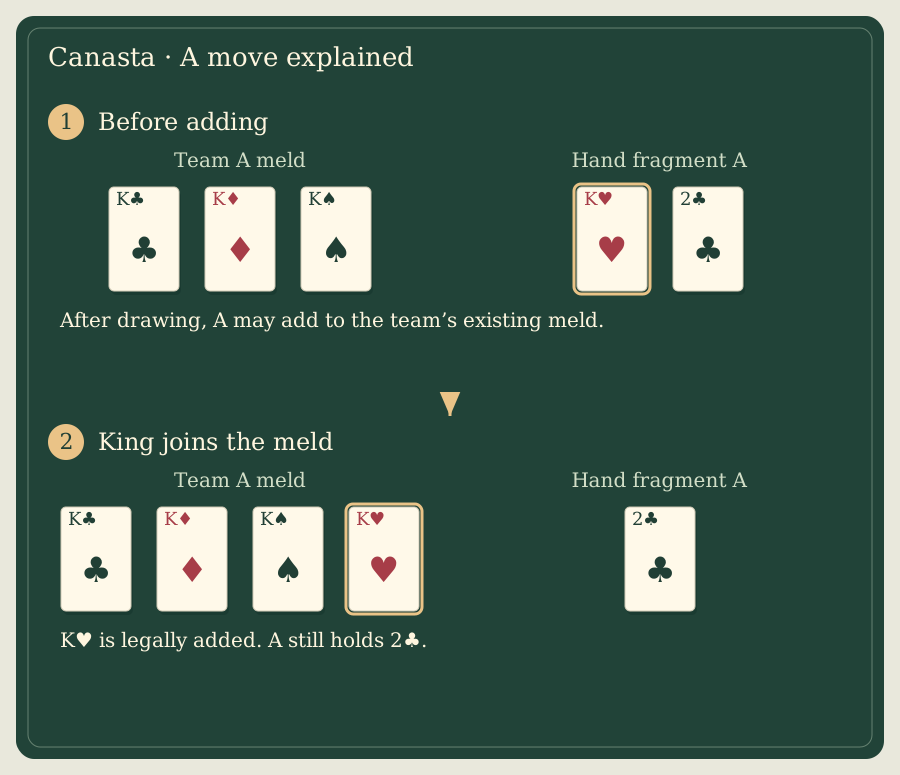
A meld has at least three cards of one rank 4 through A, including at least two natural cards and at most three wilds. Twos and jokers are wild; all-wild melds and runs are forbidden. Partners share melds, may add to each other, and combine same-rank melds; never add to opponents. Seven or more cards make a canasta, pure without wilds, mixed otherwise. Extra natural cards are allowed.
Values: joker 50; A/2=20; K/Q/J/10/9/8=10;7/6/5/4 and black 3=5. Opening meld minimum depends on prior team score: negative 15,0–1495 needs 50,1500–2995 needs 90,3000+ needs 120. Several melds may combine. Only card values count, not bonuses. Once either partner opens, both may meld freely.
03 /
Turn and discard pile
On a turn, draw one stock card or take the entire discard pile, then meld optionally and discard one from hand. You may never take a pile topped by a wild or black three. Otherwise its top card must immediately form a valid meld with cards from hand, or join your existing meld. Without a freeze, a matching natural plus wild suffices, as does a natural pair.
The pile is frozen against unopened teams and against everyone while a buried wild or initial red three remains. A black three blocks only while on top in this selected profile. Taking a frozen pile requires two matching natural cards in hand, even with an existing meld. First show them and the top discard as a meld, then collect the rest. For an opening minimum, top discard may count; buried cards may not. Taking the pile removes the freeze.
04 /
Special threes
Expose every red three drawn and replace it immediately; a red three acquired within the discard pile is exposed without replacement. Each gives 100, all four together 800, positive if your team melded anything, negative otherwise. Black threes block the pile and may be melded only as a natural set of three or four in the turn you go out. Never substitute wilds for threes.
05 /
Going out and empty stock
You may empty your hand, with or without a final discard, only if your team has at least one canasta, possibly completed now. Otherwise keep at least one card. You may ask your partner for permission immediately after drawing a stock card or taking the discard pile, before making any further melds; their yes/no answer is binding. The mandatory meld of the top discard needed to take that pile is allowed before asking. Asking is optional.
Going out concealed means melding your entire remaining hand in one turn including a canasta, having never previously melded or added to partner’s melds. If your team is unopened and you drew from stock, this concealed exit need not meet the opening minimum; taking the pile still requires it.
If the last stock card is a red three, expose it and end immediately without further meld or discard. Otherwise continue with pile pickups. With empty stock, taking an unfrozen top card matching your existing meld is mandatory; making a new meld is optional. The first legal refusal or inability to take ends the hand without an exit bonus. Our table forbids a one-card hand taking a one-card discard pile.
06 /
Hand and match scoring
Team hand score equals melded card values minus cards remaining in both hands, plus bonuses: pure canasta 500, mixed 300, red threes as above, going out 100 or concealed 200 instead. Melded black threes count 5 each. Scores may be negative. Finish the whole hand; if either team reaches 5000, higher total wins. Our tie agreement is another hand until one team leads at or above 5000. Otherwise rotate dealer and continue.
07 /
Worked score
Example: a pure canasta of seven kings has 70 card points and 500 bonus. Three aces add 60, two exposed red threes add 200, ordinary exit adds 100, while partner’s remaining 7 costs 5. Total 70+500+60+200+100−5=925.
← On a small screen, scroll the diagram horizontally. →
08 /
Do not mix modern rules
Modern American Canasta changes hand size, opening requirements, threes and special hands. All-wild canastas, mandatory two-canasta exits and sequences belong to other profiles. Agree before dealing rather than changing the classic rules mid-hand.
Common questions
Can buried discards fund the opening minimum?+
No. Only the top discard and cards already in hand count before the pile is taken.
Does adding a wild preserve a pure canasta bonus?+
No. It becomes mixed and its bonus drops from 500 to 300.