← On a small screen, scroll the diagram horizontally. →
01 /
History and selected rules
Beggar My Neighbour is a children’s game also called Taxes and Strip Jack Naked. No exact inventor or date is established here. Select 2 players with 52 cards and no jokers. Like War it offers no move choice, but A/K/Q/J demands replace rank comparison. Equal cards cause no war; slapping pairs belongs to other rules.
02 /
Setup and deal
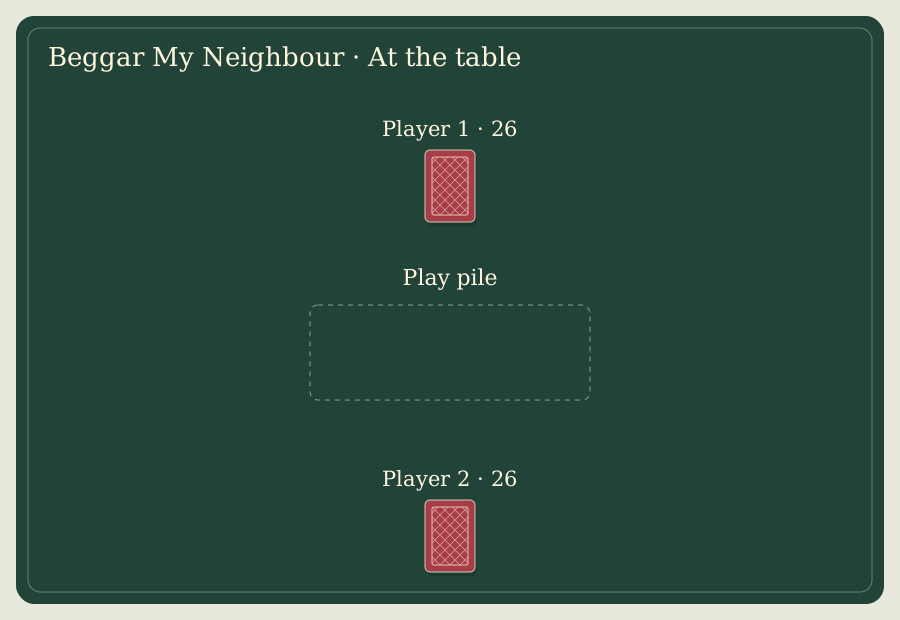
Anyone shuffles and deals singly, 26 face down each. Do not inspect or sort packets. Nondealer begins, then alternate exposing top cards to the shared centre. Number cards 2–10 are ordinary: pass the turn after them. Suits have no effect.
03 /
Playing a hand
After J the opponent must expose up to 1 card consecutively, Q up to 2, K up to 3, A up to 4. If every required card is ordinary, the last pay-card player takes the entire centre, turns it as a block beneath their packet without shuffling and leads again. Preserve its physical block order when turning it; never choose collection order manually.
A pay card during payment immediately cancels the old unpaid remainder. The other player now owes the full amount for the new pay card. For instance, if a jack appears on the second card paying an ace, do not finish the ace’s remaining payment. Every card already exposed stays in the common prize.
04 /
Ending and result
Fix the loss timing explicitly: no card when required to expose one loses; a last-card pay card can still recover the centre if paid. Play without points until one owns everything. Games may be very long or cycle. Exact repetition of both packets, centre, next actor and outstanding payment is a draw. Alternatively agree a time limit and stop after the current centre resolves: most cards wins, equal counts tie.
05 /
Worked example
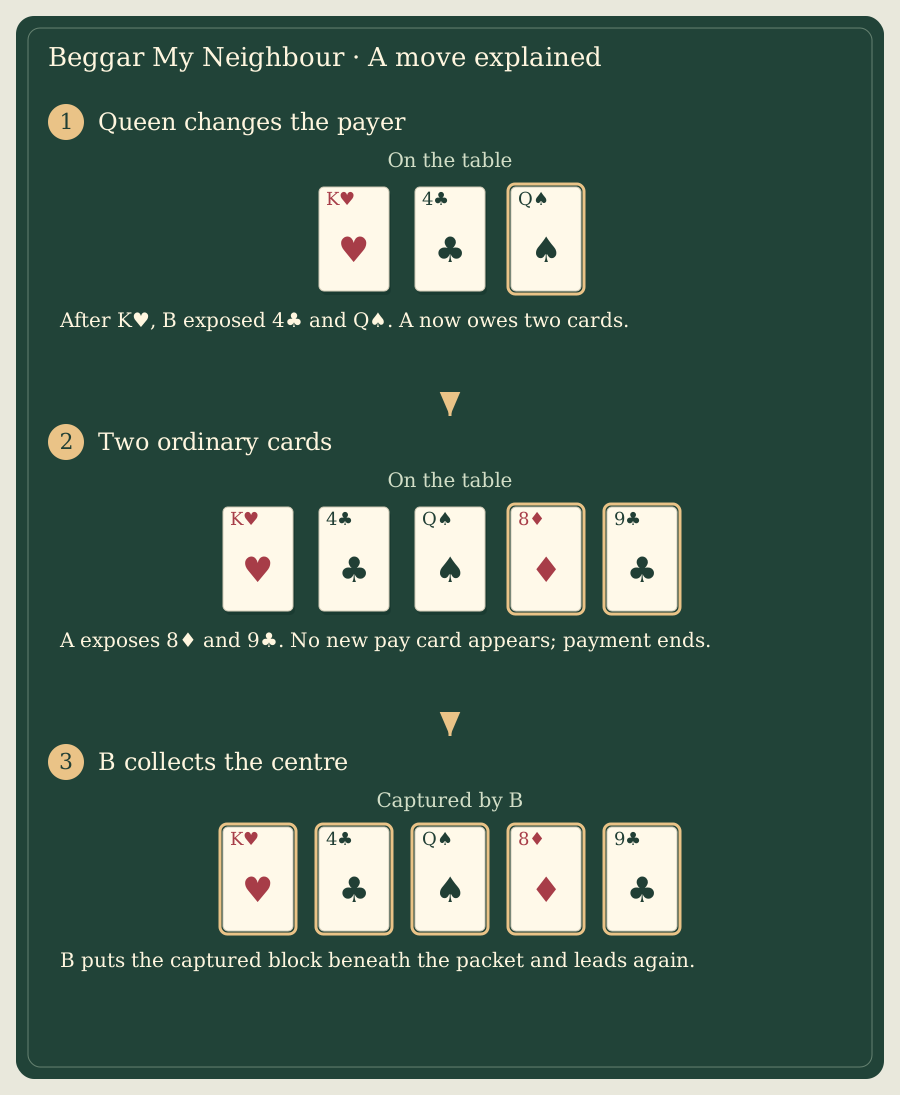
Anna exposes K♥. Boris pays 4♣, Q♠ and stops. Anna now owes 2 and exposes 8♦, 9♣. Both ordinary, so Boris takes all 5 cards and leads his next top card. The king’s unpaid third card was cancelled by the queen.
← On a small screen, scroll the diagram horizontally. →
Common questions
Must an ace beat a king?+
No. Ranks are not compared; a pay card starts a new payment.