← On a small screen, scroll the diagram horizontally. →
01 /
The game at a glance
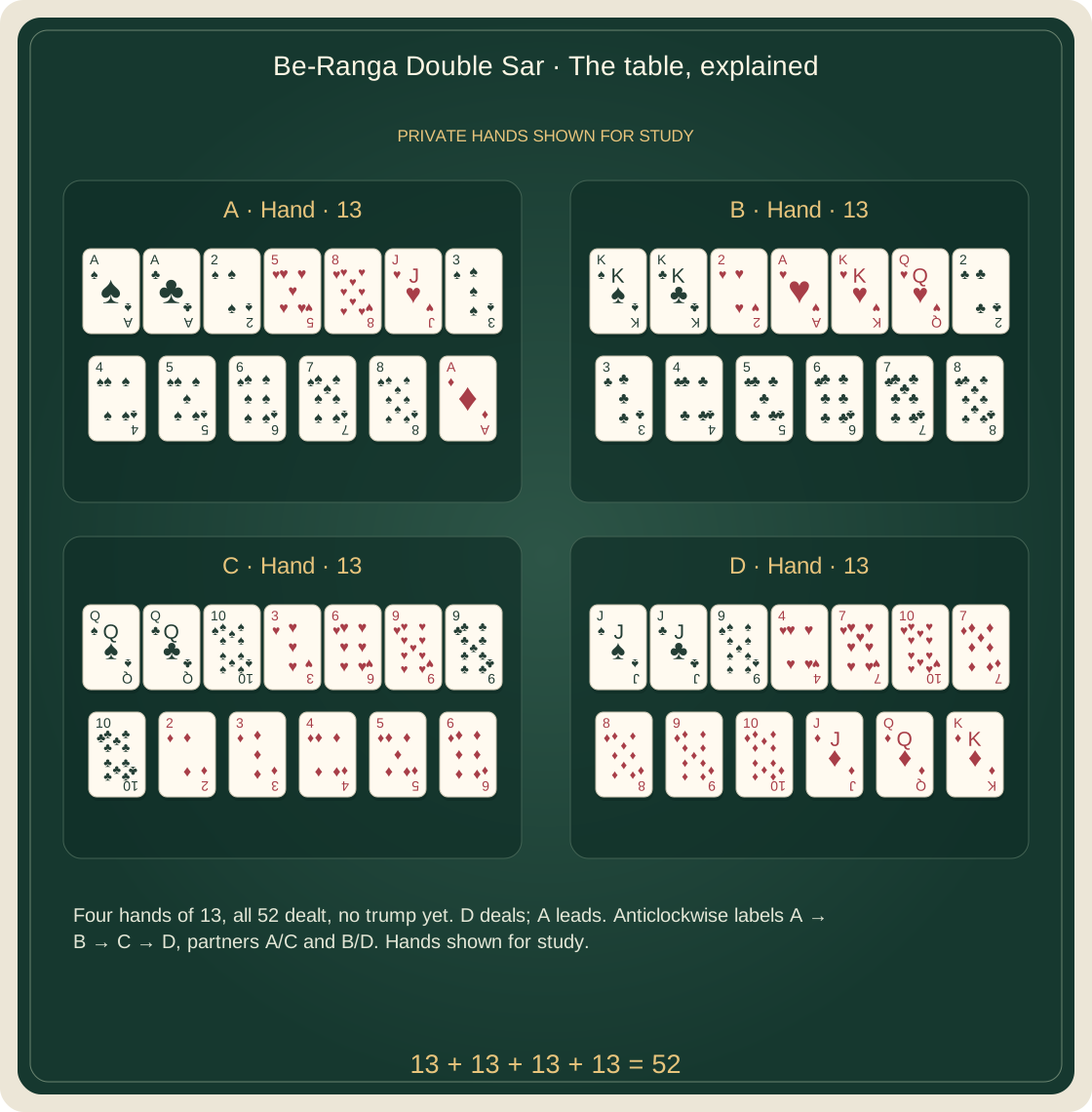
Four players use an ordinary 52-card pack with no jokers, 13 each. Cards rank A K Q J 10 9 8 7 6 5 4 3 2 in every suit. There are no card-point values. Your team wants to collect at least 7 of the 13 tricks; count collected tricks, not merely the number of individual tricks your players won before a collection.
02 /
Prepare and deal
Choose the initial dealer, shuffle and let the right neighbour cut. Deal all cards anticlockwise; do not stop after the first packet to nominate trumps. The player to dealer’s right leads the first trick. Put a clearly separated space in the middle for unclaimed tricks and a separate collected pile for each team. Everyone holds their full hand before the opening lead.
03 /
How play proceeds
Follow the led suit whenever possible. The first player who cannot follow plays any other suit; that played suit becomes trump immediately for the rest of the deal. Thereafter, when void you may trump or discard: trumping and overtaking are not compulsory. Highest trump wins, otherwise highest led suit. The winner leads next, but leaves the completed trick face down in the centre unless collection is permitted.
04 /
Rules that change your decision
Only the same player winning consecutive tricks can collect the whole centre; partners winning successively do not qualify. Collection is barred through the trump-setting trick, but its winner may collect after also winning the next. A collection resets the run: another win starts a new centre, rather than extending the previous pair. The last trick’s winner always takes the remaining centre, even without a consecutive win.
05 /
Finish and scoring
Play all 13 tricks and count team collections. A majority wins the deal. Winning 7 consecutive deals scores a court; capturing all 13 in one deal scores a court immediately, not merely the first seven. If the dealer’s team captures all, it scores 3 courts. Any court resets the deal-winning streak. Agree a session length and compare courts; equal courts give a tied session. A confirmed uncorrected failure to follow suit awards opponents a court under the parent rules.
06 /
A worked example
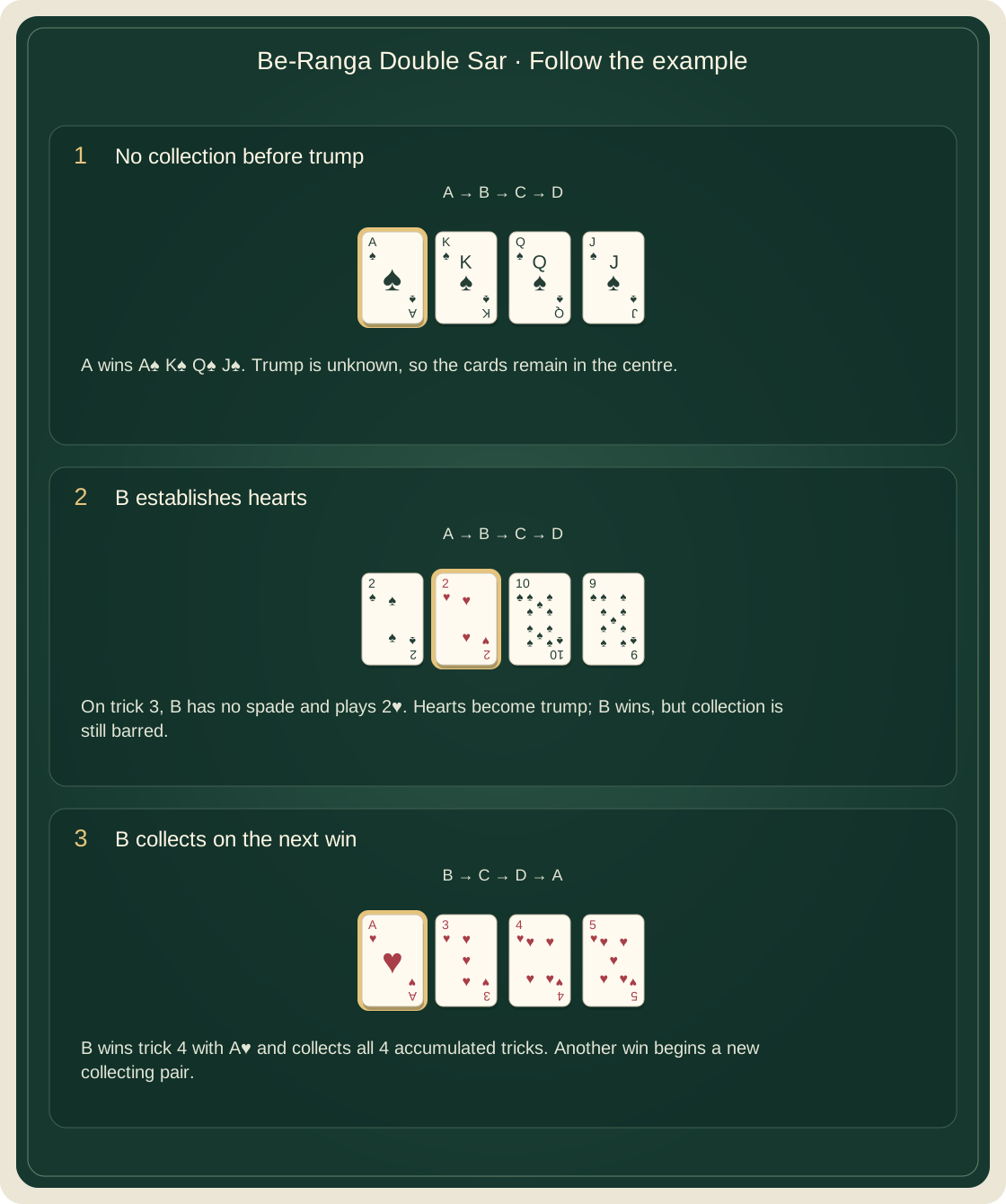
A wins the opening spade and club tricks, but trump is still unknown, so both remain in the centre. On trick 3 A leads 2♠; B has no spade and plays 2♥, establishing hearts. C 10♠ and D 9♠ follow; B wins but cannot yet collect. On trick 4 B’s A♥ beats 3♥ 4♥ 5♥ and B gathers all 4 tricks. B also wins trick 5, but its 4 cards begin a fresh centre. Only another consecutive win allows another collection.
| Trick | Order | Cards | Winner | Collected tricks |
|---|---|---|---|---|
| 1 | A → B → C → D | A♠ · K♠ · Q♠ · J♠ | A | — |
| 2 | A → B → C → D | A♣ · K♣ · Q♣ · J♣ | A | — |
| 3 | A → B → C → D | 2♠ · 2♥ · 10♠ · 9♠ | B | — |
| 4 | B → C → D → A | A♥ · 3♥ · 4♥ · 5♥ | B | 1, 2, 3, 4 |
| 5 | B → C → D → A | K♥ · 6♥ · 7♥ · 8♥ | B | — |
| 6 | B → C → D → A | Q♥ · 9♥ · 10♥ · J♥ | B | 5, 6 |
| 7 | B → C → D → A | 2♣ · 9♣ · 7♦ · 3♠ | C | — |
| 8 | C → D → A → B | 2♦ · 8♦ · A♦ · 3♣ | A | — |
| 9 | A → B → C → D | 4♠ · 4♣ · 3♦ · 9♦ | A | 7, 8, 9 |
| 10 | A → B → C → D | 5♠ · 5♣ · 4♦ · 10♦ | A | — |
| 11 | A → B → C → D | 6♠ · 6♣ · 5♦ · J♦ | A | 10, 11 |
| 12 | A → B → C → D | 7♠ · 7♣ · 6♦ · Q♦ | A | — |
| 13 | A → B → C → D | 8♠ · 8♣ · 10♣ · K♦ | A | 12, 13 |
← On a small screen, scroll the diagram horizontally. →
07 /
What to watch at the table
Track the previous winner, the centre size and whether collection is currently unlocked. Helping partner win a single trick may interrupt your own collecting run. Before trump appears, a long suit can hand another player the power to select it by going void. Do not confuse a large unclaimed centre with a secured team lead; the last trick can transfer it wholesale.
08 /
Choose the rules before starting
Next-dealer rules follow the parent game. If the dealer’s side wins, the right neighbour deals next. If the forehand’s side wins without a court, the dealer repeats; after its court the dealer’s partner takes over. Ordinary Double Sir chooses trump before play, while Hidden Rung has a secret indicator and different reveal timing. Their restrictions on collecting early or late tricks are not silently added here.
09 /
History and related games
Be-Ranga belongs to the South Asian Court Piece and Double Sar tradition. The parent games are documented in India and Pakistan, with many local names and house profiles. Dynamic trump and delayed collective ownership give this variant its identity. The published player account does not establish a single inventor or a reliable founding date.
10 /
Check your understanding
Do partners winning successively collect?
Show answer
No. The same individual must win consecutively, except the final-trick rule.
Can the trump-setting trick be collected immediately?
Show answer
No. Its winner must also win the following trick to collect; earlier consecutive wins do not unlock it.
Common questions
When are trumps chosen?+
The first failure to follow suit establishes the suit actually played as trump.
What does the last winner take?+
All cards remaining in the centre, even without another consecutive win.
Is this ordinary Court Piece?+
No. Delayed collections and dynamically established trump are the defining differences.