← On a small screen, scroll the diagram horizontally. →
01 /
The game at a glance
Four players sit in fixed opposite partnerships. Use 32 cards, 7 through A. Jacks are trumps in order J♣ J♠ J♥ J♦, above the selected suit’s A 10 K Q 9 8 7. Other suits rank A 10 K Q 9 8 7. Values A=11, 10=10, K=4, Q=3, J=2, others zero: 120 total. The target is 20 tally marks, not card points.
02 /
Prepare and deal
To choose teams, deal face up until different players receive jacks; the first jack holders partner and move opposite. Shuffle, let the right neighbour cut, then deal clockwise in packets of 4 until each has 8. The left neighbour speaks first and normally leads. The deal moves left after settlement. In the first deal, the team holding J♣ owns the chalk. Record chalk ownership separately from the score.
03 /
How play proceeds
Bid once in clockwise order: pass, a trump count or Solo. A count includes every jack plus cards of the intended suit, not necessarily your longest. Higher count wins; tied opponents compare their lowest proposed trump, higher wins, then earlier seat. Tied partners may choose between themselves without detailed discussion. With no jacks you must pass; with all jacks only Big Solo or pass. Before any bid, holding some but not all jacks forces a bid. A total pass-out moves to the next dealer.
After a numerical bid you may only bid a higher count or a qualifying equal count (mit); you cannot undercall.
04 /
Rules that change your decision
Follow effective suit: every jack belongs to trump. If void, you must trump even when partner is winning or you cannot overtrump. When a jack has appeared, a later trump player must overtake it with a higher jack if able. Otherwise there is no general obligation to head the trick. Highest trump wins, else highest led suit; winner leads. Only if void in both suit and trump may you discard freely.
05 /
Finish and scoring
Chalk holders need 42 card points to score and retain chalk; opponents need 79 to score and take it. A scoring side gets 1 mark, increased to 2 with at least 91 points or 3 for every trick. Reaching 20 marks wins. Solo is unavailable in the first deal. Later J♣ may bid Small or Big Solo, naming trumps and taking all 8 tricks alone against the opponents; partner sits out. Small exchanges a card blindly with partner, face up if a jack; Big exchanges nothing. Success or failure awards 8 or 12 marks respectively to the winning team and transfers chalk if needed.
| Chalk points | Other side | Marks / chalk |
|---|---|---|
| 0–29 | 91–120 | Opponents 2, or 3 for all tricks |
| 30–41 | 79–90 | Opponents 1, take chalk |
| 42–90 | 30–78 | Chalk side 1, retains |
| 91–120 | 0–29 | Chalk side 2, or 3 for all tricks |
06 /
A worked example
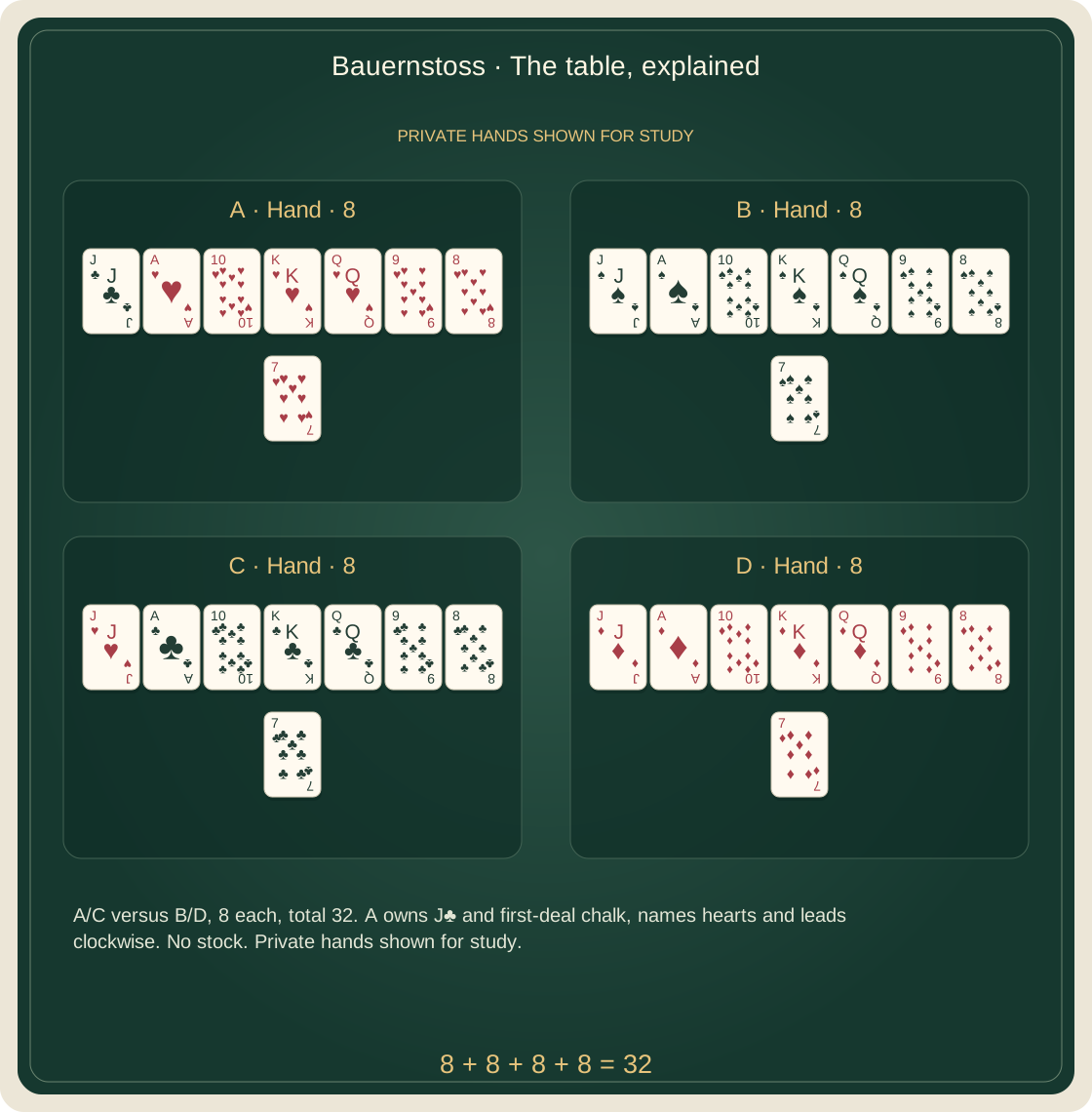
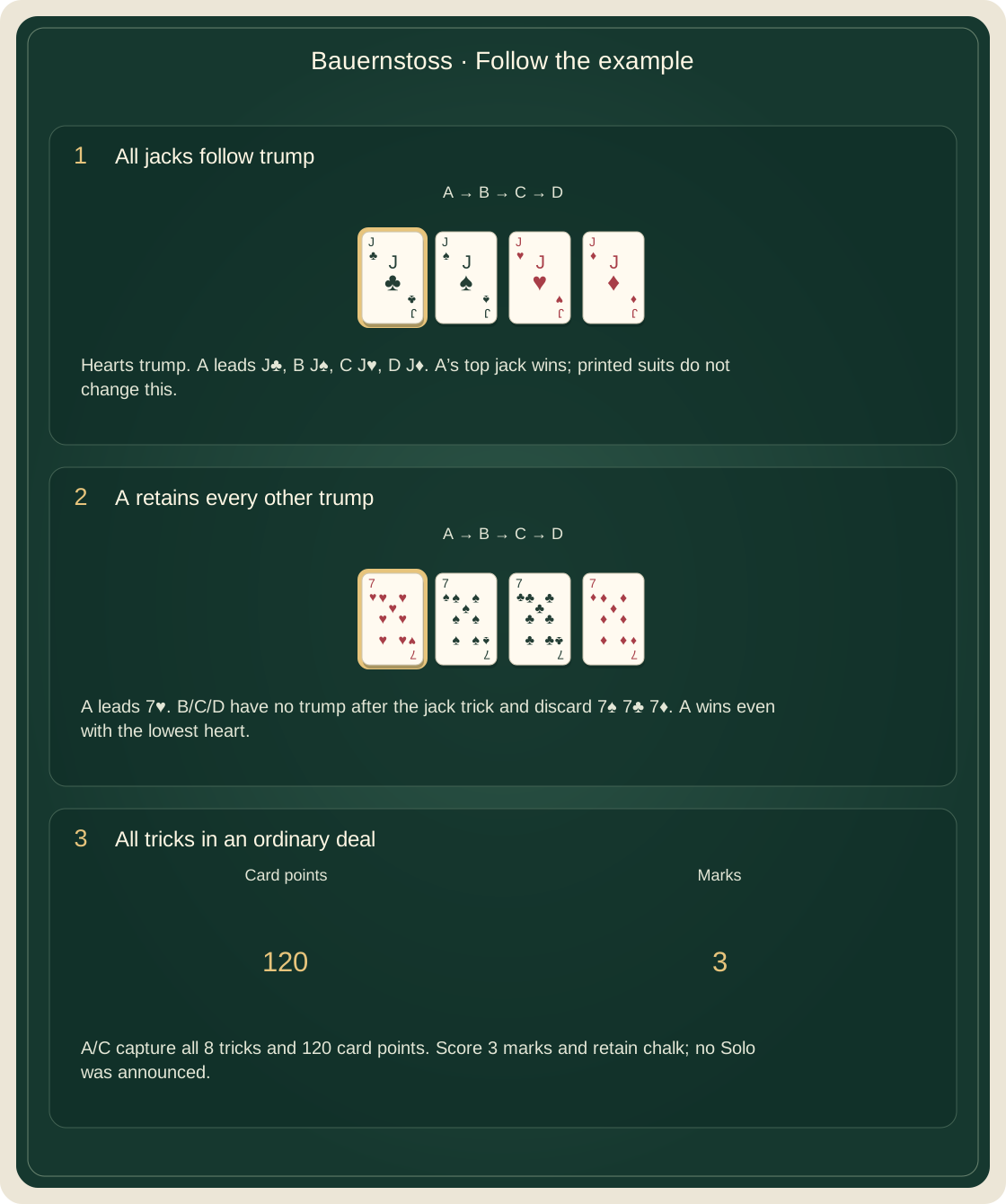
In the lesson each player can propose 8 trumps; the lowest is a seven, so earlier A has priority and names hearts. A holds J♣ and the 7 ordinary hearts, while B/C/D each hold a lower jack. A leads J♣: J♠ J♥ J♦ must follow. All remaining trumps are A’s hearts, so A takes every later trick. A/C capture 120 points and score 3 marks, retaining their first-deal chalk. This is ordinary play, not an announced Solo. In a different deal chalk 42 against 78 would still earn 1 mark.
| Trick | Order | Cards | Winner |
|---|---|---|---|
| 1 | A → B → C → D | J♣ · J♠ · J♥ · J♦ | A |
| 2 | A → B → C → D | 7♥ · 7♠ · 7♣ · 7♦ | A |
| 3 | A → B → C → D | 8♥ · 8♠ · 8♣ · 8♦ | A |
| 4 | A → B → C → D | 9♥ · 9♠ · 9♣ · 9♦ | A |
| 5 | A → B → C → D | Q♥ · Q♠ · Q♣ · Q♦ | A |
| 6 | A → B → C → D | K♥ · K♠ · K♣ · K♦ | A |
| 7 | A → B → C → D | 10♥ · 10♠ · 10♣ · 10♦ | A |
| 8 | A → B → C → D | A♥ · A♠ · A♣ · A♦ | A |
← On a small screen, scroll the diagram horizontally. →
07 /
What to watch at the table
Know whether your team owns chalk before committing high cards: a defensive result can be enough when you have that privilege. Count jacks separately from their printed suits. A long trump proposal may lose to an equal length with a better bottom card. In a Solo, one lost trick ends the attempt immediately; partner cannot rescue you with a later winning lead.
08 /
Choose the rules before starting
In Solo the usual forehand leads unless that player is the resting partner; then the next active player leads. The small exchange must be simultaneous in information: partner returns an original card without first seeing the incoming hidden card. Alter Schoofkopp has different mark targets, bonuses and overtrumping rules. Do not apply those changes to this chalk table.
09 /
History and related games
This local Schafkopf form is documented in Erfweiler in the southwestern German Palatinate. Its fixed partnerships, jack hierarchy and chalk mechanism distinguish it from the familiar Bavarian game. The modern account rests on local players’ practice; the older German Schafkopf family provides context, not proof of an exact inventor for this village profile.
10 /
Check your understanding
Does a printed club jack follow clubs?
Show answer
No. Every jack is trump, independent of its printed suit.
Can chalk win with fewer card points?
Show answer
Yes. Chalk 42 against 78 still scores; without chalk 79 is required.
Common questions
How many cards?+
32, with 8 per player and no stock.
Can partner win a Solo trick?+
No. Partner sits out; the bidder must win every active trick.
Is beating every trump compulsory?+
No. The special overtaking duty concerns a jack already played, when a higher jack is held.