← On a small screen, scroll the diagram horizontally. →
01 /
The game at a glance
Play individually with 4 people and 32 cards, removing ranks below 7. There are no jokers, trumps or partners. High to low is A K Q J 10 9 8 7. Card values are A=11, 10=10, K=4, Q=3, J=2 and the others zero. Each suit contains 30 card points, so the pack contains 120. More card points usually mean fewer game points.
02 /
Prepare and deal
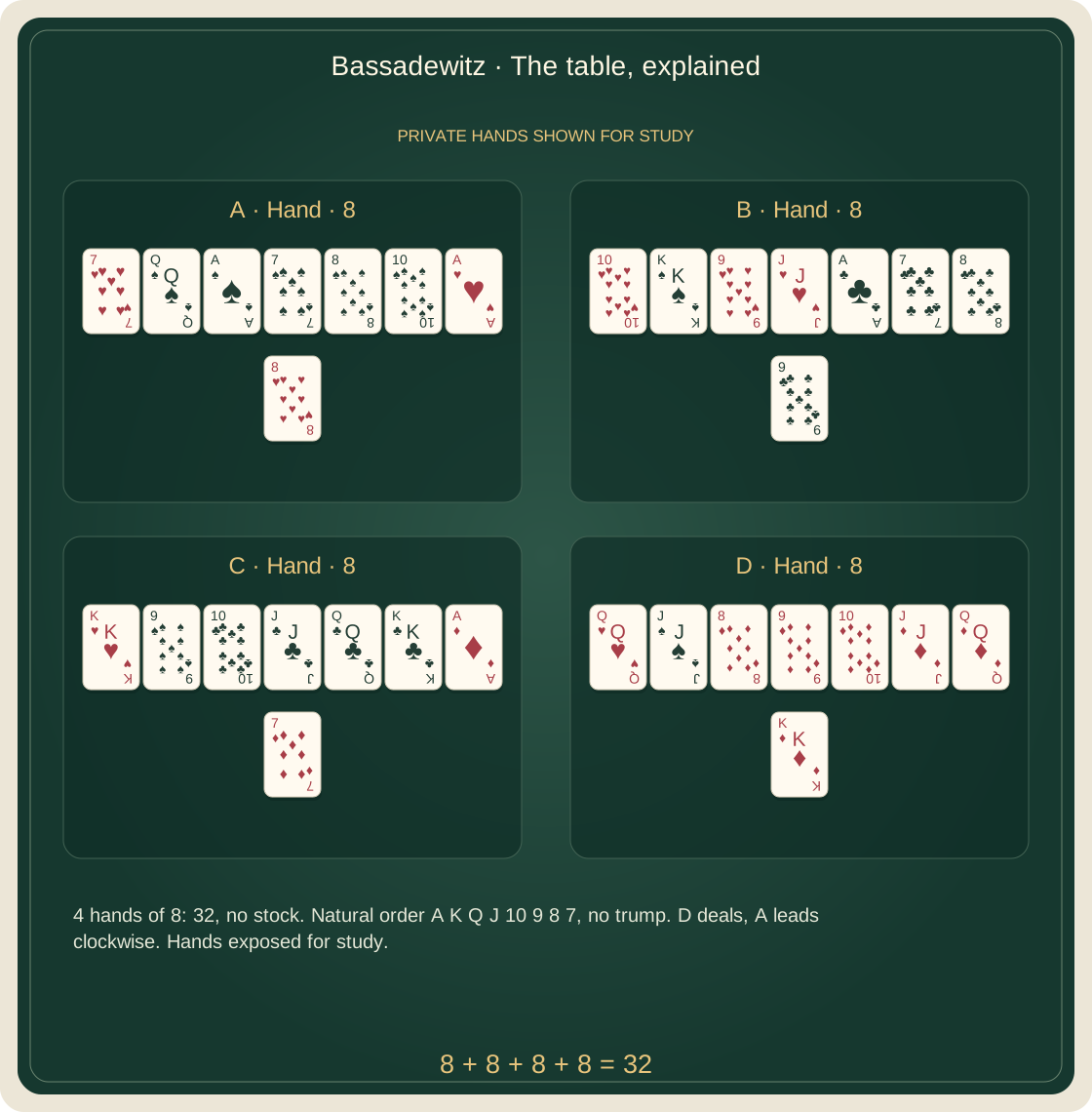
Choose a dealer, shuffle, cut and deal 8 cards to each player. All cards are in hands; no stock, exchange or discard pile exists. Record a separate column for each person’s game score, initially zero. The dealer’s left neighbour leads and play proceeds clockwise. Pass the deal to the left after scoring. Keep captured tricks separate for later counting.
03 /
How play proceeds
Lead any card. Everyone follows suit when able; otherwise discard any card. There is no obligation to overtake and no way for an off-suit card to win. Highest in the led suit takes all cards and leads next. Play every trick even if someone already appears to have a terrible total: taking every trick is a different result from taking almost everything.
04 /
Rules that change your decision
The ten is expensive but sits below the jack in this profile. That creates opportunities to give away many points under a relatively cheap picture card. Card points and game points are different units; keep separate headings. A zero-point trick is still a trick, so it prevents another player from claiming every trick even though it changes no card-point total.
05 /
Finish and scoring
After 8 tricks sum card points, then apply the scoring table. If someone took all 8, that player alone gains 10 game points and everyone else gains zero; this overrides the ordinary zero-card-point award. Otherwise award each player independently by their total. Play until someone reaches 36. For a simultaneous crossing, our stated table agreement compares totals after the deal and shares a tied lead.
| Card points | Game points |
|---|---|
| 0 | 10 |
| 1–24 | 6 |
| 25–48 | 2 |
| 49–120 | 0 |
06 /
A worked example
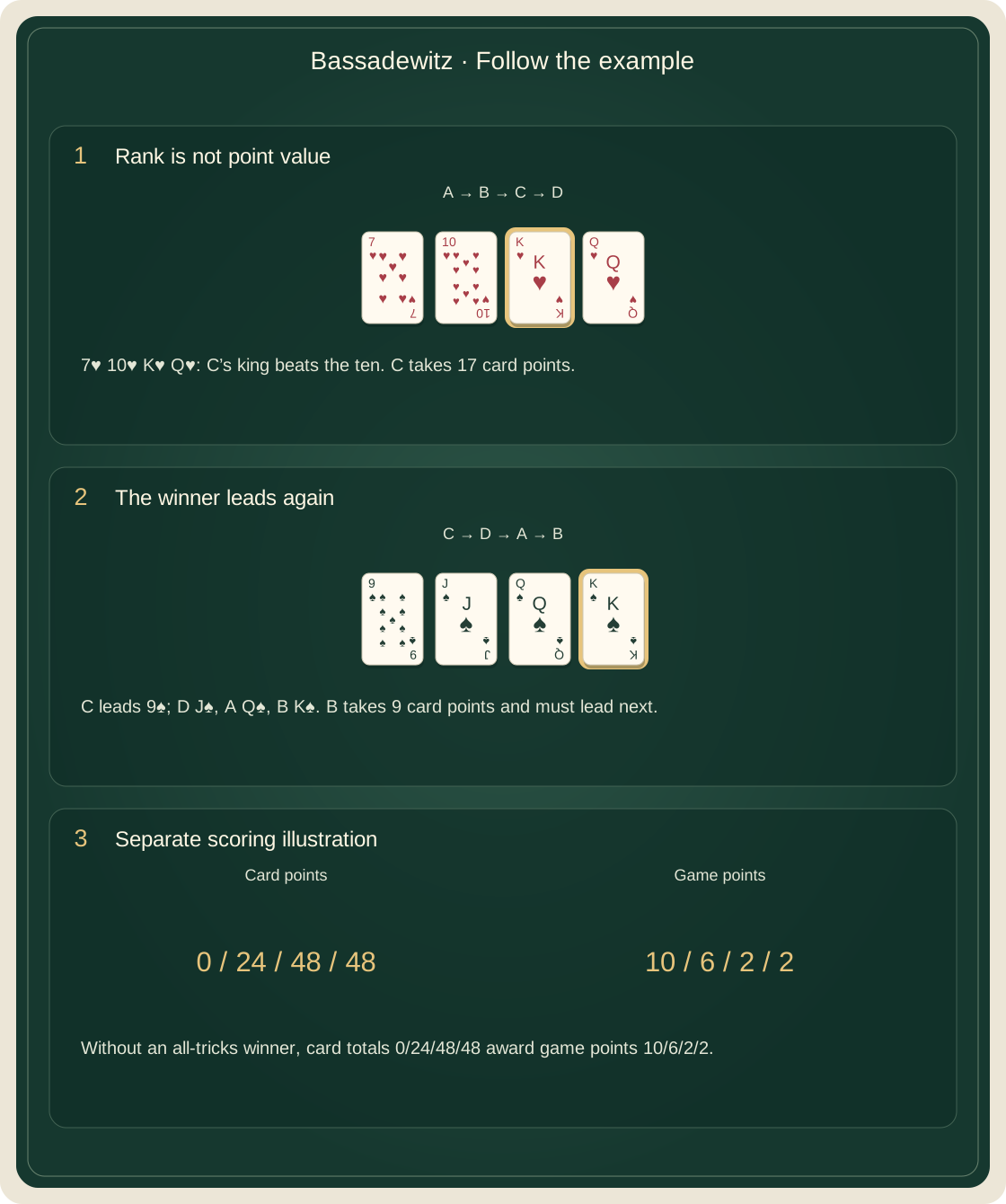
A leads 7♥; B plays 10♥, C K♥, D Q♥. C wins with K♥, despite B contributing the expensive ten. The trick contains 0+10+4+3=17 card points. C leads 9♠; D J♠, A Q♠ and B K♠ follow, so B takes 0+2+3+4=9. Both tricks obey suit. In a separate end-of-deal illustration totals 0/24/48/48 sum to 120 and award 10/6/2/2 game points, provided nobody took every trick.
| Trick | Order | Cards | Winner |
|---|---|---|---|
| 1 | A → B → C → D | 7♥ · 10♥ · K♥ · Q♥ | C |
| 2 | C → D → A → B | 9♠ · J♠ · Q♠ · K♠ | B |
| 3 | B → C → D → A | 7♣ · 10♣ · 8♦ · 7♠ | C |
| 4 | C → D → A → B | 7♦ · 9♦ · 8♥ · 8♣ | D |
| 5 | D → A → B → C | 10♦ · 8♠ · 9♣ · A♦ | C |
| 6 | C → D → A → B | J♣ · J♦ · 10♠ · A♣ | B |
| 7 | B → C → D → A | 9♥ · Q♣ · Q♦ · A♥ | A |
| 8 | A → B → C → D | A♠ · J♥ · K♣ · K♦ | A |
← On a small screen, scroll the diagram horizontally. →
07 /
What to watch at the table
Judge whether your hand can lose safely before trying to take everything. A single low trick taken by another player breaks the sweep, and a large partial haul may score nothing. Track high cards remaining in your long suits; a ten is often a useful gift when someone else already controls a trick. A safe low exit can be worth more than an isolated ace.
08 /
Choose the rules before starting
Other accounts use a counter pool, a promoted ten or a different ace value. Those change scoring thresholds or trick winners and are not active here. Confirm natural order and the game-point table before dealing. The simultaneous-finish convention above completes our table agreement; it is not presented as a universal historical tiebreak.
09 /
History and related games
Bassadewitz is an old German avoidance game with several spelling variants. Its name appears in an early humorous poem, and later rulebooks show that both scoring and card order have varied. Its relationship to other avoidance games is useful context, but similarity does not prove an exact inventor or a single unbroken national ruleset.
10 /
Check your understanding
Can K beat 10?
Show answer
Yes in the same suit under our natural order, despite having a smaller point value.
Does a sweep let opponents claim zero-point bonuses?
Show answer
No. The sweep replaces ordinary scoring: its winner 10, everyone else 0.
Common questions
Are there trumps?+
No. Only the led suit can win.
How many points are in the pack?+
120 card points, converted to game points after the deal.
Do I have to beat a led card?+
No. Follow suit when possible; you may play lower.