← On a small screen, scroll the diagram horizontally. →
01 /
The game at a glance
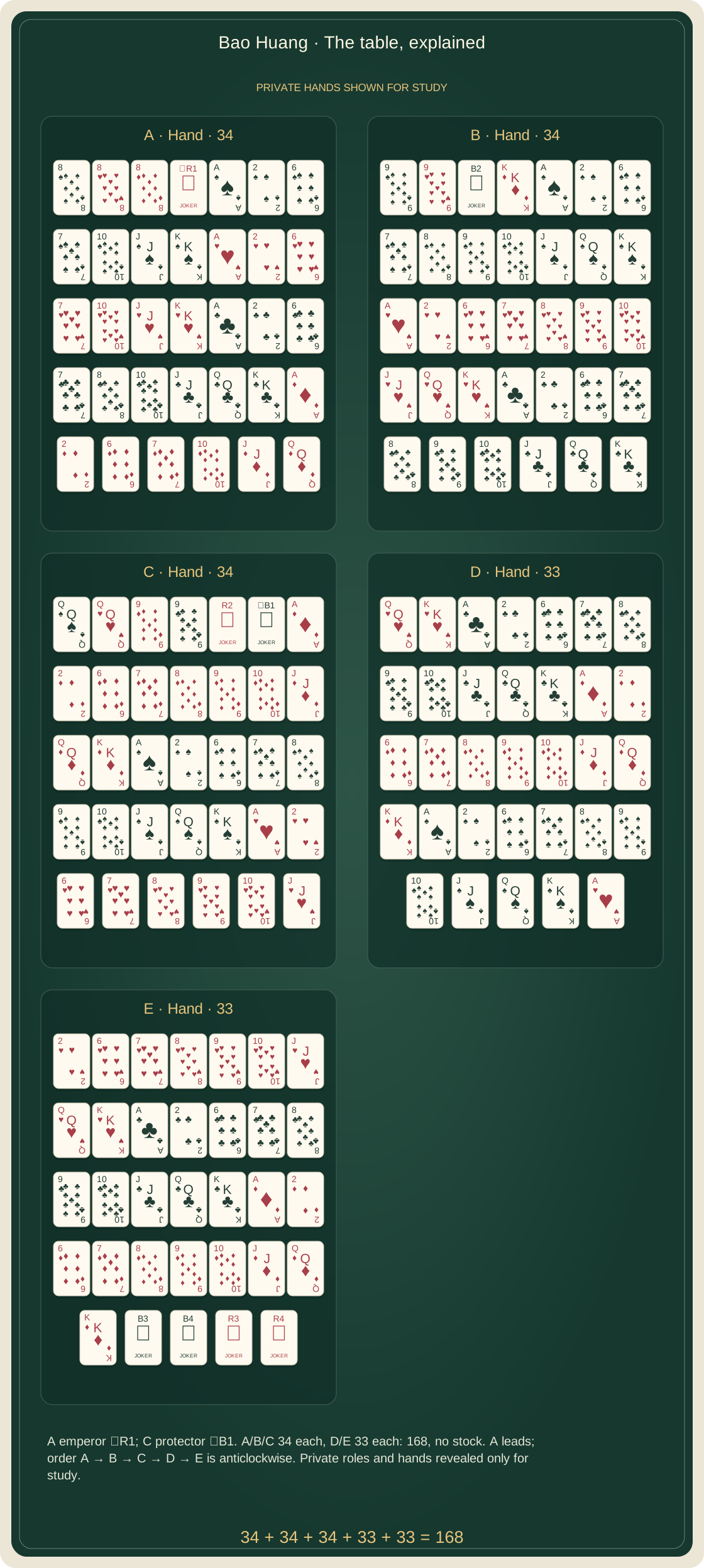
There are exactly 5 players. Combine 4 ordinary packs, remove every 3, 4 and 5, and add 4 red and 4 black jokers: 160+8=168. Suits do not rank. High to low: red joker, black joker, 2, A, K, Q, J, 10, 9, 8, 7, 6. Mark the face of one red joker for the emperor and one black for the protector, keeping backs indistinguishable.
02 /
Prepare and deal
After shuffling, the right neighbour cuts and the next right neighbour draws first. Take cards one at a time anticlockwise until none remain: hands are 34/34/34/33/33 before role transfers. The red-mark holder may pass that card clockwise without exchange until someone accepts; if all refuse, the original holder must accept. The black-mark holder is that emperor’s partner. Holding both makes the emperor play alone.
03 /
How play proceeds
The emperor leads. Play a single, any number of one ordinary rank, that rank with jokers, or jokers alone. No runs or full houses. Subsequent players pass or beat with exactly the same number of cards. Sort both groups by strength: every new card must strictly exceed its counterpart. After all other active players pass consecutively, the unbeaten player leads afresh. A pass does not bar a later response after someone else raises.
04 /
Rules that change your decision
A group containing any red joker cannot be beaten in this profile: no card exceeds it. Equal ordinary cards do not become stronger merely by adding a joker. Before play, any non-emperor may declare allegiance, doubling settlement once, regardless of further declarations. An emperor holding both role cards may declare solo for that same doubling. Players who finish drop out; if their final group stands, the next active player to their right leads.
05 /
Finish and scoring
Stop when a whole team has finished. With partners, finishing places carry +2/+1/0/−1/−2. Sum the emperor team’s places; give that sum to the protector, double it for emperor, and the opposite sum to each commoner. Apply any declaration double. A lone emperor finishing first gets +12 against −3 each; second is zero; third or worse −12 against +3 each. A declaration doubles these figures. After an undecided group of remaining teammates, their combined place values suffice.
06 /
A worked example
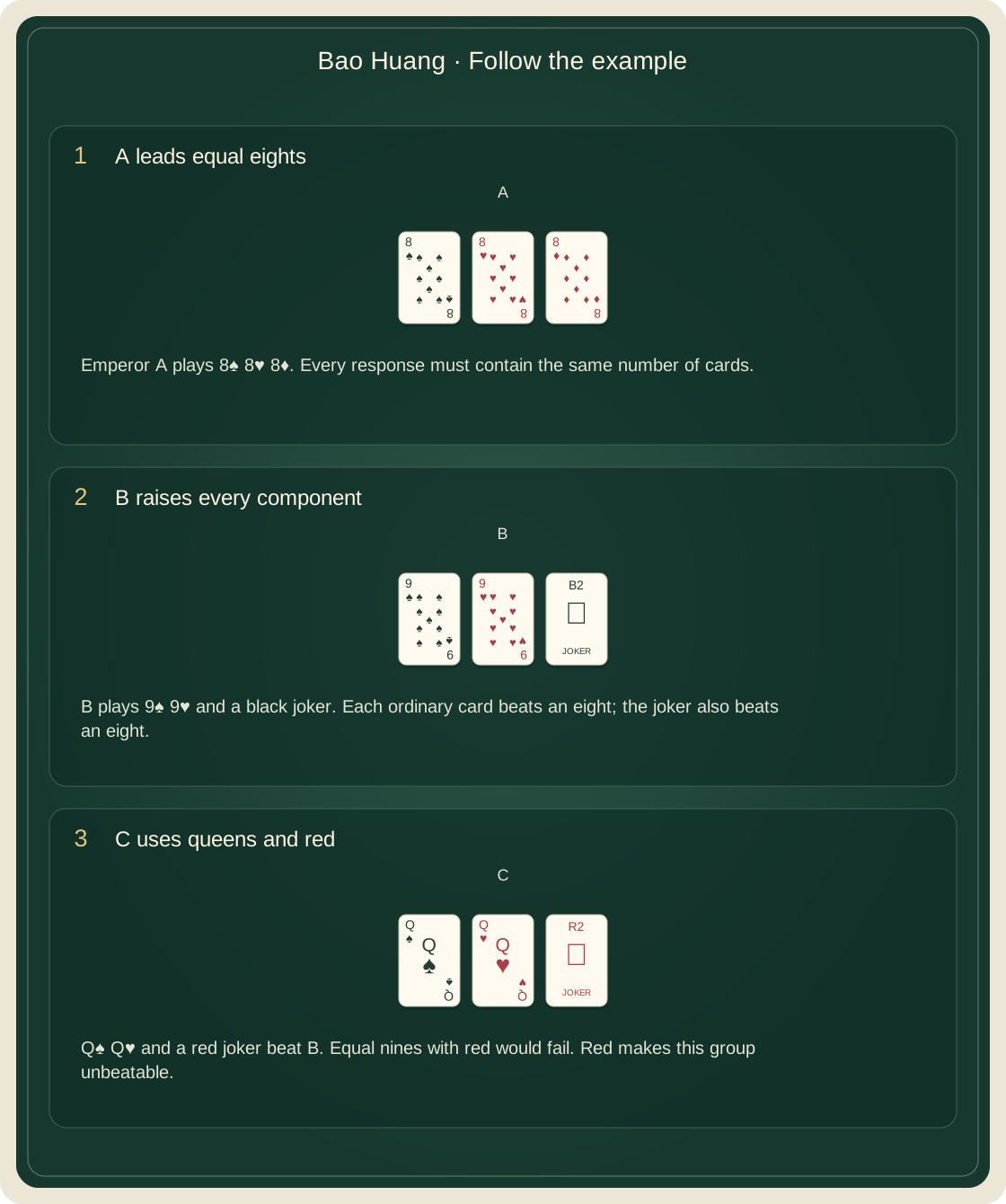
A is emperor, C the hidden protector. A leads 8♠ 8♥ 8♦. B answers 9♠ 9♥ and a black joker: every card improves. C cannot answer with 9♦ 9♣ and a red joker, because equal nines do not beat nines. C may instead play Q♠ Q♥ and a red joker, which beats every component and is then unbeatable. In an independent finish A/C in places 1 and 3 give team +2; A +4, C +2, B/D/E −2 each, total zero before doubling.
← On a small screen, scroll the diagram horizontally. →
07 /
What to watch at the table
Helping the emperor can reveal the protector, but a seemingly helpful pass may be deceptive. Keep an unbeatable exit for an awkward remaining rank and avoid spending high jokers merely because you can. Group size is binding: a long group can strand an opponent with many powerful singles. Check the ordinary cards as well as the jokers before accepting a claimed overcall.
08 /
Choose the rules before starting
For subsequent deals, rotate the starting draw. The previous losing side gives its highest non-joker cards to the winners: one per commoner or protector, two for emperor, four for a lone emperor; the previous emperor correspondingly receives two or four when winning. No tribute after a zero result. Agree a session length. Optional sixes-last, a full 216-card pack, partner selection by a matching card and relaxed beating are separate variants, inactive here.
09 /
History and related games
The game is associated with Shandong in northern China, including the Rizhao profile used here. Its name reflects the asymmetric imperial and popular sides. Contemporary accounts describe many local and online versions rather than one uniform national code. A particular inventor and precise founding year are not established.
10 /
Check your understanding
Can equal nines plus red beat nines plus black?
Show answer
No. Every corresponding card must improve, including the ordinary cards.
Does passing remove me from the contest?
Show answer
No. You may respond later after another player raises; consecutive passes only clear the current unbeaten group.
Common questions
Do suits matter?+
No. Rank and joker colour matter; ordinary suits do not.
Must the protector announce?+
No. The marked black card can remain hidden until played.
Are sixes forced last here?+
No. That is a separate optional variant, not used in the illustrated profile.