← On a small screen, scroll the diagram horizontally. →
01 /
History and context
Pagat documents Backstab Fish as a variant played in Adelaide. An Australian rules account also describes the double deck, exact-quantity requests and optional book hoarding. No inventor or invention date is established.
It belongs to the Fish and Go Fish family, but uses books rather than pairs and makes the requested quantity matter independently.
02 /
Set up
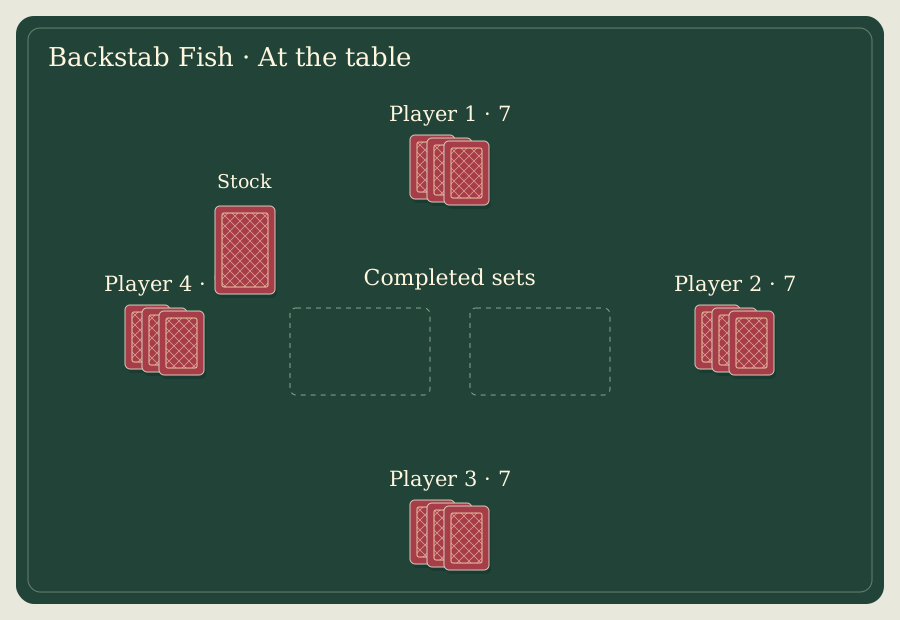
Four to ten people play. Shuffle two standard packs and four jokers together:108 cards. Deal seven each; leave the remainder face down as stock. Jokers form a separate rank, not wild cards; four jokers make a book.
A book is any four equal-ranked cards. Ignore suits; duplicate suit-and-rank cards from the second deck are valid. Laid books stay face up before their owner and cannot be requested.
Home agreement: dealer’s left begins. Everyone may lay completed books before the first request.
03 /
Requests and continuing a turn
Choose an opponent with cards and state a rank plus an exact positive quantity: “Lena, give me three sixes.” You must hold at least one six in hand; a laid book does not qualify.
With at least three sixes, Lena must transfer exactly three, retaining extras. You may lay books and make another legal request to any opponent.
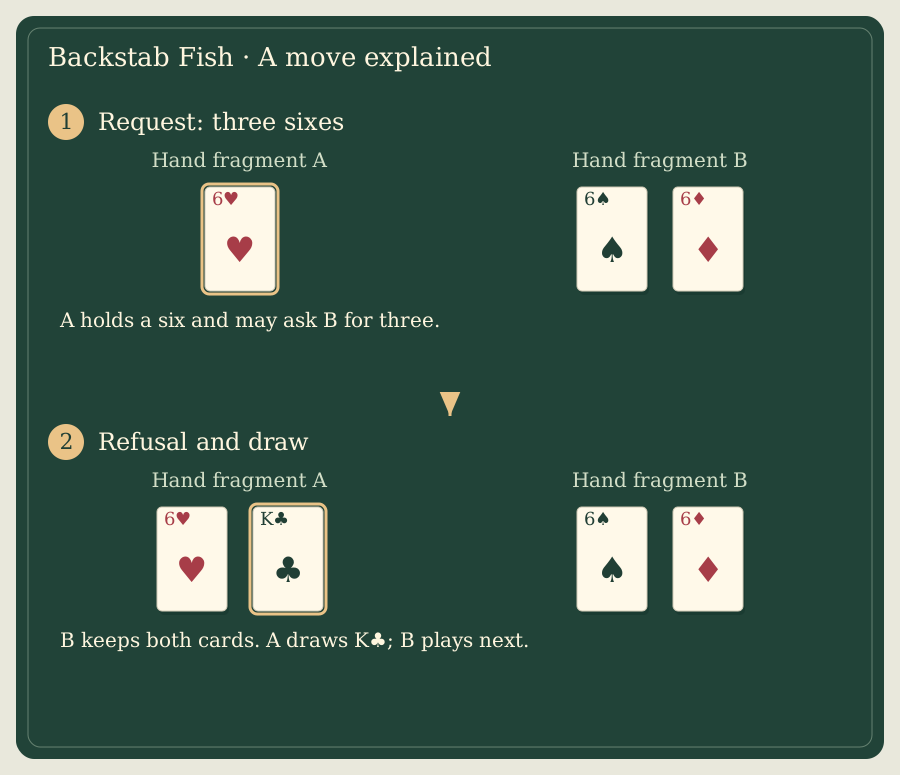
With fewer than three, Lena transfers nothing. Draw one stock card, optionally lay a completed book, then give Lena the turn—even if you drew a six. A matching draw does not preserve the turn in this version.
04 /
Lay or retain a book
While stock remains, completed books may stay in hand. They support requests for the remaining cards of that rank, but remain available to opponents. Laying a book protects it; without another card of that rank in hand, you lose the right to ask for it.
Whenever a hand empties, immediately draw up to seven cards, taking all remaining stock if fewer. This includes an opponent who handed over their last card. With no stock, an empty-handed player leaves the request cycle.
05 /
Empty stock and settlement
Home agreements for a clear ending: once stock is empty, lay every completed book at the end of your own turn. Failed requests draw nothing but still pass the turn to the addressee. If that player has emptied, use the next clockwise player with cards. Empty-handed players cannot be targeted.
Continue until all cards form books:27 in total. Each book scores one point. Highest total wins; equal leaders share victory. One exhausted pack settles a game; no fixed series target is needed.
06 /
Why quantity matters
Anton has one six; Lena has two. Anton asks for three sixes. Lena refuses and keeps both: partial transfers are not allowed. After Anton draws, Lena takes the turn.
If Anton had requested one, Lena would transfer exactly one and he would continue. Asking merely “Do you have sixes?” is incomplete: the quantity must be stated first.
Later Anton holds four sixes but does not lay them. Boris, also holding a six, requests three. Anton must surrender three, breaking what was a completed book. Had Anton already laid it, the request could not touch those cards.
← On a small screen, scroll the diagram horizontally. →
07 /
Keep agreements separate
Another Australian tariff adds a bonus for two books of one rank. Some descriptions also pass the turn after each request. Neither is silently imported: successful requests continue here, while failures pass to the addressee.
Common questions
Must I give all cards of the rank?+
No. Transfer exactly the requested number if you have enough.
Can I give two when asked for three?+
No. An insufficient holding transfers nothing.
Are jokers wild?+
No. They make their own four-card book.
Can I lay two books of sixes?+
Yes: the double deck contains eight sixes. Here those books score two points.