← On a small screen, scroll the diagram horizontally. →
01 /
Context and scoring cards
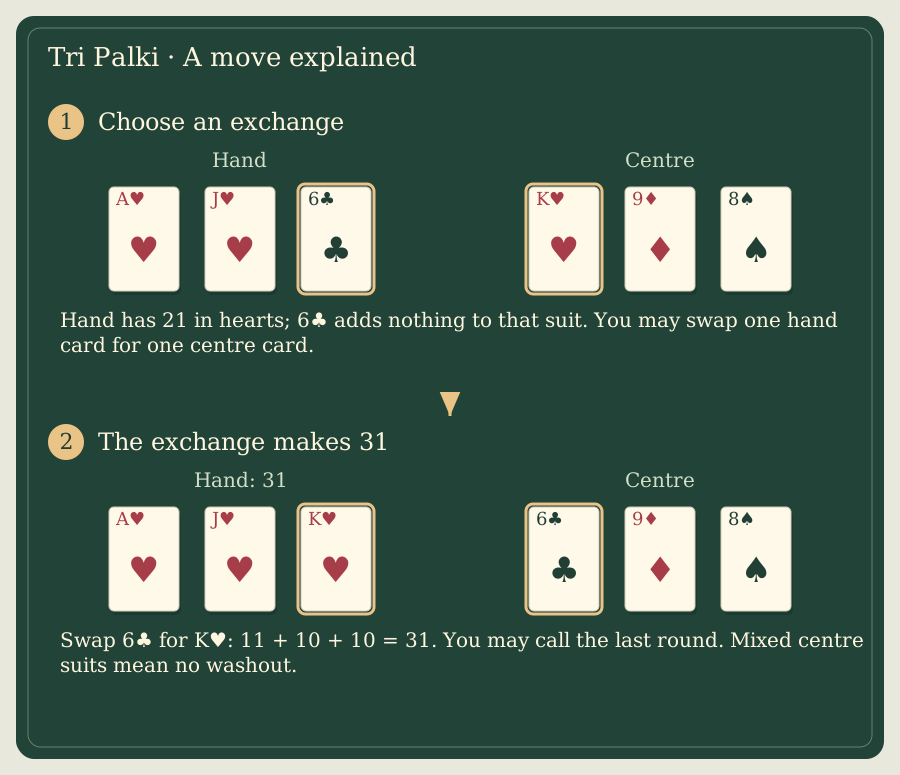
Tri Palki means Three Sticks. This Russian form of the Schwimmen family was described by Alexander Tvaladze; no single invention date is established. Use 36 cards,6 through A. Aces count 11, faces 10, numerals face value. Ordinary hand value is the highest sum in any ONE suit, not all three cards. Maximum 31. For equal totals, compare scoring-card ranks high to low using A K Q J 10 9 8 7 6, then suits hearts>diamonds>clubs>spades. Our table applies this comparison to the best scoring suit only, an explicit clarification for mixed hands.
02 /
Deal and actions
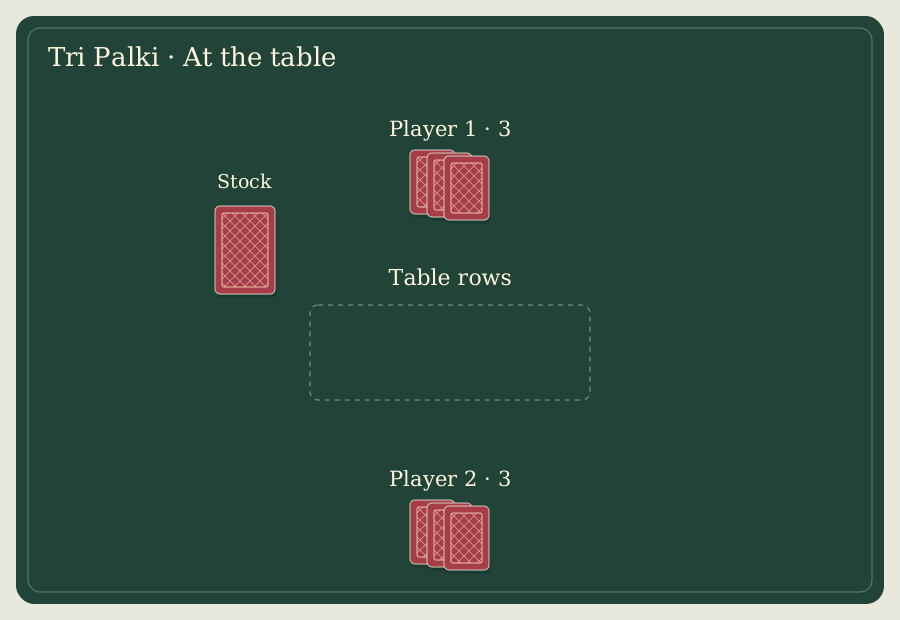
Choose first dealer randomly. Deal clockwise one card to each player then one face up to centre, three times: three each and three centre cards. The rest is a face-down reserve. Dealer acts first, then clockwise. Exchange one hand card for one centre card, exchange ALL three for ALL three, or pass. Never exchange just two. Keep hands concealed. No stock card can be drawn directly.
03 /
Washouts and extra turns
Whenever centre cards are all one suit, including immediately after dealing, discard those three permanently and replace with three fresh reserve cards. Repeat until centre has at least two suits. If a player’s action caused the washout, the SAME player gets another turn after a successful replacement. This still applies in a final round and can repeat several times.
If reserve cannot provide a full replacement triple, our table ends immediately without a partial replacement. This clarifies the source’s empty-reserve stopping rule. Hand cards are scored as held; washed-out cards never return that hand.
04 /
Stopping and special hands
A player with an ordinary 31 at the end of their turn may call “last round”; each OTHER player then gets one final turn, plus any washout repeats, before reveal. Calling is optional. Also end when everyone passes consecutively or replacement becomes impossible. Special hands alone do not permit a last-round call.
Three sixes and a suited 6–7–8 are safe and never take a stick. Three aces are also special: if anyone has them, every ordinary-hand player takes one stick, regardless of ordinary totals. Other equal-rank triples are not special; three kings count only 10. Without three aces, the lowest ordinary hand takes one stick; safe special hands are ignored.
05 /
Sticks, dealer and victory
Begin with zero sticks. A loss adds one until three; losing again when already at three eliminates the player. So three sticks themselves do not eliminate. Last survivor wins. If more survive, the highest ORDINARY hand deals next, using the same rank/suit tiebreak. Special hands cannot earn the next deal.
If everyone has a special hand, no one gets a stick and the dealer repeats. If the best ordinary hand is eliminated, its next surviving clockwise neighbour deals. A three-ace hand guarantees at least its holder survives simultaneous ordinary eliminations, so no last-survivor tie arises.
06 /
Worked special hands
Four show: A has 6♥–7♥–8♥, safe; B has A♣–A♦–A♠, three aces; C has K♦–Q♦–10♦,30; D has A♥–J♥–9♥,30. Both C and D receive one stick because of B’s aces. D beats C’s ordinary hand by ace-high ranks despite equal 30, and therefore deals next unless eliminated. If D already had three sticks, D is out and the next surviving clockwise player deals.
← On a small screen, scroll the diagram horizontally. →
Common questions
Does a three-of-a-kind always protect me?+
No. Only three sixes and three aces have that special status.
Can an extra washout turn occur after the last-round call?+
Yes. The final round preserves the washout repeat rule.