← On a small screen, scroll the diagram horizontally. →
01 /
The game at a glance
Partners sit opposite and share their melds. A meld has at least 3 cards: equal ranks, including duplicate copies, or consecutive cards in one suit. Ace follows king, not two; sequences do not wrap. Twos are wild substitutes, always making a meld mixed here. Neither colour of three belongs in a meld. At least 7 cards make a canasta: clean without wilds, mixed with a wild. Every card used in a meld is assigned once.
02 /
Prepare and deal
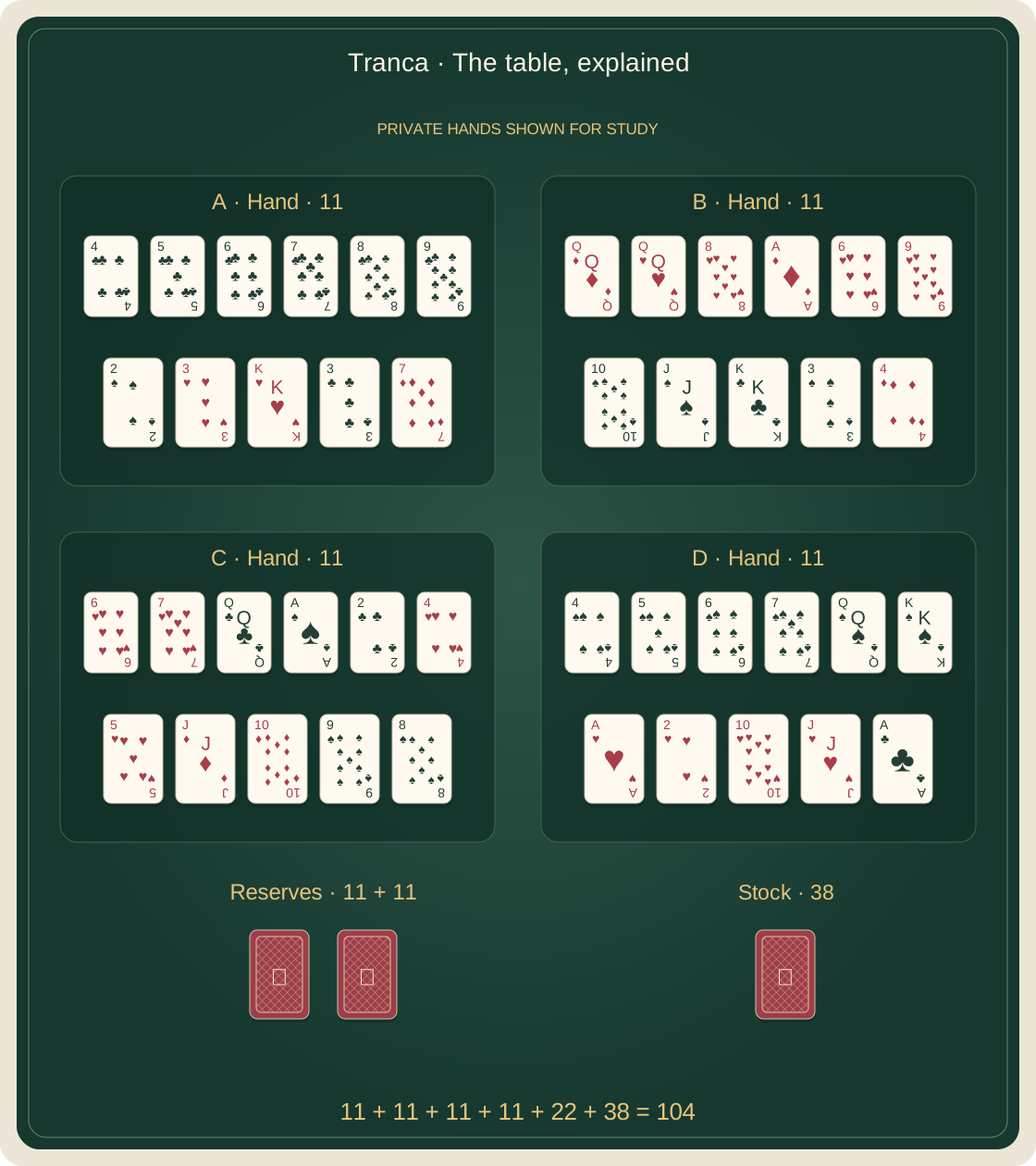
Shuffle 104 cards and cut. Choose dealer and deal clockwise 11 each. Put aside two separate face-down reserves of 11 (mortos), one claim per partnership; they are not personal hands yet. Remaining 38 form stock; no initial discard. Dealer’s left starts. Our physical example therefore has 44 dealt, 22 reserved and 38 stock. At later deals rotate dealer left.
03 /
How play proceeds
On your turn draw one stock card or take the whole discard pile. The latter requires using its top card immediately in your team’s existing meld or a new meld with at least 2 cards from hand. Show this justification before collecting buried cards. Only the top is visible. Then expose or extend your team’s melds and discard one to end the turn, unless a legal empty-hand finish intervenes. You cannot lay off on the opponents.
04 /
Rules that change your decision
Discarding a black three blocks only the next player while it remains on top. Once covered it does not permanently freeze the pile. Expose red threes separately during your turn; they are not meld cards and give no free replacement in this teaching agreement. When a partnership first empties a hand, take one morto. Without discarding you may continue immediately, without another draw; after a final discard wait until your next turn and then take the normal draw. A partnership may never claim both mortos.
05 /
Finish and scoring
After taking the morto a later empty hand ends the deal only if your partnership has a clean canasta. Do not go empty illegally just because a mixed canasta exists. If stock runs out, turn an unclaimed morto into stock as agreed here, then the other if needed; mark it unavailable as a private reserve. If neither stock nor reserve remains when a draw is required, stop and score, without a going-out bonus. Red threes alone do not satisfy a canasta requirement.
06 /
A worked example
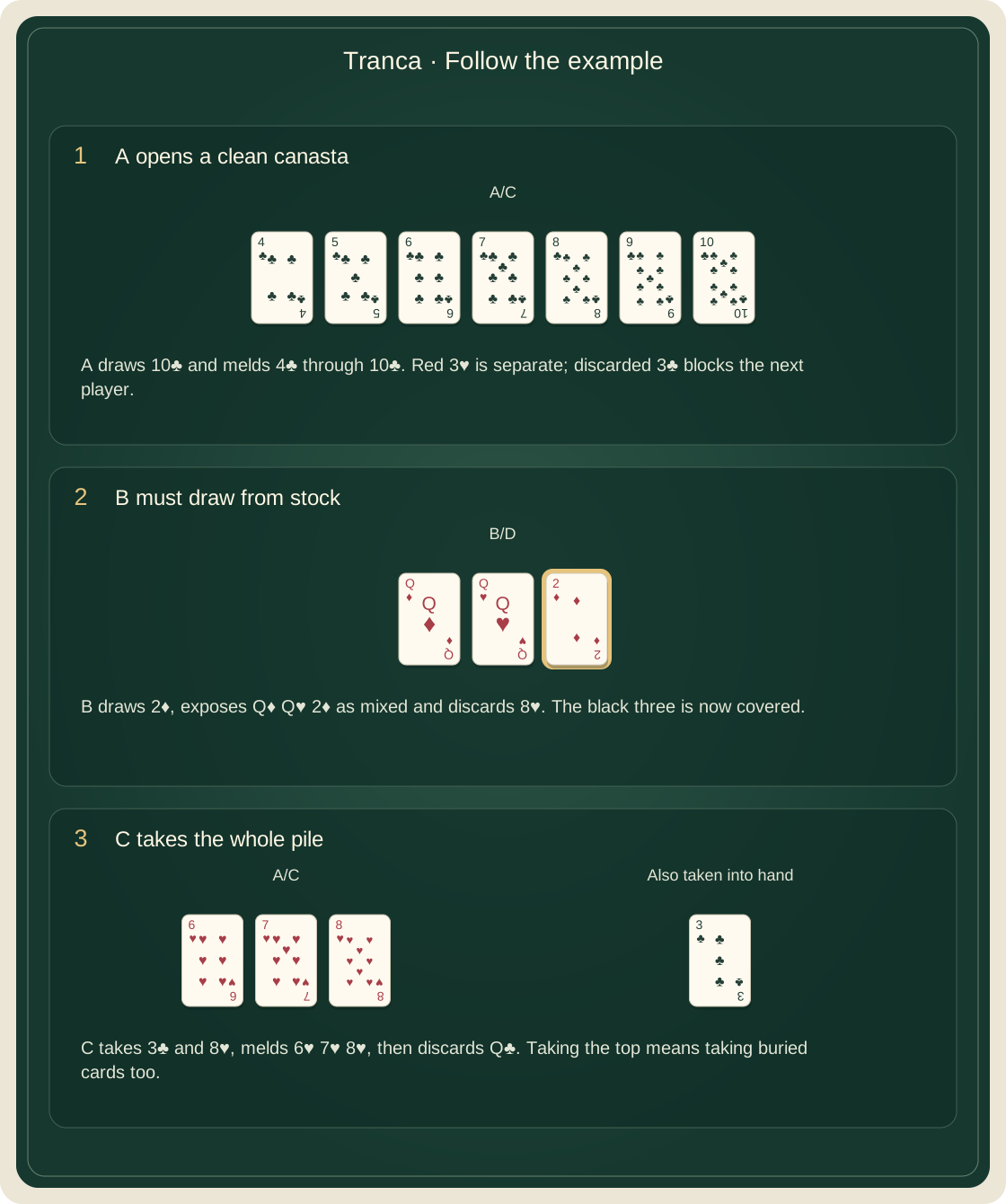
A draws 10♣, lays clean 4♣–10♣, exposes 3♥ and discards 3♣. B cannot take the locked pile: draws 2♦, melds Q♦ Q♥ 2♦ and discards 8♥. C can now take both 3♣ and 8♥, using 8♥ with 6♥ 7♥, then discards Q♣. After these turns A/B/C/D hold 3/8/9/11 cards; stock has 36, reserves 22. A/C have a clean canasta but nobody has taken a morto, so no one has gone out.
| Turn | Draw / take | New meld | Discard |
|---|---|---|---|
| A | 10♣ | 4♣ · 5♣ · 6♣ · 7♣ · 8♣ · 9♣ · 10♣ | 3♣ |
| B | 2♦ | Q♦ · Q♥ · 2♦ | 8♥ |
| C | 3♣ · 8♥ | 6♥ · 7♥ · 8♥ | Q♣ |
← On a small screen, scroll the diagram horizontally. →
07 /
What to watch at the table
At settlement each ordinary meld card adds 10 and every card still in either partner’s hand subtracts 10. Add 200 per clean canasta, 100 per mixed, and 100 for a legal final exit. Exposed red threes score separately: +100 each with any canasta, −100 each without; do not add another ordinary 10 for them. An unclaimed morto costs 100. An indirectly taken morto not yet played when opponents finish still incurs that penalty. A separate example: 20 meld cards, clean 200, mixed 100, red three 100, exit 100, three held cards −30 give 670.
08 /
Choose the rules before starting
Protect a clean canasta instead of inserting a wild merely to reduce your hand. Use a black three to deny an attractive discard at the right time. The selected session lasts 4 deals with cumulative partnership totals; highest wins, shared if tied. Other tables use a target score, allow finishing with a mixed canasta, treat aces differently or set other wildcard limits. Agree these before play rather than mixing their scoring charts.
09 /
History and related games
Tranca is a Brazilian Buraco/Canasta-family game distinguished by its treatment of threes and discard access. Its Portuguese name points to locking the pile. Current operators publish noticeably different profiles, so their rules are evidence of living variation, not one universal code. The consulted sources do not establish an exact inventor or origin year.
10 /
Check your understanding
Does a buried black three still lock the pile?
Show the answer
No. The current top card decides access.
Does one mixed canasta permit the final exit?
Show the answer
No here. Your partnership needs a clean canasta and a taken reserve.
Common questions
How many cards?+
104: two standard packs without jokers.
Is ace low?+
No. In this profile it follows king.
Can both partners take a reserve?+
No. One reserve per partnership.