← On a small screen, scroll the diagram horizontally. →
01 /
The game at a glance
Ace counts 1, courts 10, other cards face value. Books contain 3 or 4 equal ranks; runs contain at least 3 consecutive cards in one suit, ace low. A-2-3 is legal, Q-K-A is not. Only exposed spreads and cards added to them leave your hand total. A perfectly good run still hidden in your hand continues to count.
02 /
Prepare and deal
Choose a dealer by cutting high, shuffle and cut, deal 5 singly clockwise. Turn one starter discard; leave the stock closed. Dealer’s left begins. Agree one unit and the session length first. For this teaching session deal passes left after every hand; this is an explicit rotation agreement. All cards are gathered and shuffled for the next deal.
03 /
How play proceeds
Before any play, an original hand worth 49 or 50 must be shown immediately. A sole claimant receives 2 units from each other player and the hand stops. Multiple claimants make a dead hand with no payments, even if one has 50 and another 49. Later collecting this total has no automatic effect. This profile has no automatic low-hand win.
04 /
Rules that change your decision
At the start of your turn, either drop before drawing, or draw stock top/discard top. After drawing you may expose books and runs and hit your own or others’ exposed spreads. You need not open first to hit. Otherwise end by discarding one. Only the discard top is available; buried discards stay hidden. Going empty while melding/hitting ends immediately without needing a discard.
05 /
Finish and scoring
Emptying without a final discard pays 2 from each opponent; emptying by final discard pays 1. A successful drop requires strictly less than every other hand and pays 1 from each. On a caught drop, caller pays 2 to everyone tied with or below them; each lowest noncaller additionally receives 1 from every other noncaller. Caller does not pay a further ordinary unit. Stock exhaustion is different: continue taking top discards until someone wants empty stock, then stop and pay the lowest 1 each. For a stock-end tie our agreement is no payments and redeal.
06 /
A worked example
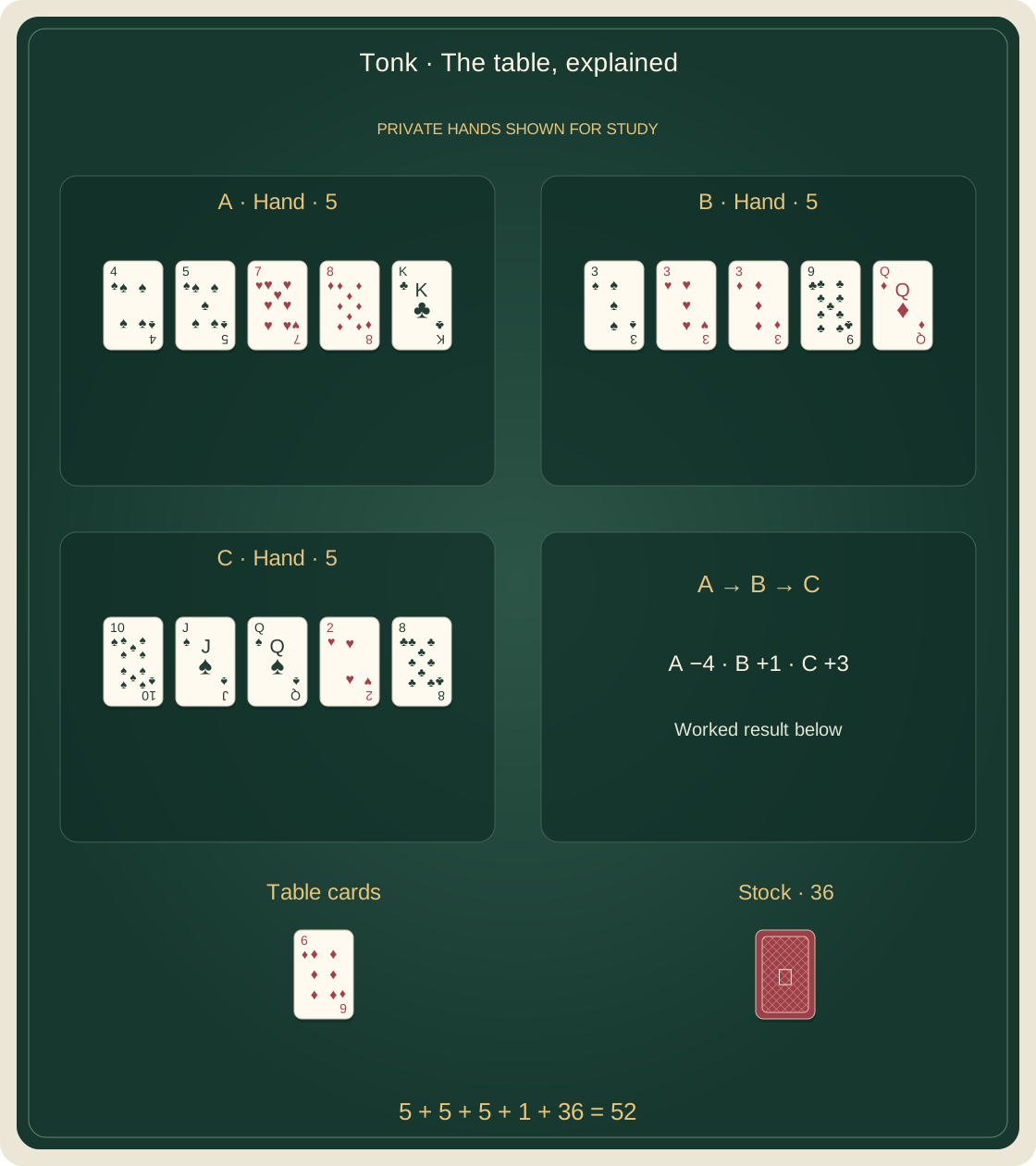
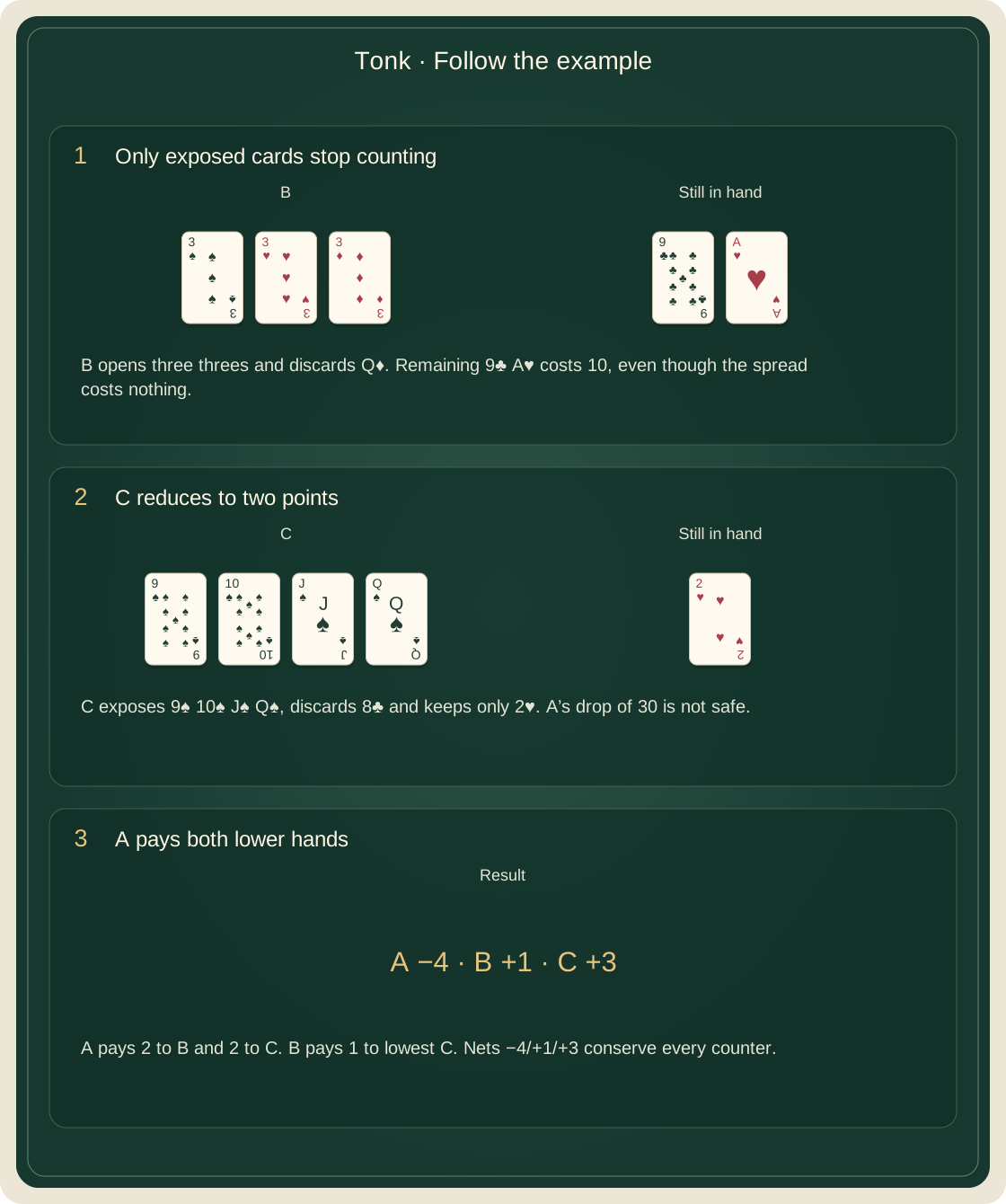
A draws 6♣ and discards K♣. B draws A♥, exposes three threes and discards Q♦, keeping 9♣ A♥ = 10. C draws 9♠, exposes 9♠-10♠-J♠-Q♠ and discards 8♣, keeping 2♥ = 2. A drops with 4♠ 5♠ 6♣ 7♥ 8♦ = 30. Both opponents catch A: A pays 2 to B and 2 to C; B also pays 1 to minimum C. Nets A/B/C are −4/+1/+3, totalling zero.
| From | To | Units |
|---|---|---|
| A | B | 2 |
| A | C | 2 |
| B | C | 1 |
← On a small screen, scroll the diagram horizontally. →
07 /
What to watch at the table
Watch the size of exposed opponents’ hands before dropping: a small total is not automatically lowest. You may hit any exposed spread but may not rearrange it into another spread. Distinguish a hidden run from an exposed run when counting points. Agree the exact payment schedule first; the game has no universal tournament settlement.
08 /
Choose the rules before starting
Waiting after melding or being hit, automatic low totals, different 49/50 priorities, 40-card packs and alternative catch payments are separate variants. None applies in the basic profile here. At a tied initial tonk no one is charged; at a failed drop caller loses ties. Those are different situations. End the session at the agreed deal count and compare net counters.
09 /
History and related games
Tonk is documented in American jazz circles of the twentieth century, including accounts connected to Duke Ellington’s musicians. A Philippine origin has been proposed, but similarity to Tongits does not establish that claim. The consulted contributor account records many local versions rather than one inventor’s definitive rules.
10 /
Check your understanding
Does a hidden run reduce your total?
Show the answer
No. Every card still held counts.
Does a later total of 50 win automatically?
Show the answer
No. The special claim applies only to the initial hand.
Common questions
Are there wild cards?+
No, not in this basic profile.
May you drop after drawing?+
No. Drop is chosen at the start before drawing.
Does a tied drop win?+
No. Caller is caught by an equal count.