← On a small screen, scroll the diagram horizontally. →
01 /
The game at a glance
A set is 3 or 4 equal ranks; a run is at least 3 consecutive cards of one suit. A-2-3 is valid; Q-K-A is not. A card belongs to only one combination. Ace costs 1, courts 10, numbers their face value. At a comparison, valid concealed combinations are excluded from unmatched points. This differs from Tonk, where cards still held count until exposed.
02 /
Prepare and deal
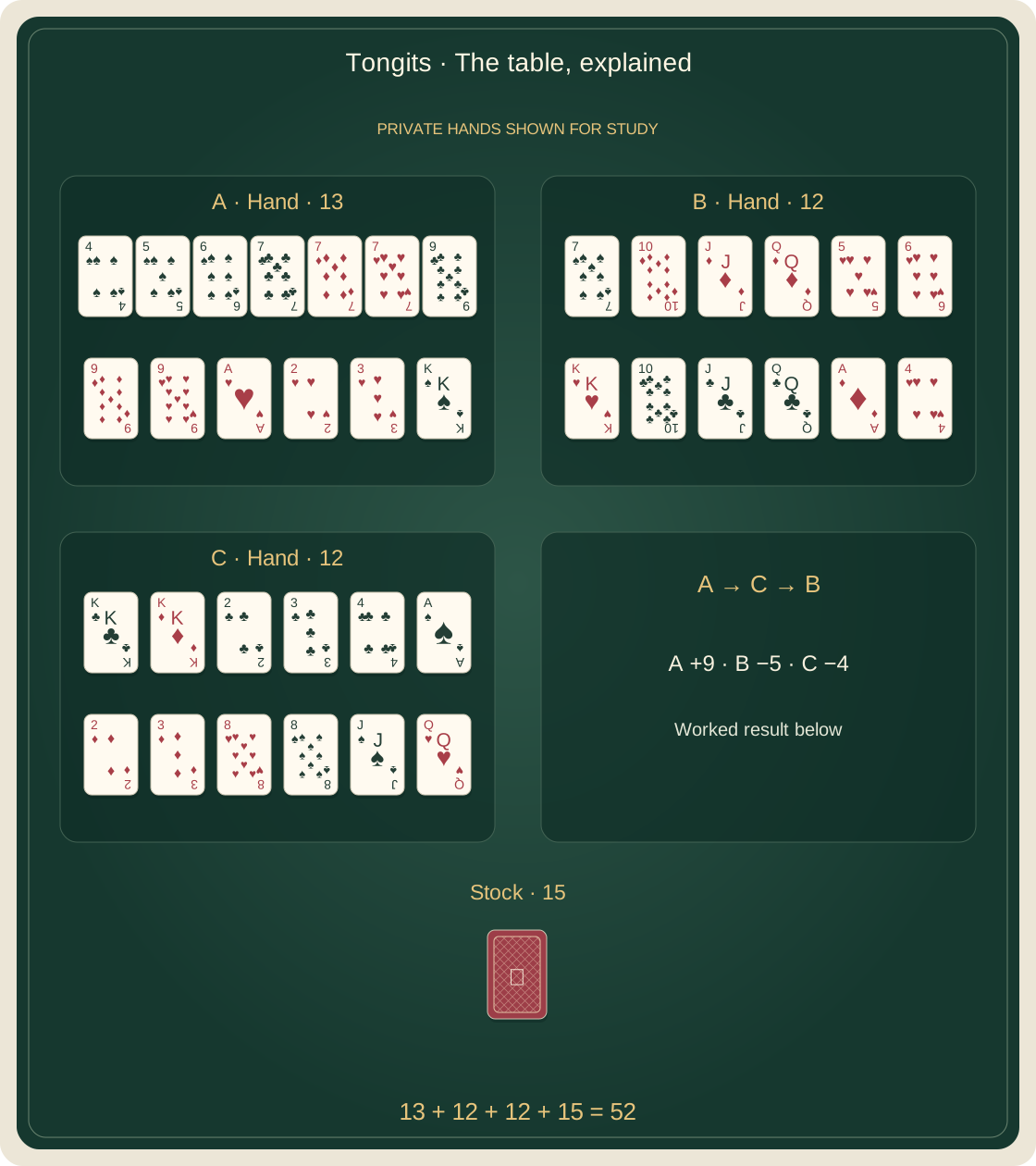
Choose the first dealer randomly; later the previous winner deals. Shuffle and cut. Deal singly counterclockwise starting with dealer: 13, 12, 12; stock has 15 and no initial discard. Dealer does not draw on the first turn: optionally expose melds, then discard one. That starts the pile and passes play to the right. Before each deal everyone puts 2 chips in the separate side pot.
03 /
How play proceeds
Later turns begin by drawing stock top or taking discard top. A discard may be taken only to expose a new meld using at least 2 cards already in hand; taking it merely to extend a table meld is forbidden. After a stock draw, exposing melds is optional. Opening means placing at least one of your own melds on the table. An undrawn natural four-of-a-kind may be exposed face down, preserving its secret-set bonus while opening.
04 /
Rules that change your decision
After drawing you may lay off any number of cards on your own or others’ exposed melds, even before opening. This sapaw does not itself open your hand. Finish with one discard unless you declare Tongit by using all cards in melds/layoffs, with or without a final discard. Draw is a different claim, made before drawing: you must already be open. You cannot call it on the next turn after someone has extended your meld since your last turn, or after extending your own meld on that last turn. Being blocked from Draw does not block Tongit.
05 /
Finish and scoring
On Draw, the other players in play order fold or challenge; only open hands may challenge. Caller wins if both fold. Otherwise compare minimum unmatched points: challenger beats caller on a tie, and the challenger to caller’s right wins a challenger tie. If stock ends, finish the last drawer’s turn and stop without recycling. Unopened hands are burned. Among open hands lowest wins; a tied last drawer has priority, otherwise the next player to their right. If all are burned, our table agreement is no hand payments and redeal, carrying the side pot.
06 /
A worked example
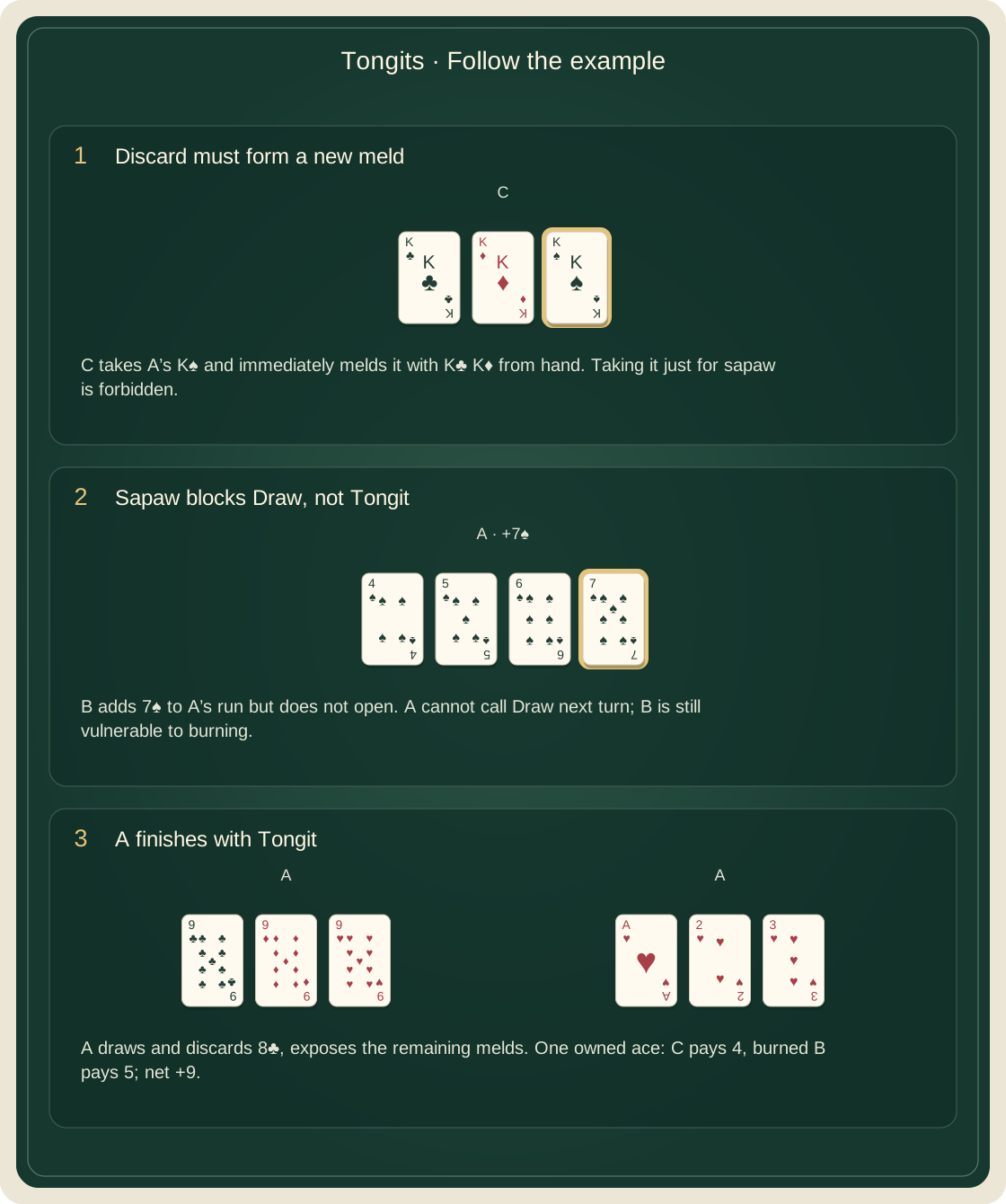
A opens 4♠-5♠-6♠ and three sevens, discarding K♠. C takes K♠ with K♣ K♦ and opens a club run, then discards Q♥. B draws A♣, adds 7♠ to A’s run and discards K♥ without opening. A cannot call Draw now, but draws 8♣, exposes three nines and A♥-2♥-3♥, discards 8♣ and declares Tongit. A owns one ace and no secret quartet: C pays 4, burned B pays 5. A gains 9 before side-pot accounting.
| From | To | Units |
|---|---|---|
| B | A | 5 |
| C | A | 4 |
← On a small screen, scroll the diagram horizontally. →
07 /
What to watch at the table
For each loser, pay the winner base 1, or base 3 for Tongit or a challenged Draw; add 1 for each qualifying ace of the winner, 3 for each secret quartet, and 1 if that loser is burned. Count only winner-owned aces still held or in their own original melds; aces laid off onto anyone’s meld do not qualify. The side pot is won only by two consecutive hand wins by the same player. It carries across other results. Agree a session length; chip balance decides a session winner.
08 /
Choose the rules before starting
Opening protects you from burning but gives opponents a target for sapaw. Concealing a useful run reduces unmatched points without opening. Do not confuse these effects. Other tables reduce bonuses to 2, add long-run bonuses or use different Draw restrictions. No such extra bonuses apply here. Keep the stock end distinct from Tonk: Tongits stops after the last stock card’s turn, rather than continuing with discards.
09 /
History and related games
Tongits is associated with the Philippines, particularly the north, and is documented as a late-twentieth-century rummy tradition. Its name and mechanisms suggest a relationship to American Tonk. That is evidence of kinship, not proof of a named inventor or exact date. Local and online versions have since developed different bonuses and timing rules.
10 /
Check your understanding
Does sapaw alone open your hand?
Show the answer
No. You must expose your own meld.
May a discard be taken only for a layoff?
Show the answer
No. It must create a new meld with at least 2 cards from hand.
Common questions
How many players?+
Exactly 3 in this profile.
Is an ace high?+
No. It is low and worth 1.
Does the stock get recycled?+
No. Finish the last drawer’s turn, then compare open hands.