← On a small screen, scroll the diagram horizontally. →
01 /
The game at a glance
A group contains at least 3 equal ranks; identical copies may belong to the same group. A run has at least 3 consecutive cards of one suit. A-2-3 is valid, Q-K-A is not. Groups may be longer, but one physical card cannot serve in two combinations. Lowest cumulative penalty wins.
02 /
Prepare and deal
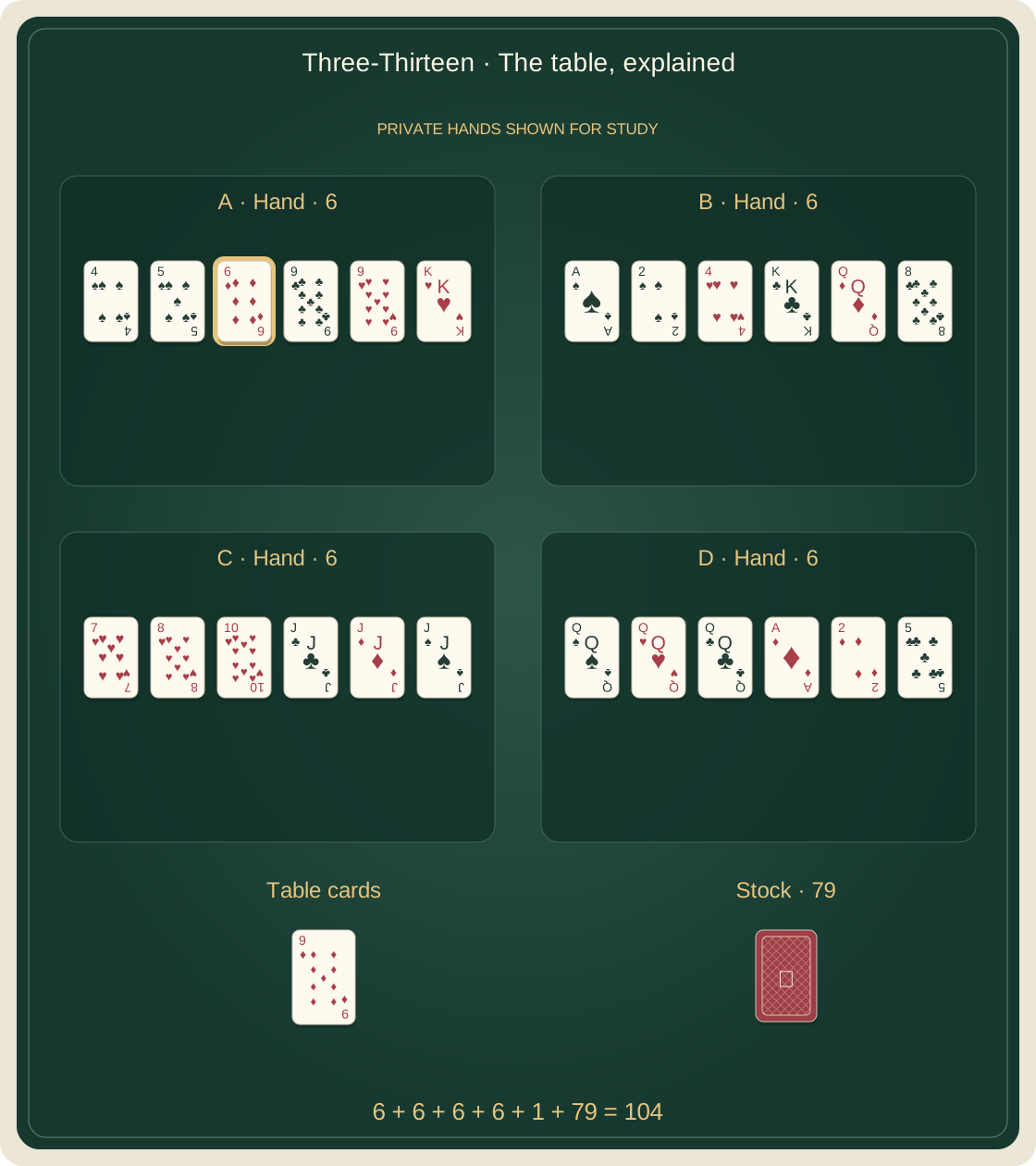
Choose dealer randomly, combine and shuffle the packs, cut. Round 1 deals 3 each, adding one each round until round 11 deals 13. Deal clockwise; left of dealer starts. Expose one discard and leave remaining stock closed. Dealer moves left each round. Before dealing announce the hand size and wild rank.
| Round | Cards per hand | Wild rank |
|---|---|---|
| 1 | 3 | 3 |
| 2 | 4 | 4 |
| 3 | 5 | 5 |
| 4 | 6 | 6 |
| 5 | 7 | 7 |
| 6 | 8 | 8 |
| 7 | 9 | 9 |
| 8 | 10 | 10 |
| 9 | 11 | J |
| 10 | 12 | Q |
| 11 | 13 | K |
03 /
How play proceeds
Draw one stock card or the top discard, then discard one face up. Only the discard top is accessible. Keep combinations private until going out or final scoring. There is no required opening contract, purchase of buried discards or laying cards on opponents’ combinations. Each player solves their own hand.
04 /
Rules that change your decision
The wild rank equals hand size: 3 through 10, then J, Q, K. A wild may replace any rank and suit, and an all-wild group is legal. It may also represent its natural card. A valid run still cannot repeat a position just because the packs contain duplicates. Declare what each wild represents when showing a combination.
05 /
Finish and scoring
After drawing, go out only if every card except the final discard fits disjoint combinations. Discard and announce out. Each other player gets one final turn, then shows their best own-hand arrangement. Outgoing player scores 0, but others may also reach 0. There is no extra winner bonus or penalty just for being last.
06 /
A worked example
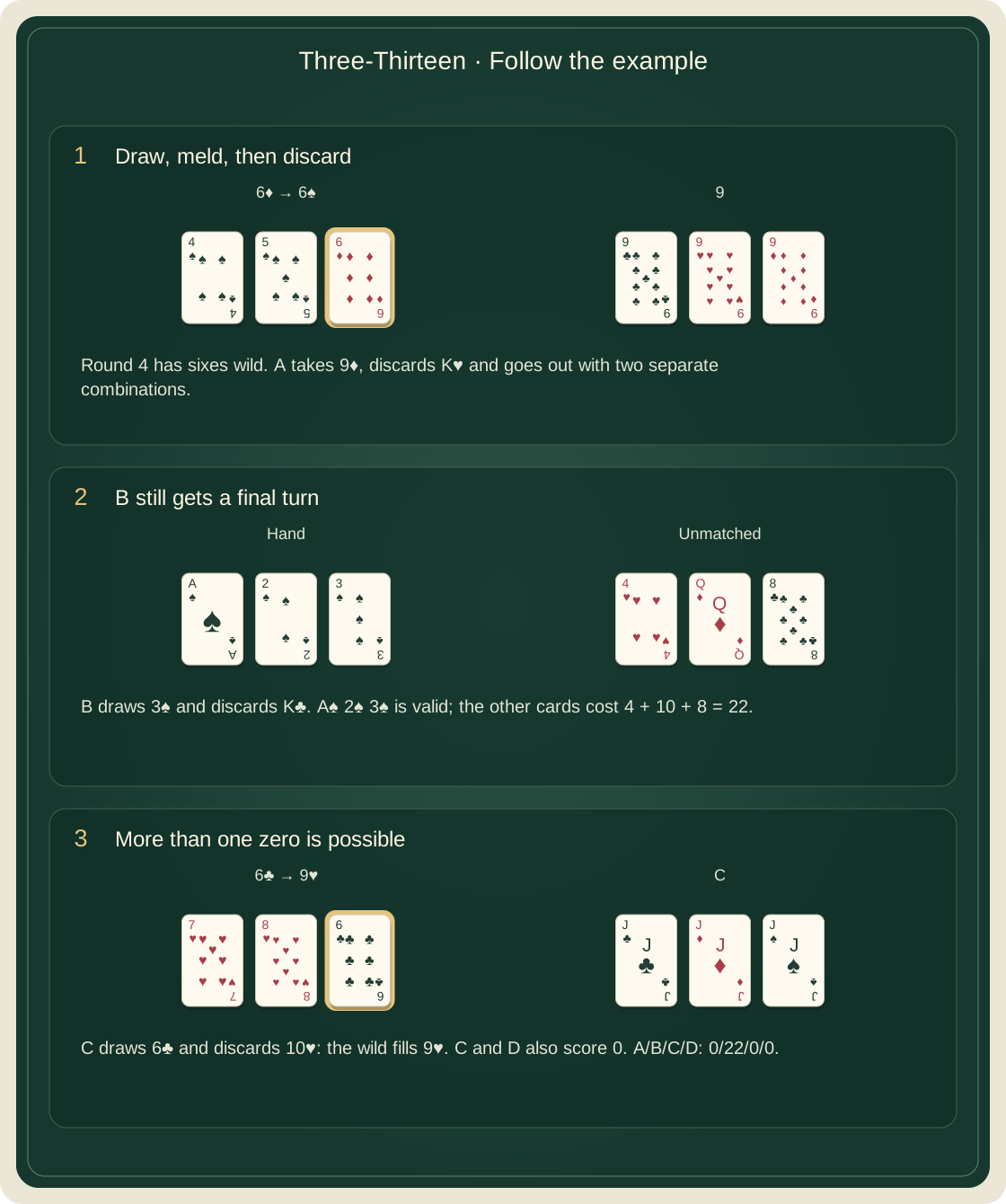
Round 4 has 6-card hands and sixes wild. A takes 9♦ and discards K♥: 4♠ 5♠ 6♦ forms a run, and 9♣ 9♥ 9♦ a group, so A goes out. B’s final draw 3♠ makes A♠ 2♠ 3♠ but leaves 4♥ Q♦ 8♣ = 22. C and D both complete their hands on final turns. Scores A/B/C/D: 0/22/0/0.
| Player | Disjoint melds | Unmatched | Penalty |
|---|---|---|---|
| A | 4♠ · 5♠ · 6♦ / 9♣ · 9♥ · 9♦ | — | 0 |
| B | A♠ · 2♠ · 3♠ | 4♥ · Q♦ · 8♣ | 22 |
| C | 7♥ · 8♥ · 6♣ / J♣ · J♦ · J♠ | — | 0 |
| D | Q♠ · Q♥ · Q♣ / A♦ · 2♦ · 3♦ | — | 0 |
← On a small screen, scroll the diagram horizontally. →
07 /
What to watch at the table
Unmatched A costs 1, numerals face value, J/Q/K 10. Wilds used in combinations cost nothing; an unmatched wild retains its printed penalty in this no-joker profile. Minimise deadwood using disjoint combinations, not the first arrangement you notice. Add each round’s penalties; after all 11 rounds lowest total wins, shared if tied by our declared match agreement.
08 /
Choose the rules before starting
Our stock agreement reshuffles covered discards, preserving the visible top. If no covered cards remain and a player cannot draw, end the round and score current hands. Other groups allow high aces, court penalties 11/12/13 or printed jokers; they change the game and are excluded. No early table melds or laying off on another player.
09 /
History and related games
Three-Thirteen is an ordinary-pack rummy tradition documented through contributed household rules, not a single universal tournament code. Commercial relatives use special packs, but this lesson does not require them. The consulted description supplies no verified inventor or precise origin date; the changing hand size explains the name.
10 /
Check your understanding
Can one physical card complete two combinations?
Show the answer
No. Every card can be assigned only once.
Can you lay off on the outgoing player?
Show the answer
No. Score only your own hand.
Common questions
Are all-wild groups allowed?+
Yes, with at least three cards.
Does Q-K-A form a run?+
Not in this ace-low profile.
Does first out automatically win the match?+
No. Lowest cumulative penalty after all rounds wins.