← On a small screen, scroll the diagram horizontally. →
01 /
The game at a glance
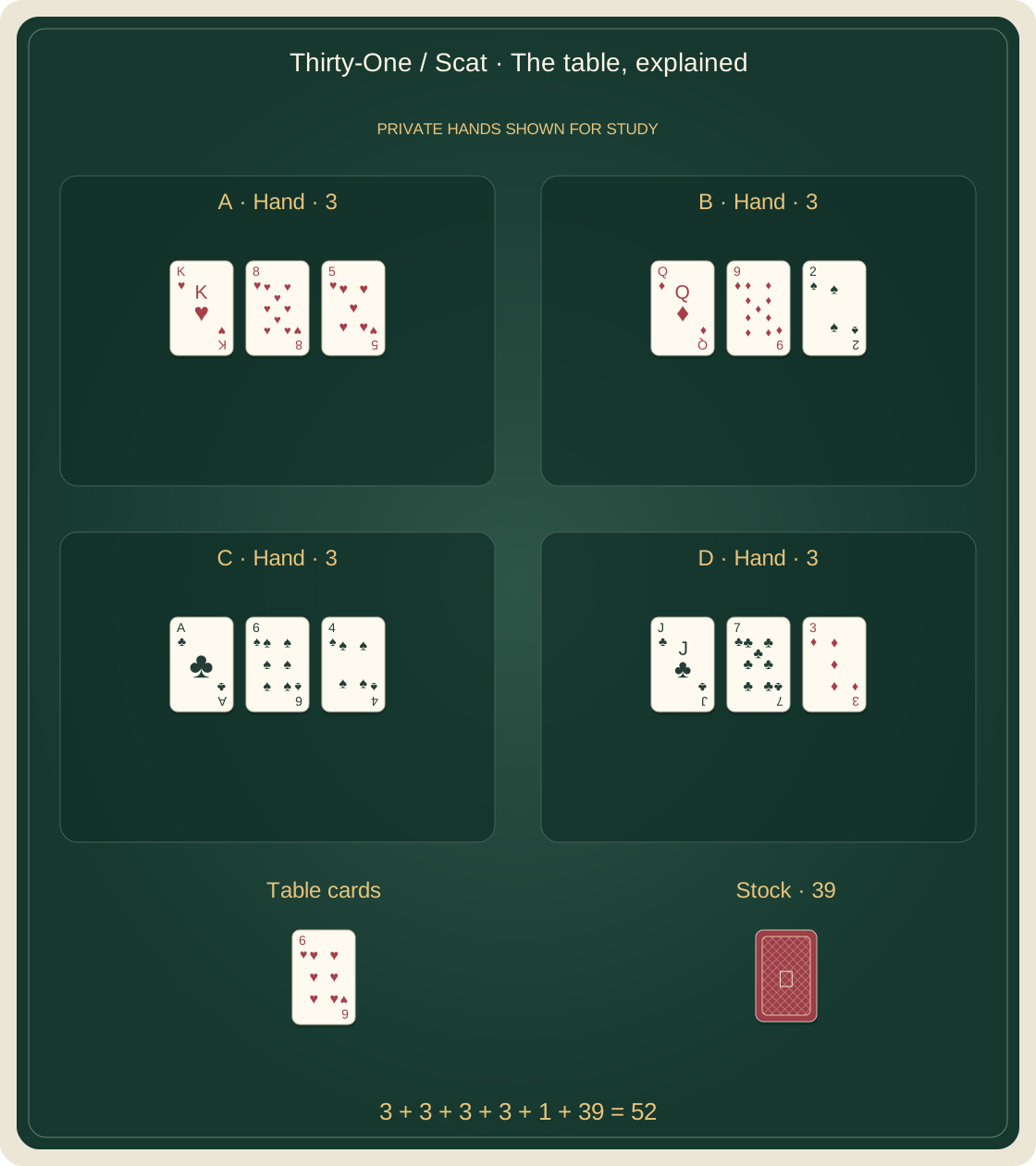
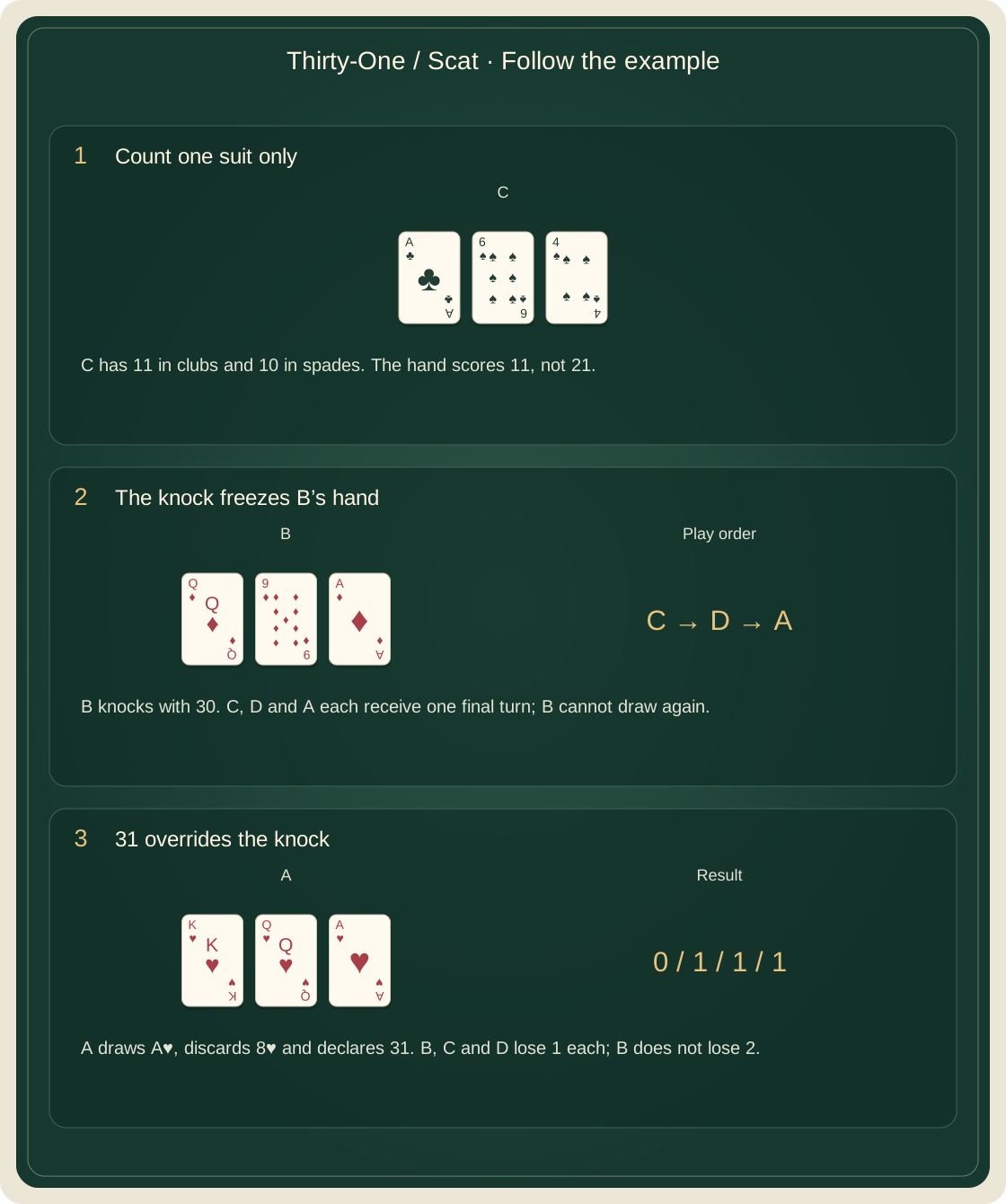
A is 11; K, Q and J are 10; numbers keep pip value. Add each suit separately and take the highest subtotal. A♣ 6♠ 4♠ scores 11, not 21; K♥ 8♥ 5♥ scores 23. Maximum 31 is an ace and two ten-value cards of one suit.
02 /
Prepare and deal
Use 52 without jokers. Choose dealer, shuffle and cut. Deal 3 each one at a time clockwise. Turn 1 starter discard; all remaining cards form stock. Dealer’s left begins; deal rotates left each hand. Give everyone 3 scoring counters, separate from the playing cards.
03 /
How play proceeds
Draw the stock top unseen or the discard top, then discard one face up, keeping 3. Only the discard top is available. If you take a discard you must retain it, not immediately return it. A stock card may be discarded immediately. Keep buried discards concealed.
04 /
Rules that change your decision
At the start of your turn you may knock instead of drawing. Freeze your hand; every other player gets exactly one final draw/discard turn. Lowest total loses 1 life; tied non-knockers all lose 1. A knocker tied for lowest is safe; a knocker alone lowest loses 2. In heads-up, the final responder may take back their own earlier discard still on top.
05 /
Finish and scoring
Declare 31 immediately on the original deal or after drawing and discarding: every other player loses 1, even the knocker. Multiple initial 31 hands are all safe. An undeclared 31 cannot be claimed later and counts as 30. If stock empties, continue only while players want the top discard; a refusal ends the hand for ordinary scoring, without reshuffling.
06 /
A worked example
A improves hearts from 23 to 24, then 28. B builds diamonds to 30 and knocks. C’s final turn reaches 25 spades; D draws and discards the same stock card, keeping 27 clubs. A takes A♥, discards 8♥ and declares K♥ Q♥ A♥ = 31. B, C and D each lose 1: B does not lose 2 just for having knocked.
| Turn | Taken | Discarded | Hand total |
|---|---|---|---|
| 1 · A | 6♥ | 5♥ | 24 |
| 2 · B | A♦ | 2♠ | 30 |
| 3 · C | 9♠ | A♣ | 19 |
| 4 · D | K♣ | 3♦ | 27 |
| 5 · A | Q♥ | 6♥ | 28 |
| 6 · B | Knock | — | 30 |
| 7 · C | 10♠ | 4♠ | 25 |
| 8 · D | 7♠ | 7♠ | 27 |
| 9 · A | A♥ | 8♥ | 31 |
| — | A | B | C | D |
|---|---|---|---|---|
| Final total | 31 | 30 | 25 | 27 |
| Lives lost | 0 | 1 | 1 | 1 |
← On a small screen, scroll the diagram horizontally. →
07 /
What to watch at the table
Pay a counter for each lost life. Losing your last counter leaves you floating: you stay in until the next loss. Losing two lives with only one counter eliminates you immediately. Gather all cards and redeal among survivors. Last non-eliminated player wins. Use score counters rather than money.
08 /
Choose the rules before starting
Watch which suit opponents collect before knocking. A safe-looking total may still be overtaken. Some tables give three equal ranks 30½ or change knock ties, life counts and recycling; none applies here. If simultaneous floating players tie when stock ends and all would be eliminated, replay that hand by the documented tie-resolution convention.
09 /
History and related games
This draw-and-discard tradition is documented through players in the USA and UK under names Scat, Blitz and Cadillac. Similar names cover different games, so the mechanism matters more than the title. The consulted accounts do not establish a precise inventor or a single starting date.
10 /
Check your understanding
Can you immediately return a taken discard?
Show the answer
No. A drawn stock card may be returned, a taken discard may not.
Does a knocker tied for lowest lose?
Show the answer
No in this selected profile; the other tied players lose.
Common questions
Do all suits add together?+
No. Use the highest single-suit subtotal.
When can I knock?+
At the start of your turn instead of drawing.
Are zero counters immediate elimination?+
No. You float until another loss.