← On a small screen, scroll the diagram horizontally. →
01 /
The game at a glance
Play with 2 individuals or 4 in fixed opposite pairs; 3 individuals are possible with a shorter final deal. Use 52 cards without jokers. For captures numbers keep their value, J is 12, Q 13, K 14, A either 1 or 11. Jack is not a wild table-clearer. Suits matter only for the scoring bonuses on 10♦ and 2♣.
02 /
Prepare and deal
Before drawing for dealer agree high card wins the draw, ace 11. Dealer shuffles; left neighbour cuts and exposes 4 cards from the lifted section for the table, then shows the lifted section’s new bottom, which becomes the deck’s bottom. Complete the cut. Deal 6 each in packets of 3 counterclockwise. A tap instead of a cut uses 4 top cards after hands are dealt. No opening jack is removed.
03 /
How play proceeds
Dealer’s right starts, counterclockwise. Play one hand card: capture any table card or group equal to its chosen value, keeping played and captured cards in your pile. You may take several disjoint groups with the same target. Never use a table card twice. You may decline a possible capture and leave your card loose. There is no building or stock draw after an individual turn.
04 /
Rules that change your decision
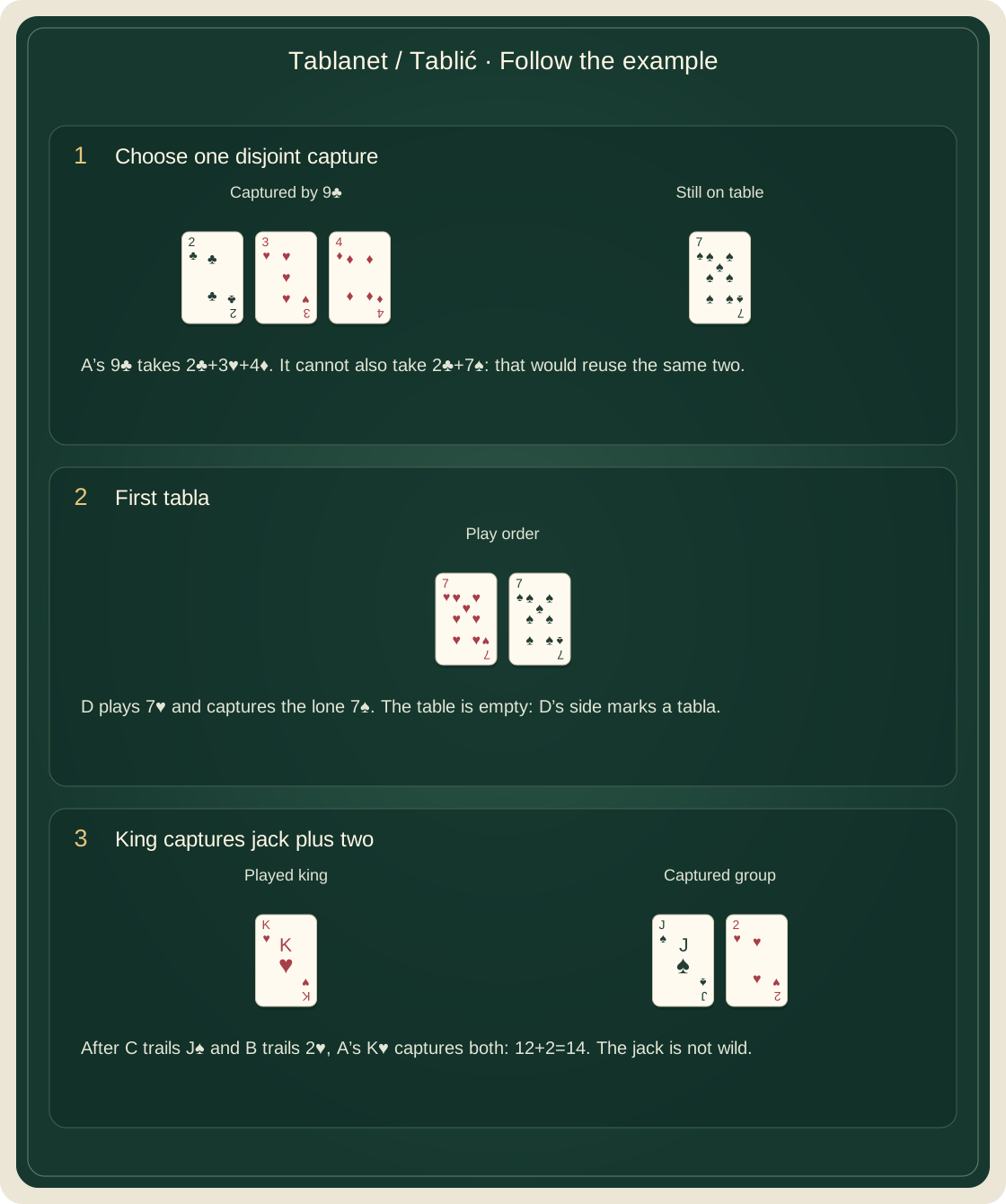
Clear the entire table in one capture to mark a tabla worth 1. Matching a single rank has no priority over sums. An ace’s 1 or 11 is a capture value, not a change to its scoring point. If a 9 can take 2+3+4 or 2+7, choose: those alternatives overlap and cannot be combined. A king may take J+2 because 12+2=14.
05 /
Finish and scoring
When all hands empty, the same dealer deals 6 more each without adding table cards. Two players have 4 batches; four players have 2. Three players finish with 4 each: 4+18+18+12=52. After the last play, dealer’s side receives every loose card, without a tabla. Dealer cannot score a tabla with that final card even if its capture clears the layout. Deal then passes right.
06 /
A worked example
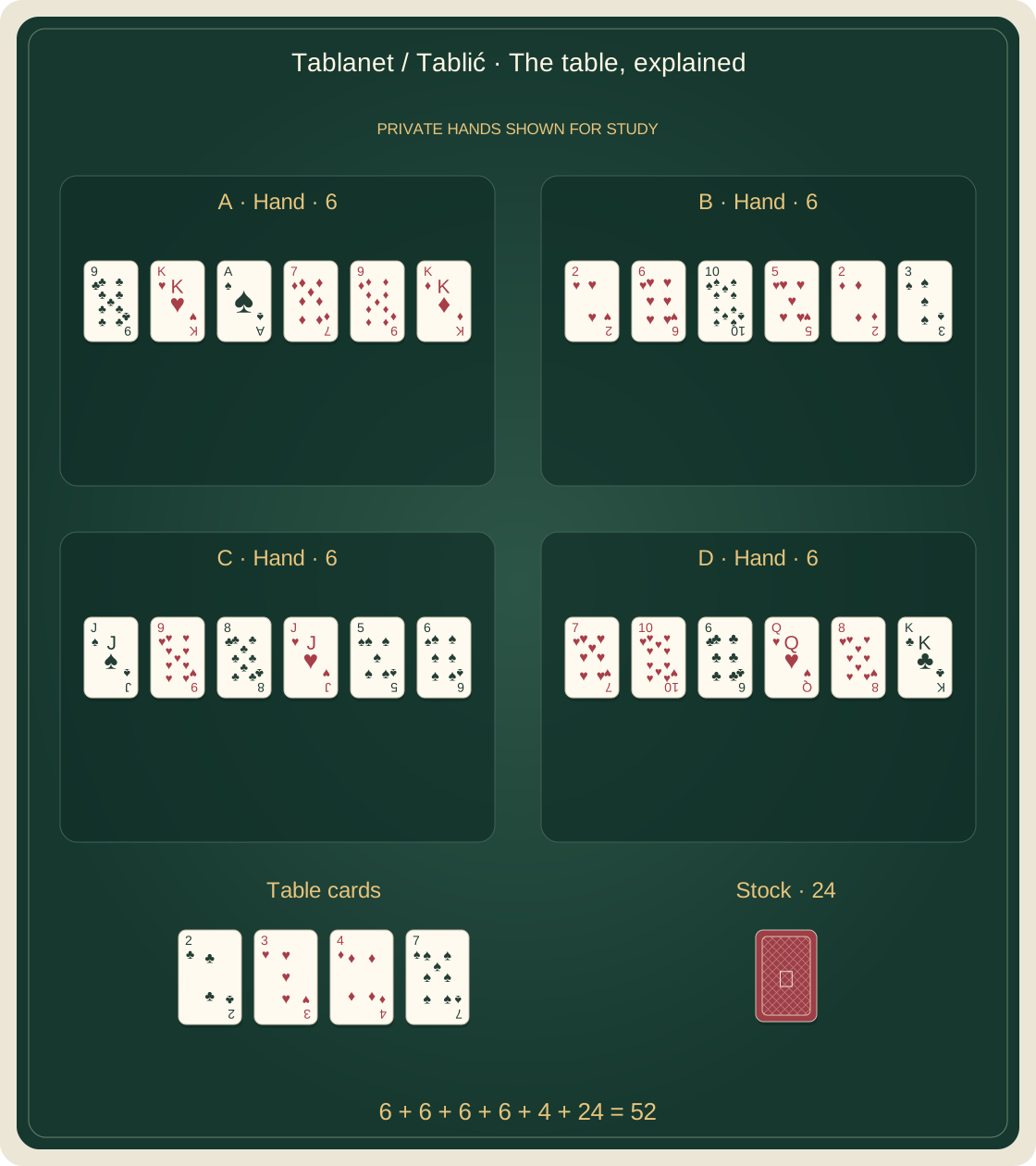
Four-player setup: loose 2♣, 3♥, 4♦, 7♠. A’s 9♣ takes 2+3+4, leaving 7♠. D plays 7♥ and clears it for a tabla. C trails J♠; B trails 2♥. A’s K♥ captures both, since 12+2=14, earning another tabla. In the complete record A/C finish with 27 cards and B/D 25. Both hold 11 card points; tablas 6 and 1 produce final scores 20 and 12.
Open the complete deal record
| # | Played | Captured groups | Table after play |
|---|---|---|---|
| 1 | A: 9♣ | (2♣ · 3♥ · 4♦) | 7♠ |
| 2 | D: 7♥ | (7♠) | |
| 3 | C: J♠ | — | J♠ |
| 4 | B: 2♥ | — | J♠ · 2♥ |
| 5 | A: K♥ | (J♠ · 2♥) | |
| 6 | D: 10♥ | — | 10♥ |
| 7 | C: 9♥ | — | 10♥ · 9♥ |
| 8 | B: 10♠ | (10♥) | 9♥ |
| 9 | A: 9♦ | (9♥) | |
| 10 | D: 6♣ | — | 6♣ |
| 11 | C: 6♠ | (6♣) | |
| 12 | B: 6♥ | — | 6♥ |
| 13 | A: A♠ | — | 6♥ · A♠ |
| 14 | D: Q♥ | — | 6♥ · A♠ · Q♥ |
| 15 | C: 8♣ | — | 6♥ · A♠ · Q♥ · 8♣ |
| 16 | B: 5♥ | — | 6♥ · A♠ · Q♥ · 8♣ · 5♥ |
| 17 | A: 7♦ | (6♥ · A♠) | Q♥ · 8♣ · 5♥ |
| 18 | D: 8♥ | (8♣) | Q♥ · 5♥ |
| 19 | C: 5♠ | (5♥) | Q♥ |
| 20 | B: 2♦ | — | Q♥ · 2♦ |
| 21 | A: K♦ | — | Q♥ · 2♦ · K♦ |
| 22 | D: K♣ | (K♦) | Q♥ · 2♦ |
| 23 | C: J♥ | — | Q♥ · 2♦ · J♥ |
| 24 | B: 3♠ | — | Q♥ · 2♦ · J♥ · 3♠ |
| 25 | Refill hands | A: Q♣ · 5♣ · 4♠ · Q♦ · 10♣ · 9♠; B: A♣ · J♣ · 2♠ · 4♥ · 7♣ · 3♦; C: 8♦ · 6♦ · A♥ · J♦ · 3♣ · A♦; D: K♠ · 5♦ · 8♠ · Q♠ · 4♣ · 10♦ | — |
| 26 | A: Q♣ | (Q♥) | 2♦ · J♥ · 3♠ |
| 27 | D: K♠ | (2♦ · J♥) | 3♠ |
| 28 | C: 3♣ | (3♠) | |
| 29 | B: A♣ | — | A♣ |
| 30 | A: 5♣ | — | A♣ · 5♣ |
| 31 | D: 5♦ | (5♣) | A♣ |
| 32 | C: A♥ | (A♣) | |
| 33 | B: J♣ | — | J♣ |
| 34 | A: 4♠ | — | J♣ · 4♠ |
| 35 | D: 4♣ | (4♠) | J♣ |
| 36 | C: J♦ | (J♣) | |
| 37 | B: 2♠ | — | 2♠ |
| 38 | A: Q♦ | — | 2♠ · Q♦ |
| 39 | D: Q♠ | (Q♦) | 2♠ |
| 40 | C: 8♦ | — | 2♠ · 8♦ |
| 41 | B: 4♥ | — | 2♠ · 8♦ · 4♥ |
| 42 | A: 10♣ | (2♠ · 8♦) | 4♥ |
| 43 | D: 8♠ | — | 4♥ · 8♠ |
| 44 | C: 6♦ | — | 4♥ · 8♠ · 6♦ |
| 45 | B: 7♣ | — | 4♥ · 8♠ · 6♦ · 7♣ |
| 46 | A: 9♠ | — | 4♥ · 8♠ · 6♦ · 7♣ · 9♠ |
| 47 | D: 10♦ | (4♥ · 6♦) | 8♠ · 7♣ · 9♠ |
| 48 | C: A♦ | — | 8♠ · 7♣ · 9♠ · A♦ |
| 49 | B: 3♦ | — | 8♠ · 7♣ · 9♠ · A♦ · 3♦ |
Final loose cards go to dealer B’s team: 8♠ · 7♣ · 9♠ · A♦ · 3♦
← On a small screen, scroll the diagram horizontally. →
07 /
What to watch at the table
Each captured A, K, Q or J gives 1 point. Each ordinary ten gives 1, but 10♦ gives 2 total; 2♣ gives 1. Card majority adds 3; tied counts give neither side that bonus. Thus 22 card points plus majority 3 make 25 before tablas, or only 22 when counts tie. Add tablas and cumulative scores. Our selected end-of-deal match ends at 101 or more, higher score winning; tied leaders play another deal.
08 /
Choose the rules before starting
Check all non-overlapping sums before playing, including combinations with pictures. Sometimes trailing rather than capturing protects a partner’s later sweep. Keep tabla marks as they occur and captured piles neat for the count. A large number on a card is not its point value: K captures as 14 but scores only 1. Final unplayed table residue is awarded, not a newly earned sweep.
09 /
History and related games
Tablanet and Tablanette are names associated with the Balkan Tablić family; Romanian Tabinet is closely related. Contributor accounts and modern operators differ on final residue and on claiming victory mid-deal. This guide selects dealer’s collection and no early claim. It does not assert one national rulebook, a verified inventor or a precise origin date, and does not add the wild-jack rule from other fishing games.
10 /
Check your understanding
Can a jack clear any table?
Show the answer
No. It captures by value 12 in this profile.
Can the same two appear in both 2+3+4 and 2+7 in one capture?
Show the answer
No. Captured groups must be disjoint.
Common questions
Is capturing compulsory?+
No. A legal capture may be declined.
Who receives leftover table cards?+
Dealer’s side in this selected profile; other tables use the last capturer.
Can I claim victory during play?+
Not in the selected end-of-deal version. Finish and count the whole deal.