← On a small screen, scroll the diagram horizontally. →
01 /
The game at a glance
Finish with more captured cards than anybody else. No rank has a special point value: each card counts once at the end. A bundle can change owners repeatedly, so its current size is not a permanent score. Suits do not affect matching.
02 /
Prepare and deal
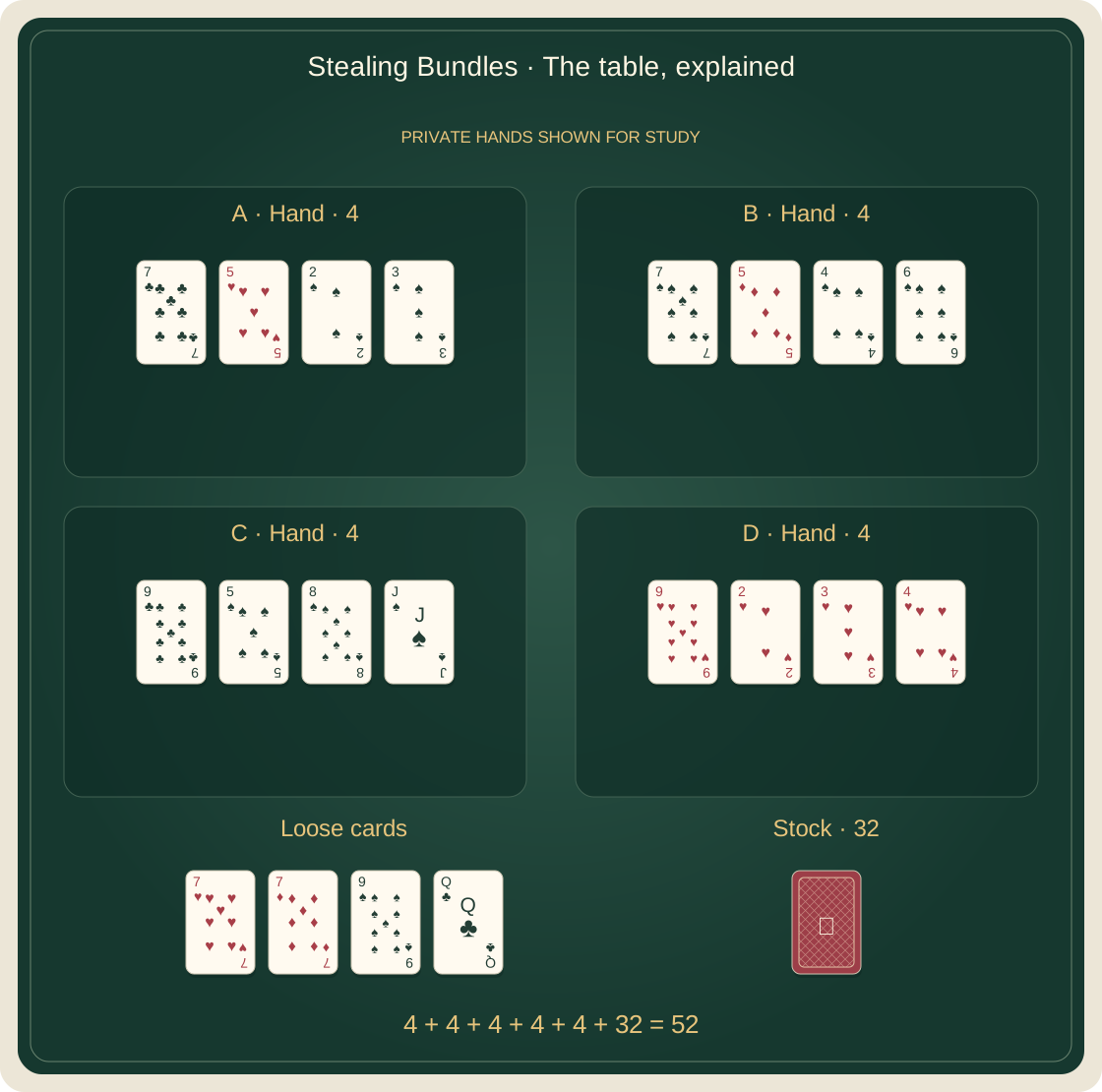
Use 52 cards without jokers. Choose dealer by a high-card draw, repeating tied draws. Deal 4 to each player clockwise and 4 face up separately on the table. Keep the rest closed. Dealer’s left plays first. Each player starts with no bundle; leave room to see the loose cards and every bundle top.
03 /
How play proceeds
Play exactly one card from hand. If it matches loose table ranks, capture all of those matched loose cards with the played card on top of your bundle. If it matches an opponent’s bundle top, you may instead take that whole bundle onto yours and put the played card on top. If no match is available, leave your card loose on the table.
04 /
Rules that change your decision
In this guide a matching action is compulsory: do not trail a card that can capture. If both loose cards and bundles match, choose one action as stated above; if multiple bundles match, choose one. Never combine card values to make a sum. Previously captured cards below a bundle top cannot be targeted directly.
05 /
Finish and scoring
Once everyone has used their 4 cards, the same dealer gives 4 more each, without adding new table cards. Continue until all cards have been played. The last player who made a capture takes every remaining loose card. Count bundles: highest count wins, equal highest counts share the result. A new game moves dealer left and starts from a shuffled complete pack.
06 /
A worked example
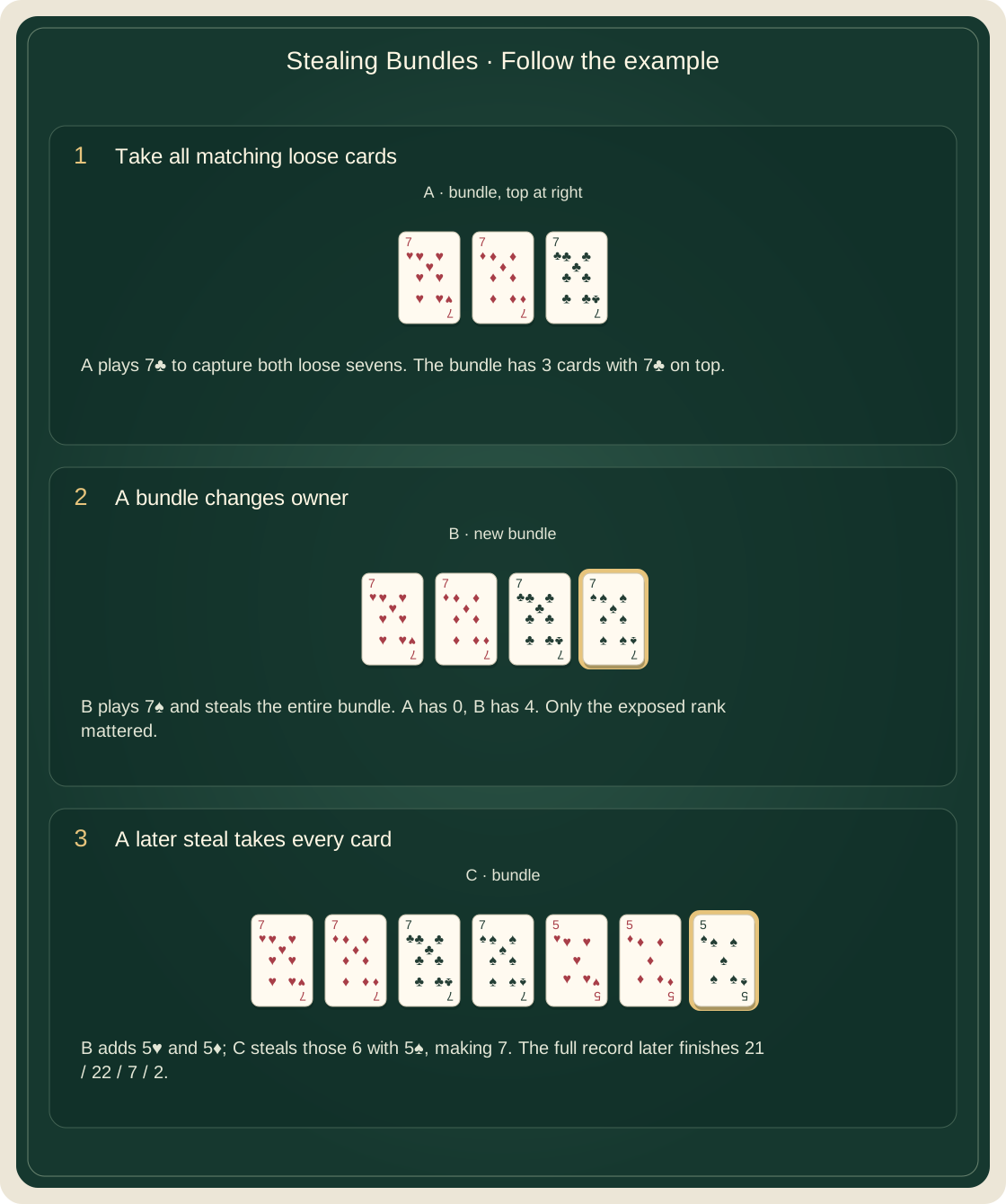
A plays 7♣ and takes loose 7♥ and 7♦: bundle 3. B plays 7♠ and steals all of A’s bundle, making 4. C captures 9♠ with 9♣; D steals that pair with 9♥. A later trails 5♥, B captures it with 5♦, then C steals B’s now 6-card bundle with 5♠. C has 7 cards, not just the visible five.
Open the complete record
| # | Play order | Action | Bundle sizes A / B / C / D |
|---|---|---|---|
| 1 | A: 7♣ | Loose capture · 7♥ · 7♦ | 3 / 0 / 0 / 0 |
| 2 | B: 7♠ | Steal bundle A · 3 | 0 / 4 / 0 / 0 |
| 3 | C: 9♣ | Loose capture · 9♠ | 0 / 4 / 2 / 0 |
| 4 | D: 9♥ | Steal bundle C · 2 | 0 / 4 / 0 / 3 |
| 5 | A: 5♥ | Leave loose | 0 / 4 / 0 / 3 |
| 6 | B: 5♦ | Loose capture · 5♥ | 0 / 6 / 0 / 3 |
| 7 | C: 5♠ | Steal bundle B · 6 | 0 / 0 / 7 / 3 |
| 8 | D: 2♥ | Leave loose | 0 / 0 / 7 / 3 |
| 9 | A: 2♠ | Loose capture · 2♥ | 2 / 0 / 7 / 3 |
| 10 | B: 4♠ | Leave loose | 2 / 0 / 7 / 3 |
| 11 | C: 8♠ | Leave loose | 2 / 0 / 7 / 3 |
| 12 | D: 4♥ | Loose capture · 4♠ | 2 / 0 / 7 / 5 |
| 13 | A: 3♠ | Leave loose | 2 / 0 / 7 / 5 |
| 14 | B: 6♠ | Leave loose | 2 / 0 / 7 / 5 |
| 15 | C: J♠ | Leave loose | 2 / 0 / 7 / 5 |
| 16 | D: 3♥ | Loose capture · 3♠ | 2 / 0 / 7 / 7 |
| 17 | Refill all hands | A: A♠ · A♥ · J♥ · 2♣; B: 10♠ · 6♥ · Q♥ · 3♣; C: Q♠ · 8♥ · K♥ · 4♣; D: K♠ · 10♥ · A♣ · 5♣ | — |
| 18 | A: J♥ | Loose capture · J♠ | 4 / 0 / 7 / 7 |
| 19 | B: 6♥ | Loose capture · 6♠ | 4 / 2 / 7 / 7 |
| 20 | C: Q♠ | Loose capture · Q♣ | 4 / 2 / 9 / 7 |
| 21 | D: K♠ | Leave loose | 4 / 2 / 9 / 7 |
| 22 | A: A♠ | Leave loose | 4 / 2 / 9 / 7 |
| 23 | B: Q♥ | Steal bundle C · 9 | 4 / 12 / 0 / 7 |
| 24 | C: 8♥ | Loose capture · 8♠ | 4 / 12 / 2 / 7 |
| 25 | D: A♣ | Loose capture · A♠ | 4 / 12 / 2 / 9 |
| 26 | A: A♥ | Steal bundle D · 9 | 14 / 12 / 2 / 0 |
| 27 | B: 10♠ | Leave loose | 14 / 12 / 2 / 0 |
| 28 | C: K♥ | Loose capture · K♠ | 14 / 12 / 4 / 0 |
| 29 | D: 10♥ | Loose capture · 10♠ | 14 / 12 / 4 / 2 |
| 30 | A: 2♣ | Leave loose | 14 / 12 / 4 / 2 |
| 31 | B: 3♣ | Leave loose | 14 / 12 / 4 / 2 |
| 32 | C: 4♣ | Leave loose | 14 / 12 / 4 / 2 |
| 33 | D: 5♣ | Leave loose | 14 / 12 / 4 / 2 |
| 34 | Refill all hands | A: 6♣ · K♣ · 4♦ · 10♦; B: 8♣ · A♦ · 6♦ · J♦; C: 10♣ · 2♦ · 8♦ · Q♦; D: J♣ · 3♦ · 9♦ · K♦ | — |
| 35 | A: K♣ | Steal bundle C · 4 | 19 / 12 / 0 / 2 |
| 36 | B: 8♣ | Leave loose | 19 / 12 / 0 / 2 |
| 37 | C: 10♣ | Steal bundle D · 2 | 19 / 12 / 3 / 0 |
| 38 | D: 3♦ | Loose capture · 3♣ | 19 / 12 / 3 / 2 |
| 39 | A: 4♦ | Loose capture · 4♣ | 21 / 12 / 3 / 2 |
| 40 | B: A♦ | Leave loose | 21 / 12 / 3 / 2 |
| 41 | C: 2♦ | Loose capture · 2♣ | 21 / 12 / 5 / 2 |
| 42 | D: J♣ | Leave loose | 21 / 12 / 5 / 2 |
| 43 | A: 6♣ | Leave loose | 21 / 12 / 5 / 2 |
| 44 | B: 6♦ | Loose capture · 6♣ | 21 / 14 / 5 / 2 |
| 45 | C: 8♦ | Loose capture · 8♣ | 21 / 14 / 7 / 2 |
| 46 | D: 9♦ | Leave loose | 21 / 14 / 7 / 2 |
| 47 | A: 10♦ | Leave loose | 21 / 14 / 7 / 2 |
| 48 | B: J♦ | Loose capture · J♣ | 21 / 16 / 7 / 2 |
| 49 | C: Q♦ | Leave loose | 21 / 16 / 7 / 2 |
| 50 | D: K♦ | Leave loose | 21 / 16 / 7 / 2 |
After all 48 plays and 2 refills, the last capturer takes the remaining loose cards. Final A / B / C / D: 21 / 22 / 7 / 2 = 52. B wins with 22; C’s earlier bundle was only a temporary lead.
← On a small screen, scroll the diagram horizontally. →
07 /
What to watch at the table
Watch exposed tops as well as bundle size. Changing the top can protect a large collection from a rank already in an opponent’s hand. Withhold a matching card if a bigger bundle may become available, but remember that you must play a card on your turn and cannot make an illegal trail to postpone a compulsory capture.
08 /
Choose the rules before starting
The related Italian Rubamazzo uses a shorter pack and counterclockwise play; its selected guide is not interchangeable with this full-pack profile. Some households leave final table cards unawarded or allow combined captures. Here the last capture receives them and the single-action agreement resolves overlap explicitly. These choices can change the winner.
09 /
History and related games
Steal the Old Man’s Bundle, Steal Pile and Stealing Bundles are names for this simple fishing-game tradition. Specialist descriptions connect it with Argentine Casita Robada and Italian Rubamazzo while specifying deck and direction differences. No precise inventor or origin date is established by the consulted account; a shared mechanism does not make all regional rules identical.
10 /
Check your understanding
Can you steal a covered rank from the middle of a bundle?
Show the answer
No. Only the currently exposed top can be matched.
Does an ace count more than a two at the end?
Show the answer
No. Every captured card counts once.
Common questions
Can card values be added to capture a total?+
No. Only equal ranks match in this profile.
Are new loose cards dealt every batch?+
No. Only players receive replacement hands.
Who takes the last loose cards?+
The player who made the final capture, including a bundle theft.