← On a small screen, scroll the diagram horizontally. →
01 /
The game at a glance
Try to hold all 4 cards of one rank and take the first spoon, or notice somebody else taking one and take another. There are not enough spoons for everybody. A good card set does not protect somebody who fails to take a spoon.
02 /
Prepare and deal
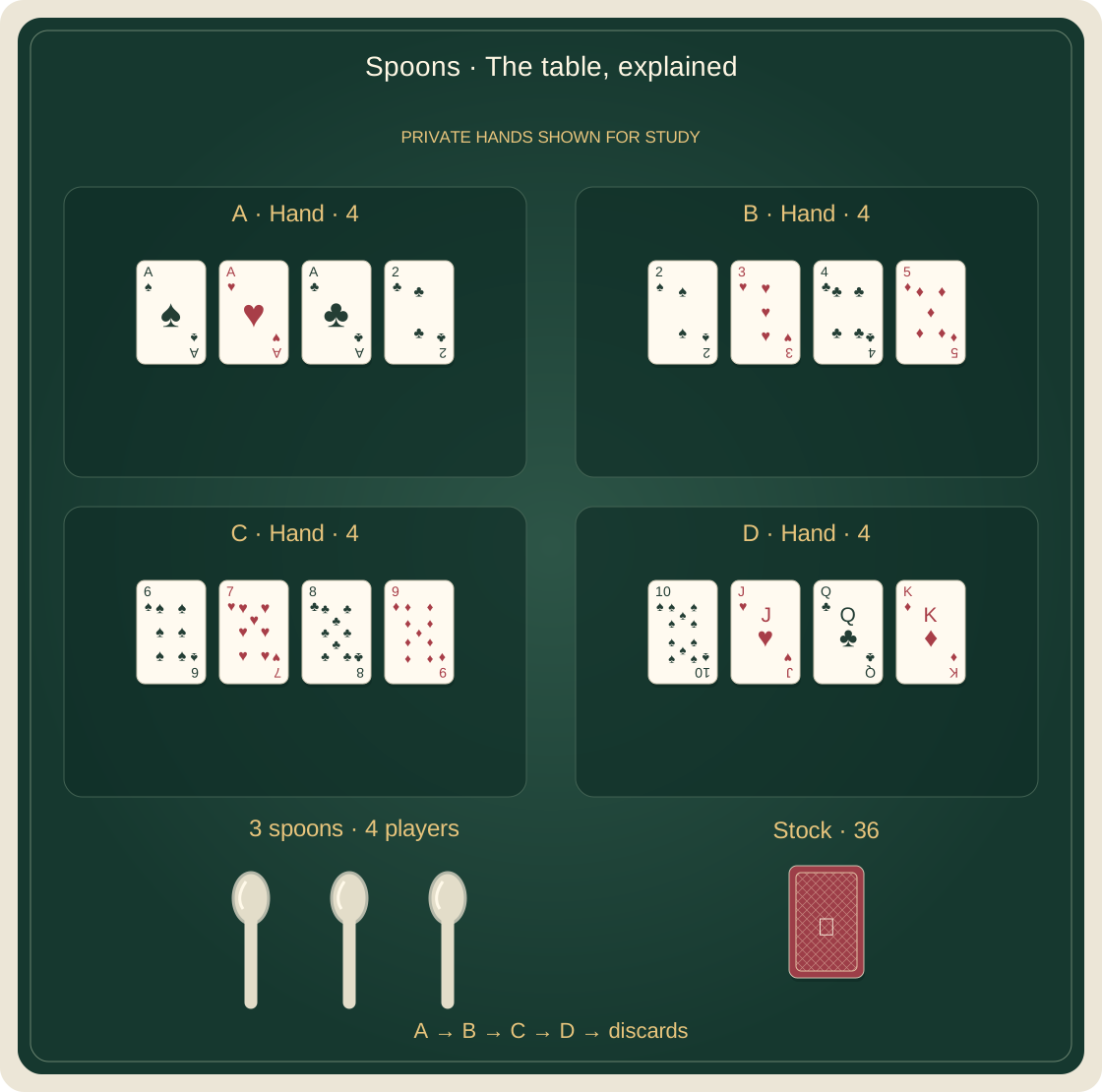
Remove jokers and place one fewer spoon than the number playing within equal reach. Deal 4 cards each; the rest is a closed supply beside the dealer. The centre has 3 spoons in our four-person lesson. Everybody may look at their hand. Keep space for incoming cards and the last player’s discard pile.
03 /
How play proceeds
Dealer draws the next supply card, briefly holds 5, chooses one and passes it face down left, keeping 4. Each next player receives a card, chooses one of their now 5 and passes left, again keeping 4. The last player sends their outgoing card to the discard pile instead of back to dealer. Cards flow continuously; nobody may pick a preferred card out of the supply.
04 /
Rules that change your decision
As soon as a player holds four of a kind, they may take a spoon. Once that first valid spoon is taken, anyone may take a remaining spoon without a set. Take at most one each. Stop card passing when the grab begins and check the initiating set. A premature first grab loses that round under our stated false-start agreement; another player is not penalised for reacting to a valid grab.
05 /
Finish and scoring
The person without a spoon takes the next letter of S-P-O-O-N. Complete the word after 5 losses and leave the game. Remove a spoon when somebody leaves; shuffle every card for a new round and move dealer left. The last survivor wins. Players with an equal number of letters are simply equally close to elimination, not required to break a tie immediately.
06 /
A worked example
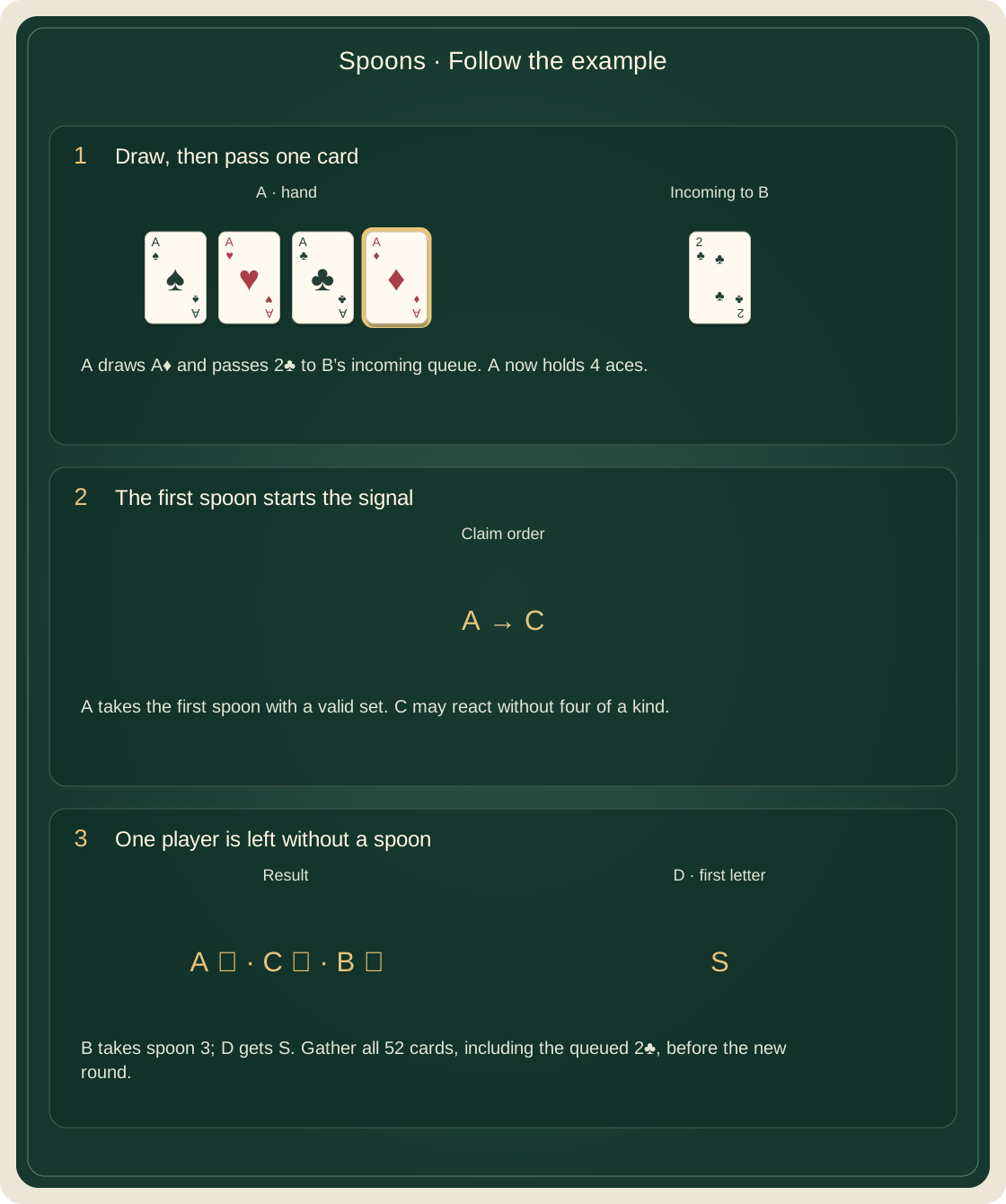
A holds A♠, A♥, A♣, 2♣ and draws A♦. A passes 2♣ left and now has all 4 aces. A takes a spoon; C notices and takes another, then B takes the third. D receives S even if D had a strong hand. The passed 2♣ remains accounted for with the incoming cards until all 52 are gathered for the next round.
← On a small screen, scroll the diagram horizontally. →
07 /
What to watch at the table
Watch the centre while deciding which rank to collect. Keep the incoming queue face down and in arrival order so faster passing does not give someone a choice of future cards. Briefly holding a received extra card is normal; hoarding a large packet or taking two spoons is not part of this profile.
08 /
Choose the rules before starting
When the dealer supply runs out, pause, shuffle only the discard pile into a new supply and continue. Do not shuffle players’ hands or queued incoming cards. Our maximum leaves a supply at the start; seating thirteen with all cards in hands needs a different passing system or additional cards. Some families eliminate after one loss or use another word; agree before playing.
09 /
History and related games
Spoons is a traditional party game combining rank collection with a shared signal. Bicycle documents this passing form and its five-letter elimination. It has no established inventor in the consulted instructions. Games using gestures rather than spoons belong to the broader family of observation and collection games, but their signals and penalties need not match.
10 /
Check your understanding
Do you need four matching cards after someone takes the first valid spoon?
Show the answer
No. Anyone may take one of the remaining spoons.
Can dealer refill from cards still in another player’s hand?
Show the answer
No. Recycle only the discard pile, leaving hands and incoming queues intact.
Common questions
Are suits relevant to a set?+
No. Match ranks: all aces, all sevens and so on.
May you take two spoons to help a friend?+
No. One spoon per person.
Does the selected penalty word have six letters?+
No. This profile uses the five-letter word SPOON.