← On a small screen, scroll the diagram horizontally. →
01 /
Your first round
Draw one, complete the whole opening contract when ready, extend melds if eligible, then discard one. Going out ends the round and scores the cards others still hold. Across seven rounds the lowest total penalties wins. A player who has not opened cannot lay off, except through the special Shanghai capture. Taking a May I does not give an extra turn.
02 /
Cards, seats and the deal
Choose first dealer randomly; pass deal clockwise after each round. Deal 11 each, one at a time clockwise, in every round. Turn one remaining card face up to start the discard and leave the rest face down as stock. Dealer’s left starts. A normal draw takes either top discard or top stock; before drawing stock, allow eligible discard claims. You cannot take a buried discard as a normal draw.
03 /
Contracts in order
| Round | Opening contract |
|---|---|
| 1 | 2 × book |
| 2 | 1 × book + 1 × run |
| 3 | 2 × run |
| 4 | 3 × book |
| 5 | 2 × book + 1 × run |
| 6 | 1 × book + 2 × run |
| 7 | 3 × run; no discard |
04 /
What happens on your turn
A book needs at least three of one rank, with duplicate suits allowed. A run needs at least four consecutive cards of one suit, ace high only: J–Q–K–A works, A–2–3–4 does not. Open with exactly the contract’s minimum groups of three and runs of four; then you may extend those or anyone’s existing melds in that same turn. Do not open two books of the same rank or two adjacent same-suit runs. Separate runs may overlap using different physical cards.
05 /
Jokers and replacement
Only jokers are wild, never twos. Each meld may contain at most one joker; state the missing rank and suit in a run. A book joker is fixed. Following the inherited contract rule, a run joker can be replaced by its real card only by a player who opened on an earlier turn, during laying off; the reclaimed joker must be used that turn, in another eligible meld, not kept in hand.
06 /
Buying a discard out of turn
May I claims only the top discard when the normal next player declines it. Among claimants, the one whose regular turn comes sooner has priority. The claimant takes that discard plus two stock cards, without melding or discarding. Resume the interrupted player’s turn, not the claimant’s neighbour. Each player may do this only twice per round; use two tokens to track it. A Shanghai call takes precedence over May I.
07 /
The two Shanghai calls
If you discard a card that fits an existing meld, say Shanghai as you discard: nobody may pick it up during the next player’s turn. If you forget, another player may call Shanghai, attach the card to a meld and offer their own hand face down; you draw one blind card from that hand into yours. The caller need not have opened. This is not a normal meld turn. Play resumes left of the discarder.
08 /
A complete worked example
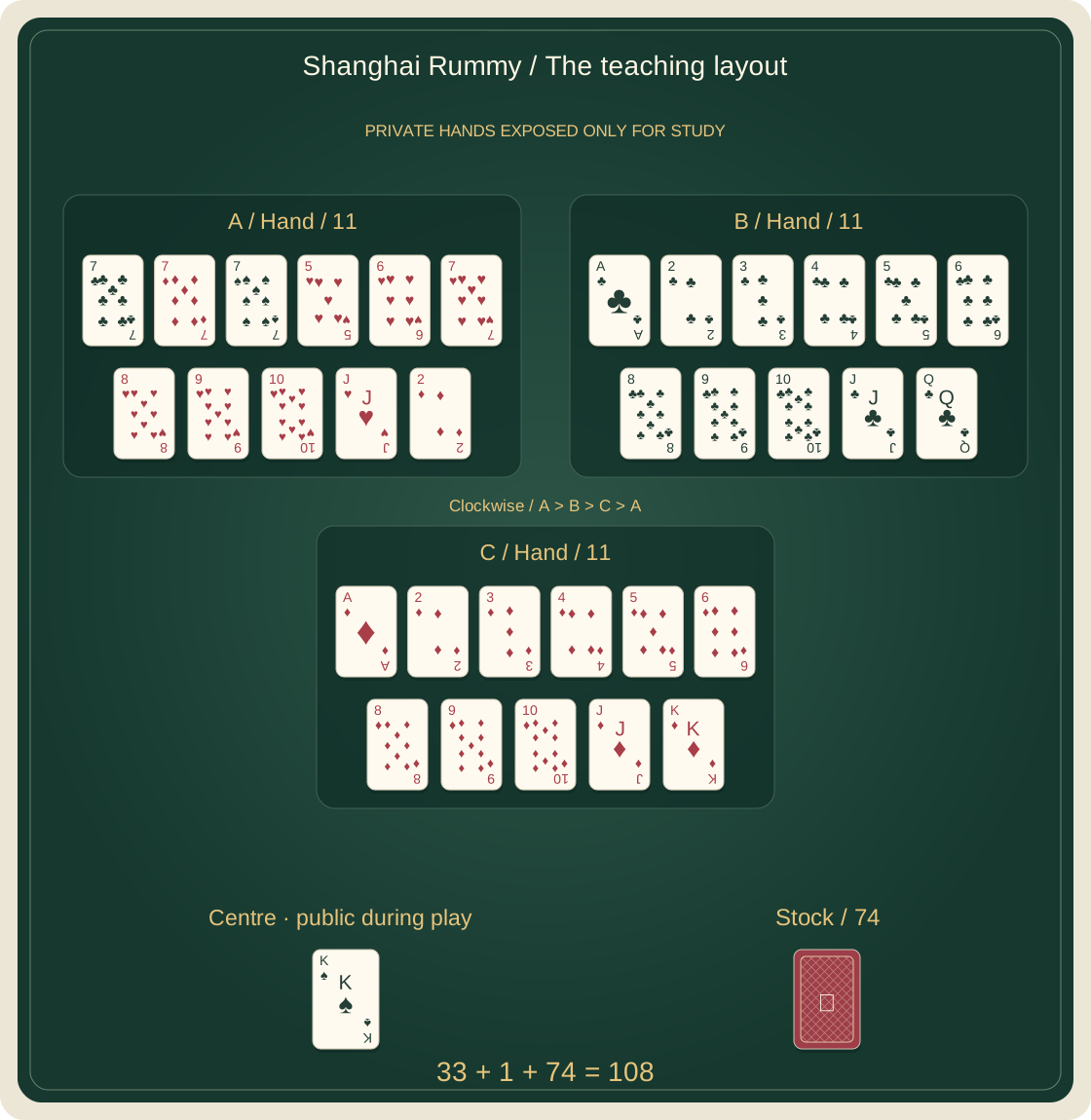
Player A
7♣ 7♦ 7♠ 5♥ 6♥ 7♥ 8♥ 9♥ 10♥ J♥ 2♦
Player B
A♣ 2♣ 3♣ 4♣ 5♣ 6♣ 8♣ 9♣ 10♣ J♣ Q♣
Player C
A♦ 2♦ 3♦ 4♦ 5♦ 6♦ 8♦ 9♦ 10♦ J♦ K♦
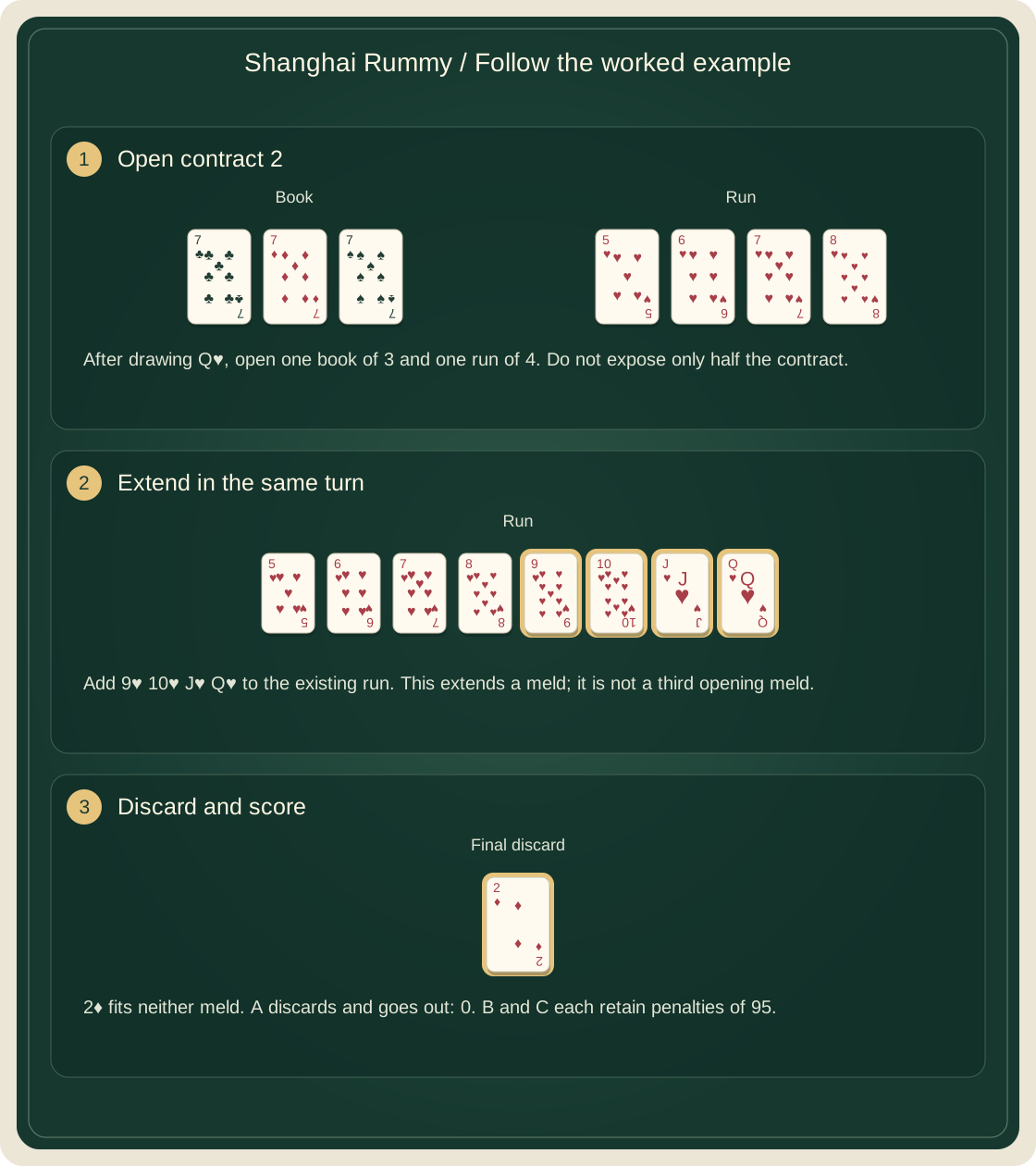
Round 2, C deals, initial discard K♠, stock 74. A draws Q♥. First open book 7♣ 7♦ 7♠ and run 5♥ 6♥ 7♥ 8♥: the required 7 cards. Immediately extend the heart run with 9♥ 10♥ J♥ Q♥. Discard 2♦, which fits neither meld, and go out. A melded 11 and discarded 1 after drawing: no extra hand or new third meld is invented.
← On a small screen, scroll the diagram horizontally. →
09 /
Scoring and settlement
Held 2–7 cost 5 each, 8–K cost 10, aces 20, jokers 50. In the example B and C each retain an ace, five low cards and five high cards: 20 + 5 × 5 + 5 × 10 = 95 each. A scores 0. Keep a seven-row score sheet and add penalties, not the value of exposed melds. Lowest cumulative total wins; agree beforehand to share a final tie or play a deciding deal.
10 /
When the round and match end
Rounds 1–6 finish after the final discard; keep one card for that mandatory discard. Round 7 requires the whole hand to go down at once as three runs, with no discard; extend runs as necessary to use bought cards. Empty stock: keep the top discard, shuffle the older discards into a new stock. If there are not enough recyclable cards to continue, end the round and score every held hand; nobody earns an invented winning bonus.
11 /
Check your understanding
A May I takes how many cards?
Reveal the answer
Three: the discard plus two from stock. It does not change whose regular turn resumes.
Can A–2–3–4 open a run?
Reveal the answer
No. Aces are high only in this Shanghai profile. J–Q–K–A is valid in one suit.
12 /
History and other versions
Shanghai belongs to contract rummy, where the required opening changes each round. Published accounts document several incompatible schedules under the same name, including seven and ten rounds. The name alone does not establish a Chinese birthplace or a single inventor. The seven-round account used here preserves the Shanghai call itself; a buying-only version should be labelled separately.
Common questions
Are twos wild?+
No. Only the four jokers substitute in this profile.
Can I extend immediately after opening?+
Yes. That is a Shanghai difference from the stricter basic Contract Rummy turn delay.
Does May I skip the regular player?+
No. Finish the claim, then resume the interrupted turn.