← On a small screen, scroll the diagram horizontally. →
01 /
Your first round
Draw stock, optionally meld, optionally lay off if opened, then discard one. Reduce your hand to zero only by a final discard. The first meld has no point minimum; a single seven suffices. A new complete meld is different from extending one already exposed, especially when claiming the discard.
02 /
Cards, seats and the deal
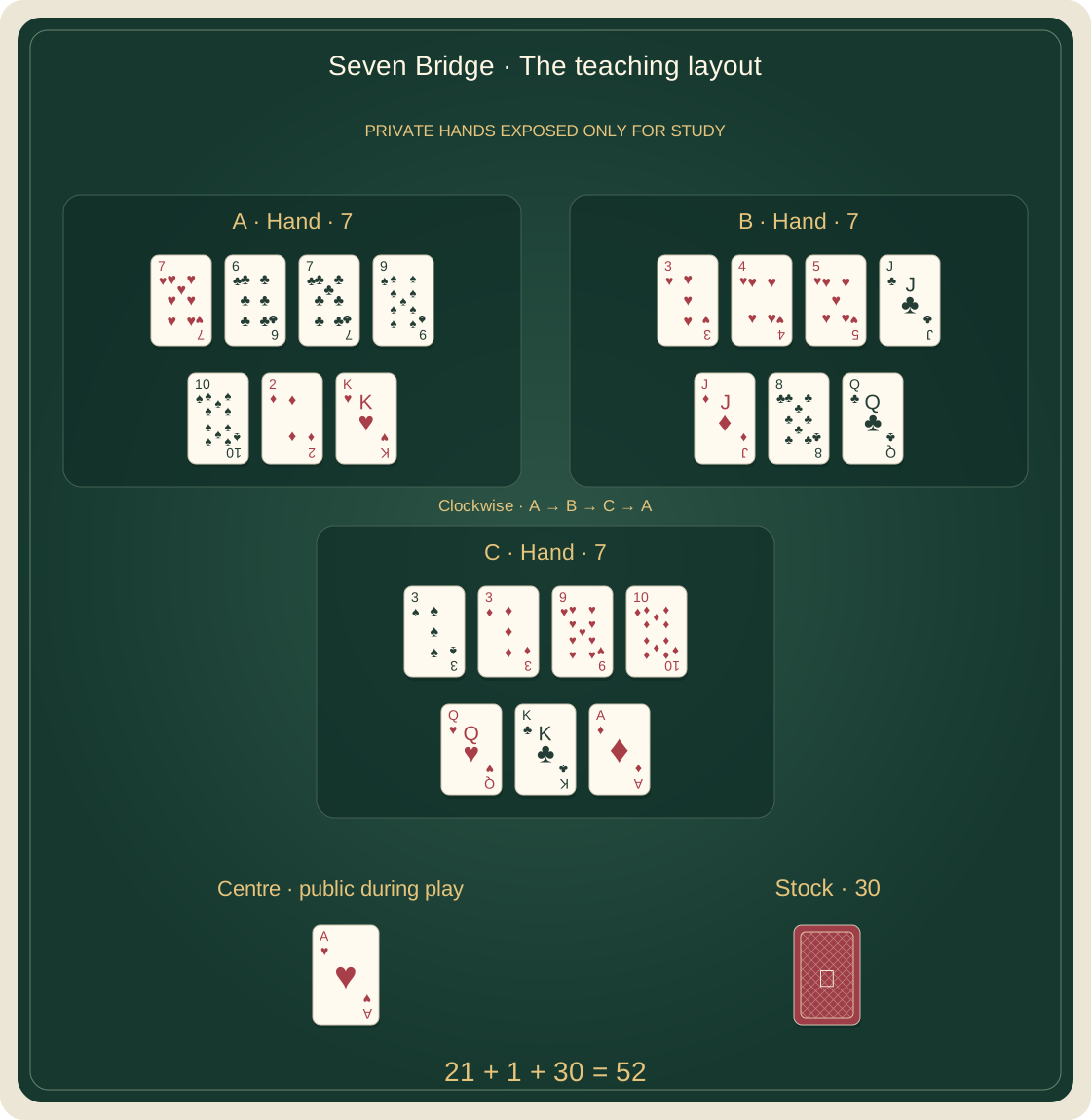
Use 52 without jokers, two to five players; three is a convenient teaching table. Deal seven each clockwise, turn one discard up, rest closed stock. Left of dealer begins; dealer passes left after each deal. In the pictured three-player deal there are 21 held, one discard and 30 stock cards. Hands stay private.
03 /
Melds and the special seven
Ordinary sets need three or four equal ranks; ordinary runs need at least three consecutive cards of one suit. Ace is always low: A–2–3 works, Q–K–A and K–A–2 do not. A seven alone is legal. A two-card set of sevens or a two-card run containing a seven is also legal. Two unrelated non-sevens are not. Each physical card belongs to only one meld.
04 /
Laying off and choosing a seven’s role
Before adding to anyone’s meld, expose at least one of your own; you may do so in the same turn. A lone 7♣ can become a run when 6♣ or 8♣ is added, or a set when another seven joins. Once defined, it cannot switch between run and set. Separate exposed sevens can start separate suit runs; announce whether you are exposing a new singleton or adding to an existing meld. No table rearrangement.
05 /
Claiming: Chi and Pon
After you have completed a normal stock-draw-and-discard turn, you may claim the latest discard to make a new meld with at least two cards from your hand. Never keep it or merely lay it off. Chi makes a new sequence and only the next player may use it. Pon makes a new set of three or four and may interrupt out of turn before the next player draws. Both replace a stock draw, then normal melding and a discard follow.
06 /
Claim priority can stop an exit
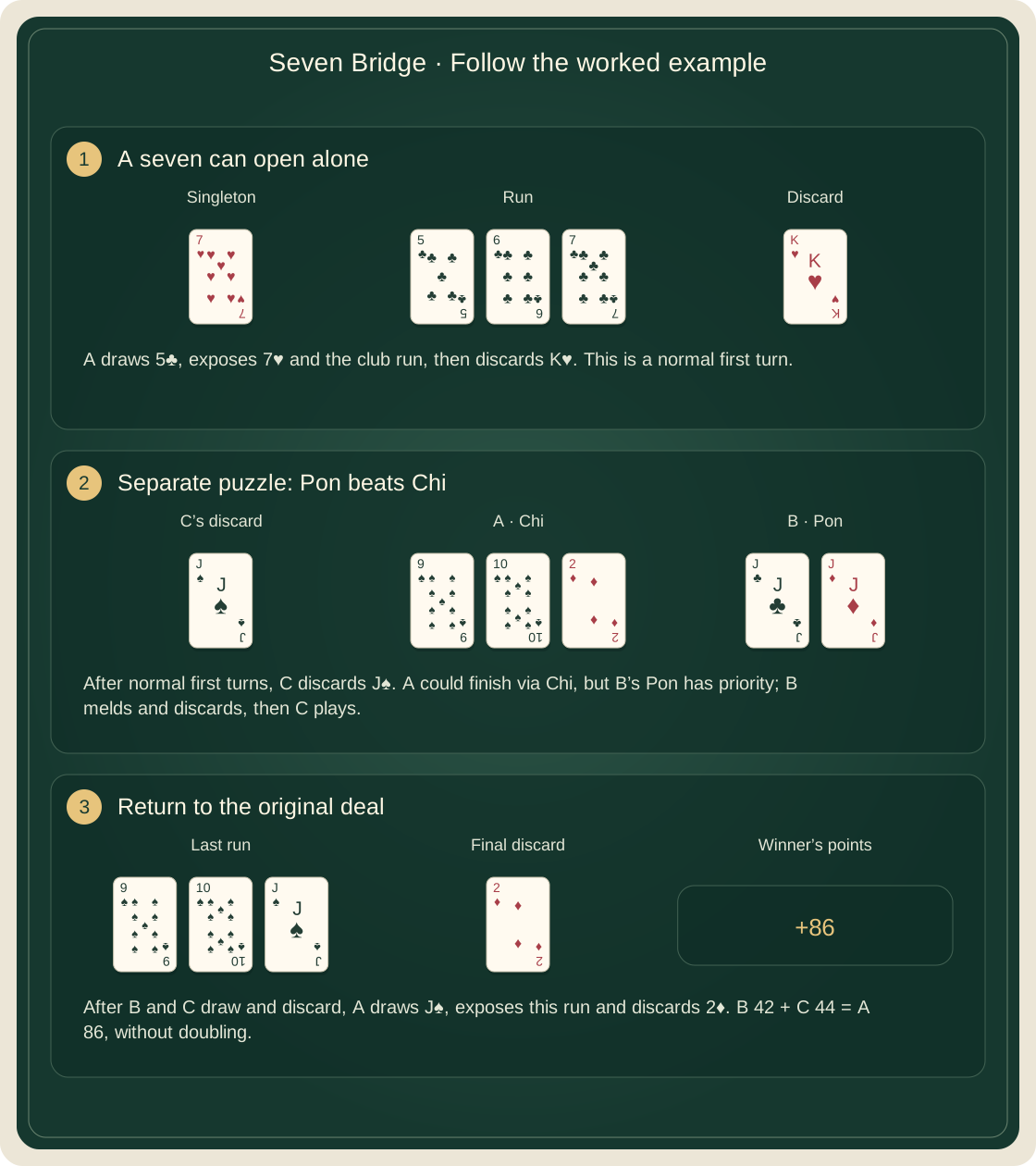
Pon outranks Chi even when Chi would let someone go out. After a claim and discard, play resumes left of the claimant, possibly skipping others. In a separate example after everyone’s first normal turn, C discards J♠. Next player A has 9♠,10♠,2♦ and could Chi to finish, but B holds J♣ and J♦ and claims Pon. B gets J♠, exposes three jacks and discards; C plays next. A’s planned exit grants no priority.
07 /
When the round and match end
Keep a final discard even when exposing several melds; you cannot win just by laying off the last card. When stock runs out, preserve the latest discard, shuffle all earlier discards and make new stock. Do not recycle exposed melds. A completed exit stops the deal immediately; held combinations do not get a final chance to be exposed.
08 /
Scoring and settlement
Held J/Q/K count 10 each, ace 1, seven 20, other numbers face value. The winner adds the sum of all opponents’ held points to their own cumulative score; losers add nothing. If the winner first exposes all seven played cards together on the winning turn, with no earlier melds, double the award. We choose target 200, checked after a deal. Do not use the alternative “each seven doubles the hand” schedule at the same time.
09 /
A complete worked example
Return to the illustrated original deal, separate from the priority puzzle. A draws 5♣, exposes single 7♥ and 5♣–6♣–7♣, then discards K♥, keeping 9♠,10♠,2♦. B draws 2♣ and discards Q♣ without melding. C draws 8♦ and discards K♣ without melding. A draws J♠ from stock, exposes 9♠–10♠–J♠ and discards 2♦ to go out. Neither first-turn discard was taken by a claim.
← On a small screen, scroll the diagram horizontally. →
10 /
Count all unexposed cards
B’s seven held cards total 42 and C’s total 44, so A earns 86, not 172: A had already melded on an earlier turn. B’s ready heart run still counts because it was not exposed. Inventory: 7 exposed, 14 held, 5 discards, 26 stock, total 52. No held seven appears in this lesson, but one would cost 20, not its printed value.
11 /
Check your understanding
May the first turn claim a useful discard?
Reveal the answer
No. First complete a normal turn drawing stock and discarding.
Can I take a seven just to lay it off?
Reveal the answer
No. A claim requires a new meld with at least two cards from your hand.
12 /
History and other versions
Seven Bridge is a Japanese rummy game, also called Seven Rummy or Mah Jong Bridge. Chi and Pon reflect a Mahjong connection; the name does not make it contract bridge. The selected account was supplied by Kuromiya Kimihiko and Takerube Nobuaki. Published leaflets and family versions differ over scoring, joker use, ace position and final discard, so confirm the whole profile rather than borrowing one attractive exception.
Common questions
Is this contract bridge?+
No. It is a Japanese rummy game with sets and sequences.
Can a single seven open?+
Yes, when properly melded on your turn after drawing.
Does needing a card to win outrank Pon?+
No. Pon still has priority over Chi.