← On a small screen, scroll the diagram horizontally. →
01 /
Your first round
Play exactly one held card per turn to make or add to a house, capture, or leave a loose card when no capture is possible. Aces capture 1, numbers their value, J 11, Q 12, K 13. There is no Scopa-style preference for a matching singleton over sums: a capturing card must collect every disjoint matching item it can take. Houses are special indivisible items.
02 /
Cards, seats and the deal
Use 52 without jokers. Dealer’s right neighbour cuts, receives four cards, and sees only those four. Four centre cards stay face down. That player bids 9–13 matching a card held; with no such card reveal the hand and redeal. Reveal the centre. The bidder must build a house of that value, capture using the bid-value card, or drop that card if neither works. Then finish dealing in packets of four: bidder has eleven left, others twelve.
03 /
Creating and owning a house
An ordinary house combines at least two cards summing to 9–13. To create it, play one card and combine loose floor cards; keep another card equal to the house value in hand. You own it until captured or broken, so may not dispose of your last backing card elsewhere. You cannot create a new house solely for your partner. A legal house action may be chosen instead of an otherwise available capture.
04 /
Breaking and raising
Break another player’s ordinary house, including your partner’s, by adding one card from hand to raise its value, while holding the new backing rank. Ownership passes to you. You may not break your own house, add floor cards to raise its value, or exceed king. If the new value matches another house or available loose equal-value group, combine them into a cemented house.
05 /
Cementing a house
A cemented house contains two or more separate copies of its value: for example 4 + 7 and a jack make an eleven-house. It cannot be raised or broken. Cement by playing an equal-rank card, adding your card plus loose cards making another copy, or raising a different house to the same value. Same-valued houses merge; loose cards or groups already matching the value are incorporated. At least one added card comes from hand.
06 /
Whose backing card is required?
When cementing or adding to an opponent’s house without breaking it, retain a matching card and become a second owner; both must keep a backing card. Adding to a partner-owned house can rely on that partner’s backing card, without making you an owner. Likewise a raised house merged into your partner’s existing house can retain the partner as owner. A single loose card and a house of the same value never remain separate.
07 /
What happens on your turn
Capture a house only with an exactly equal card; never add its value to loose cards as part of a larger sum. Loose cards may be divided into disjoint groups each equalling your played card. Take all matching singles, groups and the matching house; you cannot deliberately leave an extra capturable group. If groups overlap, choose a nonoverlapping arrangement. If you neither make a legal house action nor capture anything, your card stays loose.
08 /
When the round and match end
Each player plays twelve cards in total, including the opening action; the deal has 48 plays. Houses must be collected by the end because owners cannot spend their last backing cards elsewhere. Loose leftovers go to the last capturing team. Clearing the floor by capture scores 50, except the opening sweep 25 and the final play 0. Building a house that gathers the floor is not a sweep.
09 /
Scoring and settlement
All spades score capture value A 1 through K 13: 91 together. Other aces add 3, 10♦ adds 6, total 100 card points. Add sweeps for each team. If either team scores below 9 in a deal, it immediately loses the baazi regardless of the earlier lead. Otherwise add this deal’s score difference to the running difference; a lead of at least 100 wins a baazi and resets to zero. Agree a number of baazis before starting.
10 /
A complete worked example
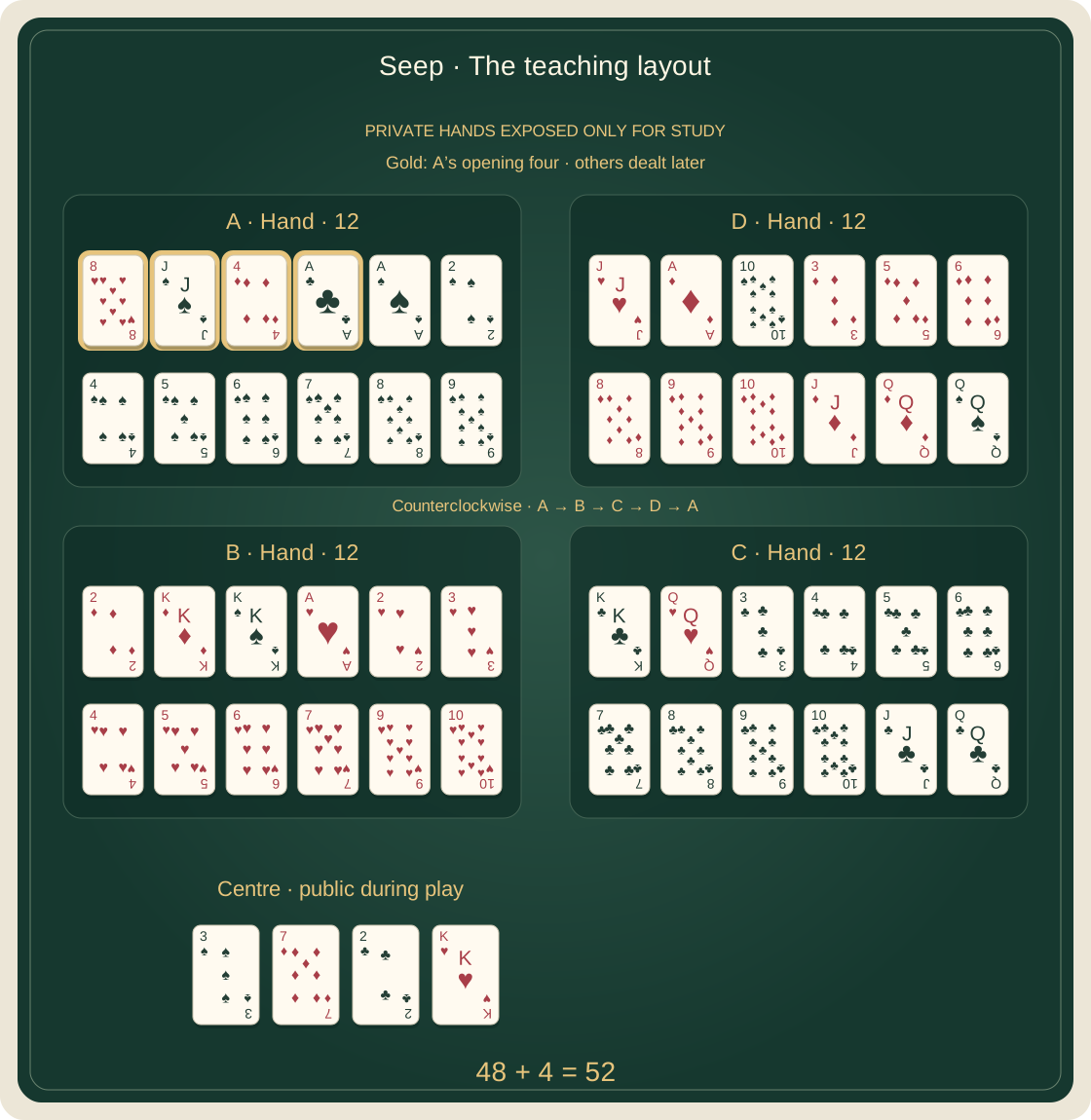
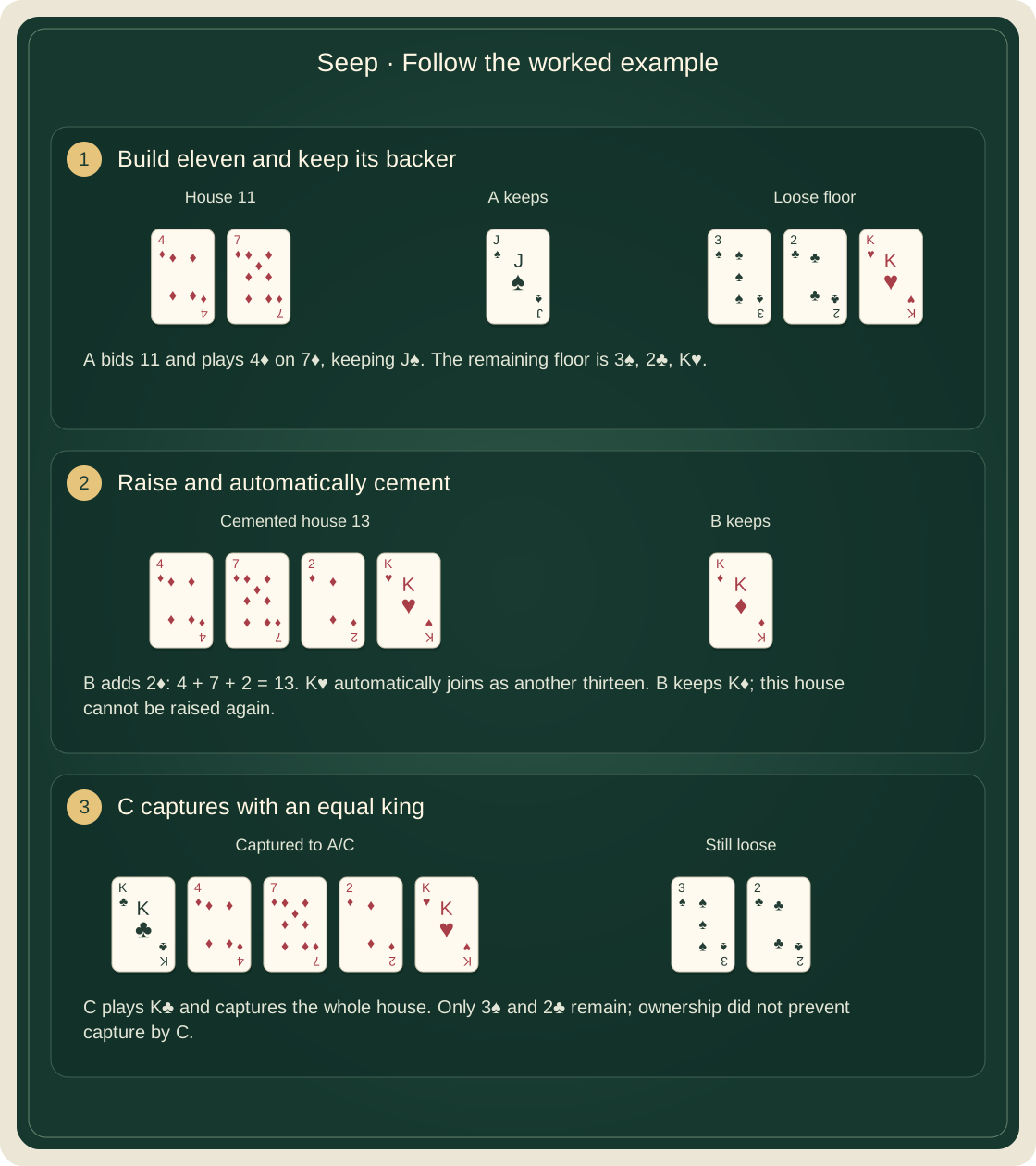
A’s opening four are 8♥, J♠, 4♦, A♣, so A bids 11 before seeing the floor 3♠, 7♦, 2♣, K♥. A plays 4♦ on 7♦ to build eleven, keeping J♠. After the rest of the deal B plays 2♦ to raise that house to thirteen, keeping K♦. The loose K♥ automatically cements it: two separate thirteen groups. C plays K♣ and takes the entire house. It cannot be raised again, and no ownership rule prevents a different player capturing it.
← On a small screen, scroll the diagram horizontally. →
11 /
A lead, not a raw target total
In the complete replay each team captures 26 cards and 50 card points, but B/D make a sweep worth 50. Deal totals A/C 50, B/D 100: B/D gain a lead of 50, not an immediate baazi from merely scoring 100. An earlier A/C lead of 70 would become 20. With 8 points a team would instead lose immediately even if previously ahead by 99. The full-allocation diagram is for study: later cards are not available to inspect before the opening action.
Open every play
| Play | Player | Card | Action | Taken | Sweep |
|---|---|---|---|---|---|
| 1 | A | 4♦ | Build | — | 0 |
| 2 | B | 2♦ | Raise and cement | — | 0 |
| 3 | C | K♣ | Capture or drop | 4♦ 7♦ 2♦ K♥ | 0 |
| 4 | D | J♥ | Capture or drop | — | 0 |
| 5 | A | 8♥ | Capture or drop | — | 0 |
| 6 | B | K♦ | Capture or drop | 3♠ 2♣ 8♥ | 0 |
| 7 | C | Q♥ | Capture or drop | — | 0 |
| 8 | D | A♦ | Capture or drop | — | 0 |
| 9 | A | J♠ | Capture or drop | J♥ | 0 |
| 10 | B | K♠ | Capture or drop | Q♥ A♦ | 50 |
| 11 | C | 3♣ | Capture or drop | — | 0 |
| 12 | D | 10♠ | Capture or drop | — | 0 |
| 13 | A | A♣ | Capture or drop | — | 0 |
| 14 | B | A♥ | Capture or drop | A♣ | 0 |
| 15 | C | 4♣ | Capture or drop | — | 0 |
| 16 | D | 3♦ | Capture or drop | 3♣ | 0 |
| 17 | A | A♠ | Capture or drop | — | 0 |
| 18 | B | 2♥ | Capture or drop | — | 0 |
| 19 | C | 5♣ | Capture or drop | 4♣ A♠ | 0 |
| 20 | D | 5♦ | Capture or drop | — | 0 |
| 21 | A | 2♠ | Capture or drop | 2♥ | 0 |
| 22 | B | 3♥ | Capture or drop | — | 0 |
| 23 | C | 6♣ | Capture or drop | — | 0 |
| 24 | D | 6♦ | Capture or drop | 6♣ | 0 |
| 25 | A | 4♠ | Capture or drop | — | 0 |
| 26 | B | 4♥ | Capture or drop | 4♠ | 0 |
| 27 | C | 7♣ | Capture or drop | — | 0 |
| 28 | D | 8♦ | Capture or drop | 5♦ 3♥ | 0 |
| 29 | A | 5♠ | Capture or drop | — | 0 |
| 30 | B | 5♥ | Capture or drop | 5♠ | 0 |
| 31 | C | 8♣ | Capture or drop | — | 0 |
| 32 | D | 9♦ | Capture or drop | — | 0 |
| 33 | A | 6♠ | Capture or drop | — | 0 |
| 34 | B | 6♥ | Capture or drop | 6♠ | 0 |
| 35 | C | 9♣ | Capture or drop | 9♦ | 0 |
| 36 | D | 10♦ | Capture or drop | 10♠ | 0 |
| 37 | A | 7♠ | Capture or drop | 7♣ | 0 |
| 38 | B | 7♥ | Capture or drop | — | 0 |
| 39 | C | 10♣ | Capture or drop | — | 0 |
| 40 | D | J♦ | Capture or drop | — | 0 |
| 41 | A | 8♠ | Capture or drop | 8♣ | 0 |
| 42 | B | 9♥ | Capture or drop | — | 0 |
| 43 | C | J♣ | Capture or drop | J♦ | 0 |
| 44 | D | Q♦ | Capture or drop | — | 0 |
| 45 | A | 9♠ | Capture or drop | 9♥ | 0 |
| 46 | B | 10♥ | Capture or drop | 10♣ | 0 |
| 47 | C | Q♣ | Capture or drop | Q♦ | 0 |
| 48 | D | Q♠ | Capture or drop | — | 0 |
12 /
Next dealer and visible information
After a normal deal a losing-team player deals. If the old dealing team is behind or tied, the same dealer stays; if it now leads, deal passes one seat right. After a baazi, take the partner of whoever would otherwise deal next. This is not automatic clockwise dealer rotation. All floor cards may be inspected; captured cards may be reviewed only until the next player has played.
13 /
Check your understanding
Can a house plus loose cards make a bigger capture?
Reveal the answer
No. A house can only be captured by its exact value.
Can I raise my own house?
Reveal the answer
No. You can cement it with valid additional equal-value groups, retaining the backing card.
14 /
History and other versions
Seep belongs to the Casino fishing family and is played in South Asia under names including Sip and Sweep. The selected northern Indian account comes from Ankit Bhageria. Punjabi thirty-point profiles have different scoring cards, sweep values and sometimes special opening restrictions; their existence is not evidence for mixing those rules with the hundred-point game. No single inventor is securely assigned here.
Common questions
Can someone steal my house?+
Yes, with a matching capture card. Ownership is an obligation, not exclusive capture rights.
Does a sweep always score fifty?+
No. The first play is twenty-five and the last scores nothing in this profile.
Does most captured cards earn a point?+
Not in this selected hundred-point schedule.