← On a small screen, scroll the diagram horizontally. →
01 /
Your first round
Play one card each turn. It either captures one equal card or a group with the same total, or stays in the centre if no capture is possible. Captures belong to the team, not the individual. Score majorities, the special seven and sweeps after all cards have been played; the greatest number of captures alone need not win the deal.
02 /
Cards, seats and the deal
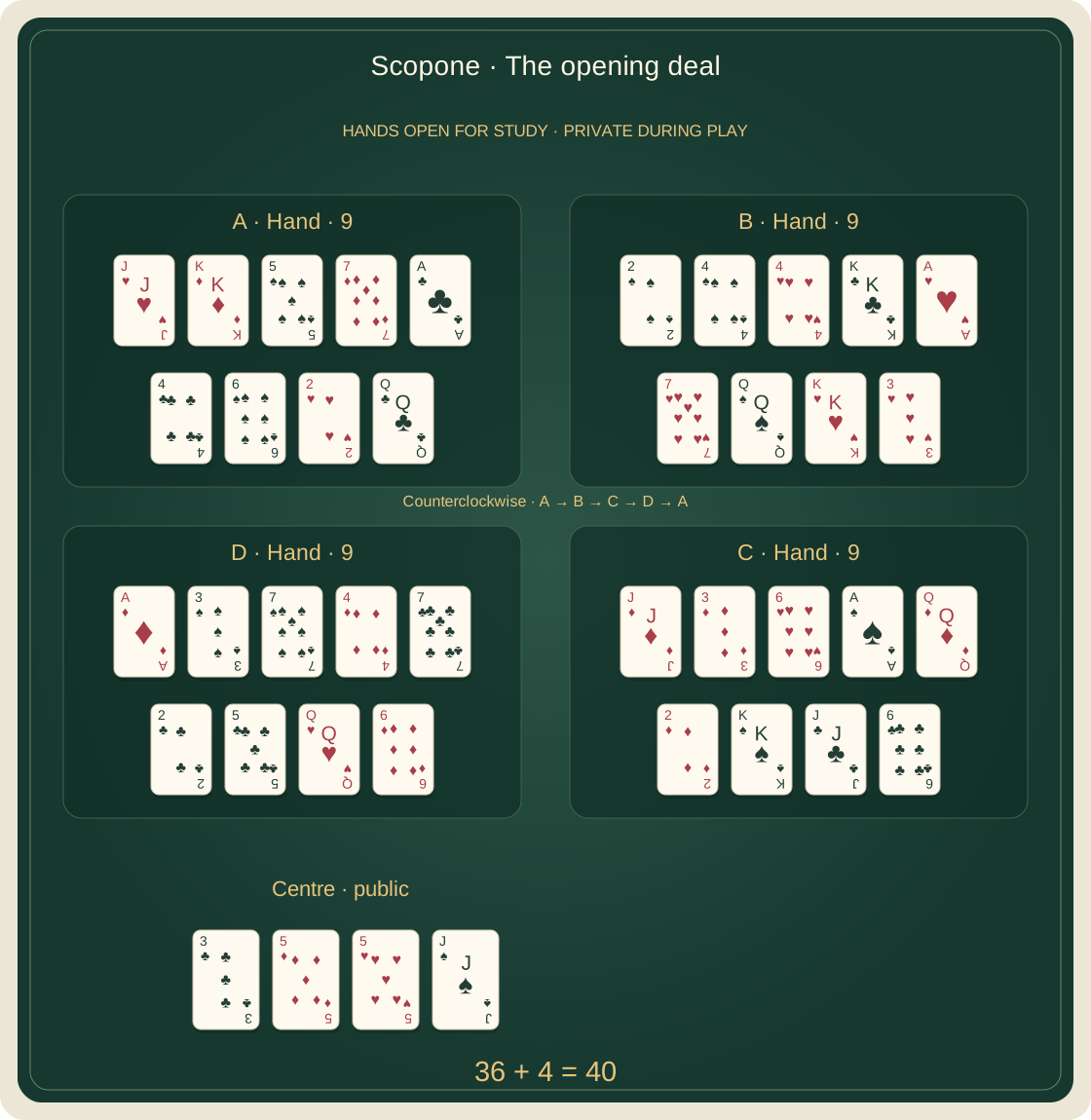
Partners A/C sit opposite B/D. Dealer offers the cut to the left. Deal anticlockwise from the right: three each, two centre, three each, two centre, three each. Everyone has nine, centre has four, no stock. Reveal the centre after dealing; three or four initial kings require a redeal by the same dealer. Right of dealer starts; dealer shifts right next deal.
03 /
What happens on your turn
Choose any held card; you need not choose one that can capture. Once chosen, however, its capture is compulsory. If an equal table rank exists, take exactly one equal card of your choice, never a sum instead. Only when no equal exists may you choose one group summing to the played card. You cannot combine a matching singleton with extra cards or make several independent captures with one play.
04 /
When the round and match end
With a capture, store both the played card and captured cards in your team pile. Without one, leave the played card face up. Clearing the centre scores one scopa, except on the dealer’s last play. After all 36 plays, give leftover centre cards to the team that last captured; this final collection is not a scopa. No further hands are dealt during the deal.
05 /
Scoring and settlement
One point each for most cards, most coins, the seven of coins, and best primiera. Add every scopa. A tied majority scores neither team; tied primiera likewise. Diamonds stand for coins in the diagrams, so 7♦ is settebello. The four basic points are separate categories, not the face values of captured cards.
06 /
Primiera step by step
For each suit choose the captured card with the highest primiera value, then add the four values. Missing a suit loses to a complete four-suit prime; if both teams miss a suit, neither scores this category. Do not total every seven in the pile or use capture values for this calculation.
| Rank | Value |
|---|---|
| 7 | 21 |
| 6 | 18 |
| A | 16 |
| 5 | 15 |
| 4 | 14 |
| 3 | 13 |
| 2 | 12 |
| J / Q / K | 10 |
07 /
The match and a useful habit
Score only after the whole deal. First team with at least 11 wins; if both reach it, higher total wins, and an exact tie needs another deal. Use team totals across deals. A clever capture can surrender a sweep next turn, so inspect the cards you leave, not only those you gain.
08 /
A complete worked example
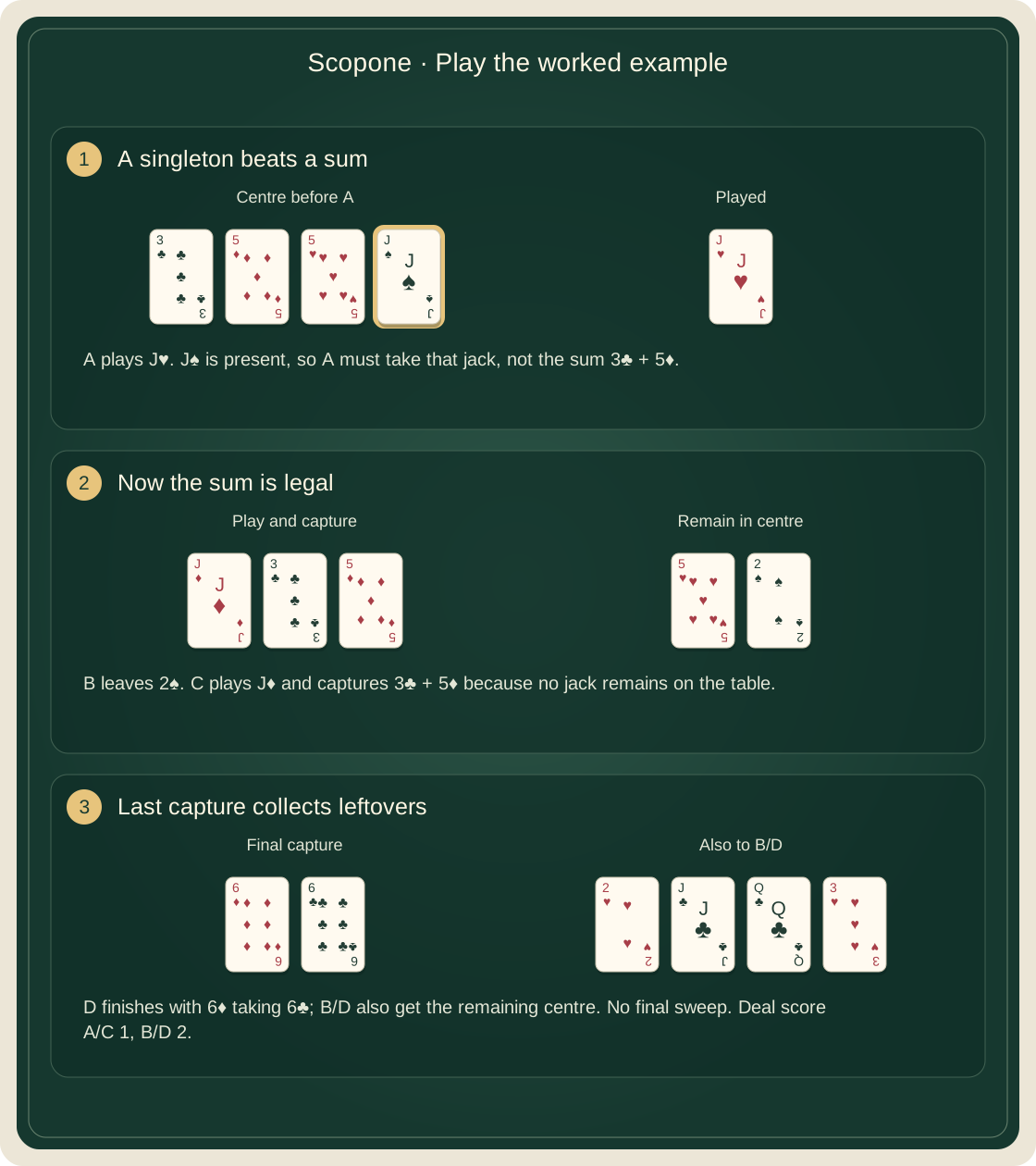
The centre starts 3♣, 5♦, 5♥, J♠. A plays J♥ and must take J♠, not 3♣ + 5♦, because an equal exists. B drops 2♠. C now plays J♦ and may take 3♣ + 5♦, because no jack remains. D drops A♦. A’s K♦ cannot capture the remaining 5♥ + 2♠ + A♦, so stays. The replay below follows all cards through the final collection.
Open the complete play record
| Play | Player | Card | Captured |
|---|---|---|---|
| 1 | A | J♥ | J♠ |
| 2 | B | 2♠ | — |
| 3 | C | J♦ | 3♣ 5♦ |
| 4 | D | A♦ | — |
| 5 | A | K♦ | — |
| 6 | B | 4♠ | — |
| 7 | C | 3♦ | 2♠ A♦ |
| 8 | D | 3♠ | — |
| 9 | A | 5♠ | 5♥ |
| 10 | B | 4♥ | 4♠ |
| 11 | C | 6♥ | — |
| 12 | D | 7♠ | — |
| 13 | A | 7♦ | 7♠ |
| 14 | B | K♣ | K♦ |
| 15 | C | A♠ | — |
| 16 | D | 4♦ | 3♠ A♠ |
| 17 | A | A♣ | — |
| 18 | B | A♥ | A♣ |
| 19 | C | Q♦ | — |
| 20 | D | 7♣ | — |
| 21 | A | 4♣ | — |
| 22 | B | 7♥ | 7♣ |
| 23 | C | 2♦ | — |
| 24 | D | 2♣ | 2♦ |
| 25 | A | 6♠ | 6♥ |
| 26 | B | Q♠ | Q♦ |
| 27 | C | K♠ | — |
| 28 | D | 5♣ | — |
| 29 | A | 2♥ | — |
| 30 | B | K♥ | K♠ |
| 31 | C | J♣ | — |
| 32 | D | Q♥ | 4♣ 5♣ |
| 33 | A | Q♣ | — |
| 34 | B | 3♥ | — |
| 35 | C | 6♣ | — |
| 36 | D | 6♦ | 6♣ |
← On a small screen, scroll the diagram horizontally. →
09 /
Score each category separately
D makes the final capture, so B/D also collect 2♥, J♣, Q♣ and 3♥ left on the table. A/C have 14 cards, B/D 26: one point B/D. Coins split 5–5: neither scores. A/C hold 7♦: one point A/C. Primiera is 73 against 76: one point B/D. No sweeps occurred. Deal score 1–2; all 40 cards are in the two team piles.
10 /
Check your understanding
Can a jack take a sum when a jack is present?
Reveal the answer
No. A matching singleton takes priority.
Is a final table collection a sweep?
Reveal the answer
No. Nor does the last dealer play earn a sweep in this profile.
11 /
History and other versions
Scopone is the partnership expansion of Scopa. Treccani’s historical account already describes the nine-card deal and four centre cards. The ten-card version often called scientifico changes that opening and can also change the last-sweep convention. Chitarrella is associated with published strategic maxims, but the name should not be turned into a securely identified inventor.
Common questions
Do aces take everything?+
Not here. Ace captures one ace and has capture value one.
Do all picture cards count ten for capture?+
No. Jack is eight, queen nine, king ten; their primiera values are different from capture values.
Are partners fixed?+
Yes. Opposite players combine their captures and match score.