← On a small screen, scroll the diagram horizontally. →
01 /
Your first round
Draw, open if eligible, expose or extend legal combinations, then discard. To win the deal you must discard the final card. The player closing scores no penalty; the opponent records the value left in hand. Over several deals try to stay below the elimination limit.
02 /
Cards, seats and the deal
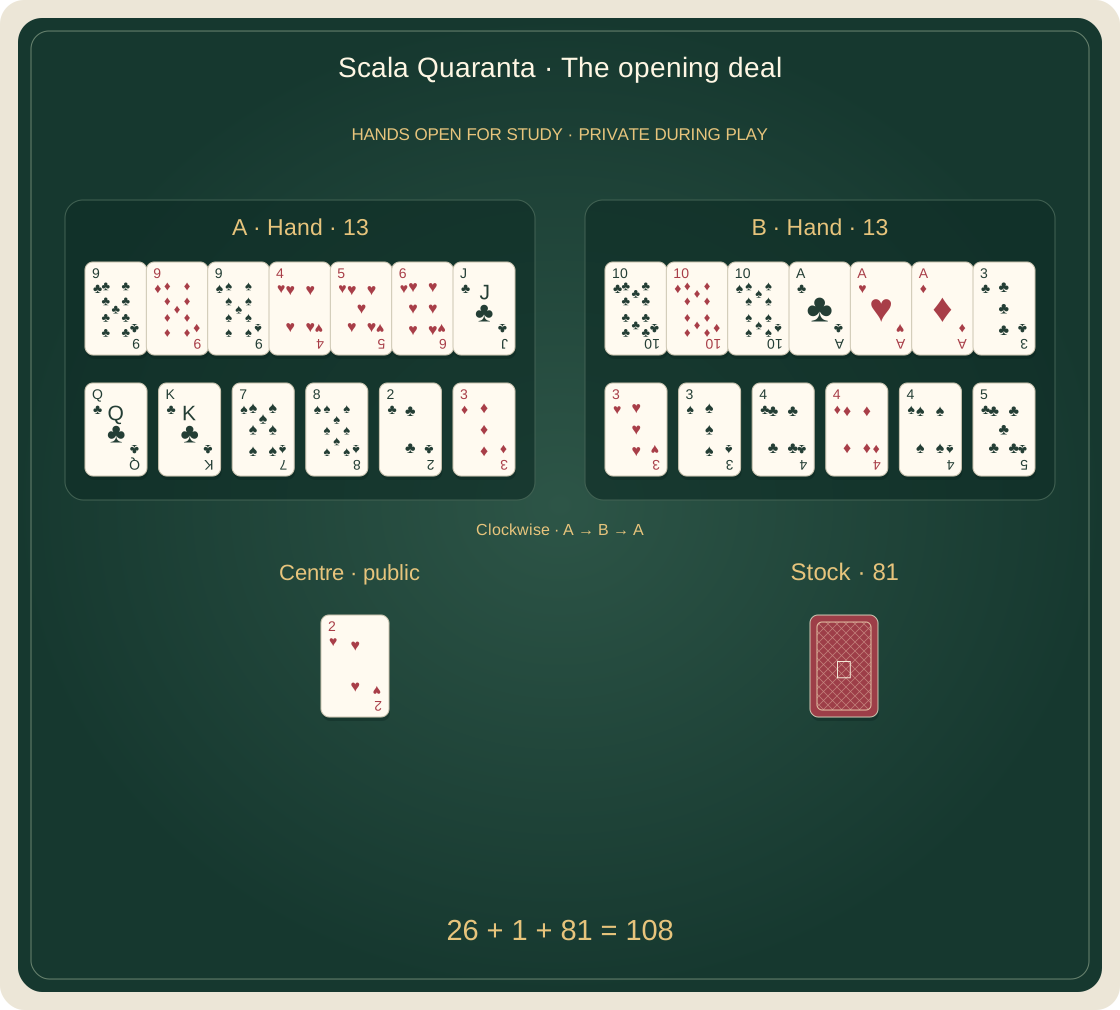
Shuffle 108 cards and offer the cut to the dealer’s right. Deal 13 each clockwise, turn one discard up and retain 81 in stock. Left of dealer starts. Keep the discard stack squared so only the top is visible. Change dealer each deal. The illustrations expose private hands solely for study.
03 /
Sets, sequences and aces
A set contains three or four equal ranks in different suits. A sequence contains at least three consecutive cards of one suit. Each meld may contain at most one joker, assigned the missing card. Ace can be low or high, never a short K–A–2 loop. FISCA also permits the full-suit fourteen-card sequence A–2–…–K–joker or joker–2–…–K–A; this exceptional endpoint extension does not license short wraparound runs.
04 /
How to open for forty
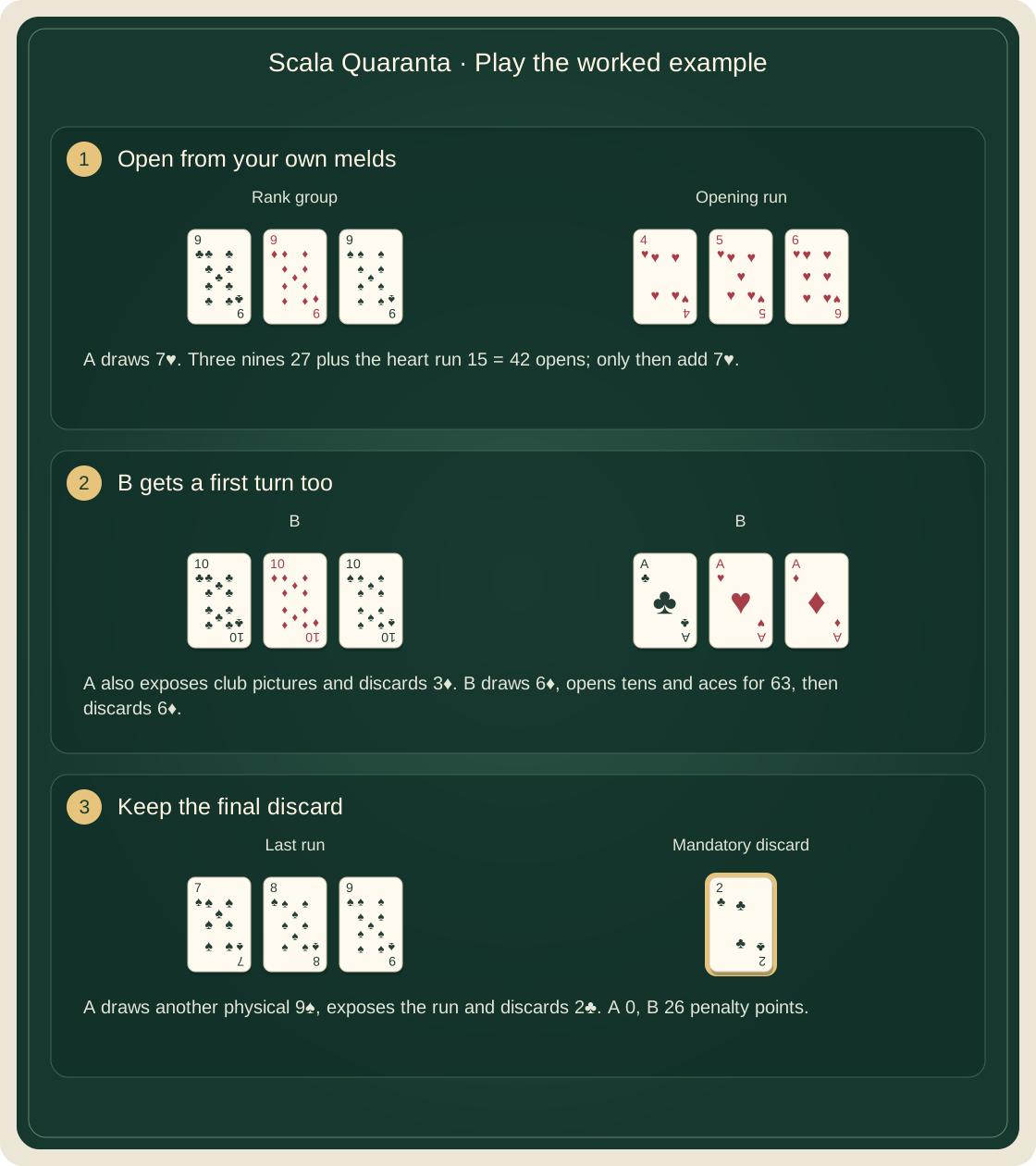
Before opening you must draw stock. Your first exposed complete combinations must total at least 40: pips face value, courts 10, ace 1 before two or 11 in a set or after king. Joker counts as the card represented. Three nines give 27 and 4♥–5♥–6♥ give 15, so together 42 opens. Later additions to other players’ melds cannot supply your opening total.
05 /
What happens on your turn
After opening, choose stock or the top discard. A taken discard must be used that turn in a meld or extension and cannot itself be discarded again. An identical second physical copy may be discarded if you declare and, when asked, show the duplicate. You may add to anyone’s exposed melds. Do not split or relocate table cards to create new combinations.
06 /
Recovering a joker
An already opened player may replace an exposed joker with the exact natural card. Reuse the freed joker on the table during that same turn; do not keep it in hand. Before committing, identify a legal destination that still obeys the one-joker limit. You cannot simply take a joker because you can remake the surrounding meld.
07 /
When the round and match end
Discarding ends the turn, including the winning turn. If you accidentally expose all cards, undo enough of your turn to retain a final discard. No one may close during the first circuit before everyone has played. In this two-player profile an opened player may discard an attachable card; multiplayer FISCA games prohibit that unless it closes. After the last stock draw finishes its turn, leave the latest discard, shuffle older discards, have them cut and form new stock.
08 /
Scoring and settlement
At closure score 0 to the winner. Others count all held cards: joker 25, ace 11, figures 10, numbers face value, even a complete meld still held. We choose elimination at 101; 201 is another agreed limit. Reaching the limit eliminates you; the last player below it wins. The baseline has neither automatic 100 for an unopened hand nor hand-closure doubling.
09 /
A complete worked example
A draws 7♥, opens three nines plus 4♥–5♥–6♥ for 42, then extends with 7♥, exposes J♣–Q♣–K♣ and discards 3♦. B draws 6♦, opens three tens and three aces for 63, then discards 6♦. Everyone has now played. A draws the other physical 9♠, exposes 7♠–8♠–9♠ and discards the final 2♣. The earlier 9♠ remains in the exposed set; no table card was reused.
← On a small screen, scroll the diagram horizontally. →
10 /
A penalty, not a reward
B keeps three threes, three fours and 5♣: 9 + 12 + 5 = 26 penalty points; A gets 0. Starting from zero, neither reaches 101, so play another deal. If B had already accumulated 80, the new total 106 would eliminate B. Do not add meld values to the winner’s score as in Rummy 500.
11 /
Check your understanding
May I open by taking the top discard?
Reveal the answer
Not under the core profile. That requires the separately agreed opening-with-discard variant.
Can the last card complete a run?
Reveal the answer
Not as a winning exit. Keep a card to discard last.
12 /
History and other versions
Scala Quaranta is an Italian member of the rummy family, with an organised federation ruleset. Its name describes the opening threshold. The FISCA text separates the core from optional variants, especially opening with a discard and closing all at once. That distinction matters more at a new table than an unsupported story about a single inventor.
Common questions
Does an ace always count one?+
No. Low in an exposed run it can; remaining in hand it is eleven.
Can a set contain identical copies?+
No. The suits in a rank set must differ.
Must a recovered joker be used immediately?+
It must be played back on the table during the same turn.