← On a small screen, scroll the diagram horizontally. →
01 /
Your first round
Draw two from stock, expose or extend your team’s melds, discard one. Partners share both the opening requirement and completed melds. Go out only when the team has two completed seven-card achievements. A legal exit may expose every card without a final discard, or expose all but one and discard it.
02 /
Cards, seats and the deal
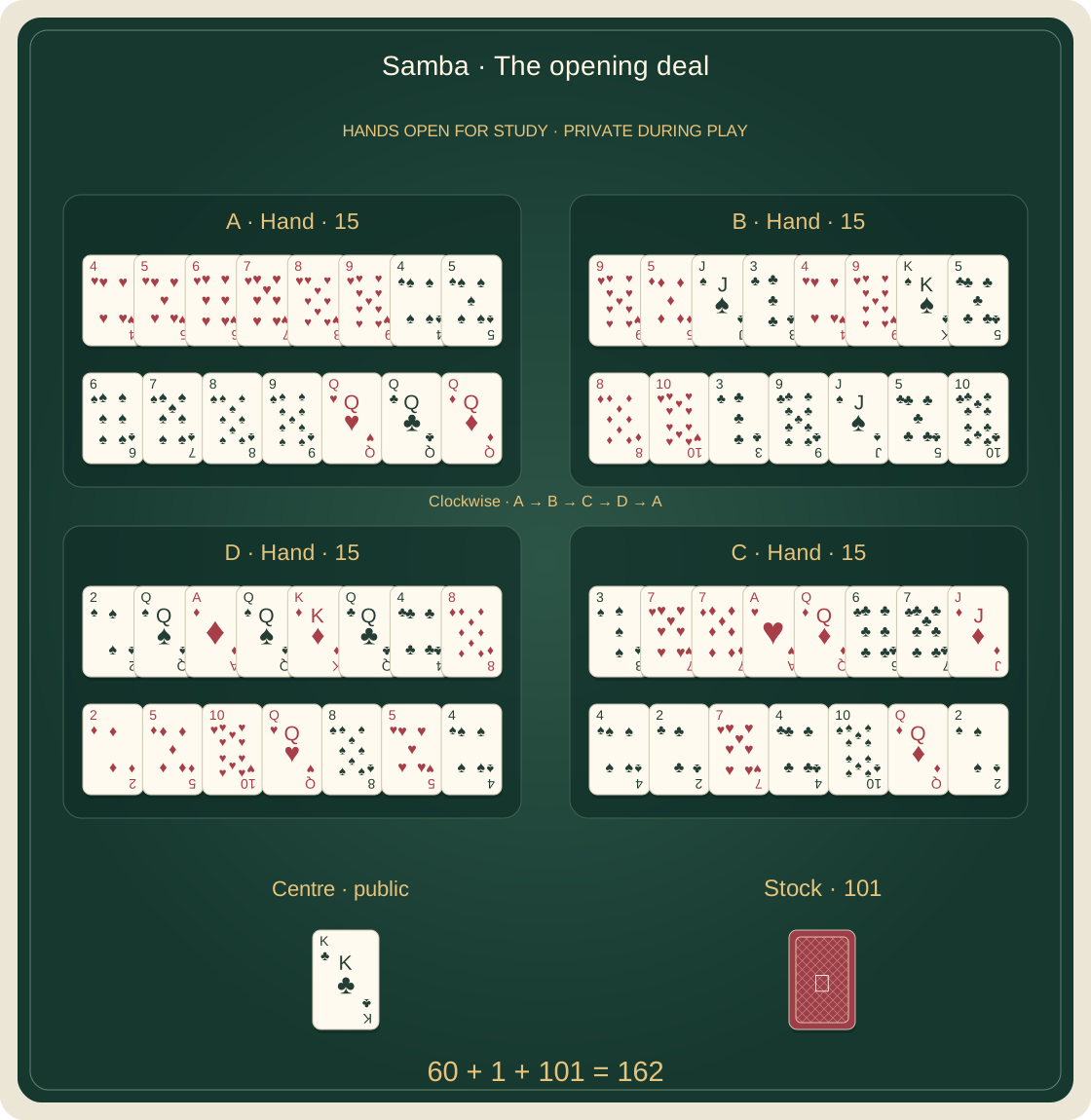
Shuffle all 162 cards. Deal 15 each, turn one up as the discard pile and keep 101 as stock. A and C partner against B and D. Left of dealer begins, clockwise. Rotate dealer between deals. If the first discard is a three or wild card it blocks pickup; normal stock drawing remains possible.
03 /
Groups and canastas
A group starts with at least three equal ranks. It must contain at least twice as many natural cards as wild cards, with at most two wild cards. Seven or more make a canasta: pure without wilds, mixed with them. You may add beyond seven; adding a wild turns a pure canasta mixed. Separate groups of the same rank may exist and may merge. Black-three groups follow the group rules but may be exposed only on your going-out turn.
04 /
Sequences and sambas
A sequence has three to seven consecutive natural cards of one suit, using ranks 4 through ace. No wilds, threes or wraparound. Seven makes a samba, which cannot be extended. Two existing sequences cannot be joined by playing a connecting card: build one sequence to completion instead. A group of seven equals a canasta, not a samba.
05 /
Opening requirement
Your team’s first melds must meet the threshold below from card values alone. Canasta, samba and red-three bonuses do not help. Once either partner opens, both may add to shared melds on their own turns.
| Score | Opening |
|---|---|
| Negative | 15 |
| 0–1495 | 50 |
| 1500–2995 | 90 |
| 3000–6995 | 120 |
| 7000+ | 150 |
06 /
What happens on your turn
Instead of two stock cards, take the discard pile only with two matching naturals from hand. Immediately meld those with the top card; meet any opening minimum using only that top and your hand, then take the rest. Alternatively take just the top if it directly extends your team’s already exposed sequence shorter than seven. You cannot start a new sequence this way or use a held connector. A three, two or joker on top blocks both routes.
07 /
Red and black threes
Expose red threes individually if you wish, with no replacement draw here. With the two completed melds required for exit, each exposed red three adds 100; all six together add 1000 instead. Without that qualification, each exposed one costs 100. Any number of red threes still held brings a single penalty of 750, not that amount per card. Discarding any three also blocks pickup.
08 /
When the round and match end
Without two completed melds you must retain at least one card. If exactly one remains and you cannot exit, pass instead of discarding it: this is the only pass exception. You may ask your partner permission to go out; the answer binds you, but asking is optional. Draw the final single stock card normally. When somebody later wants stock from an empty pile, stop without an exit bonus.
09 /
Scoring and settlement
Count exposed card values minus held values for both partners together, then bonuses. Ace and two are 20, joker 50, K/Q/J/10/9/8 are 10, 7/6/5/4 and black three are 5. Add 1500 per samba, 500 per pure canasta, 300 per mixed canasta, and 200 for going out. Apply red threes separately. Target 10000 at deal end; higher total wins if both qualify, exact tie plays on.
10 /
A complete worked example
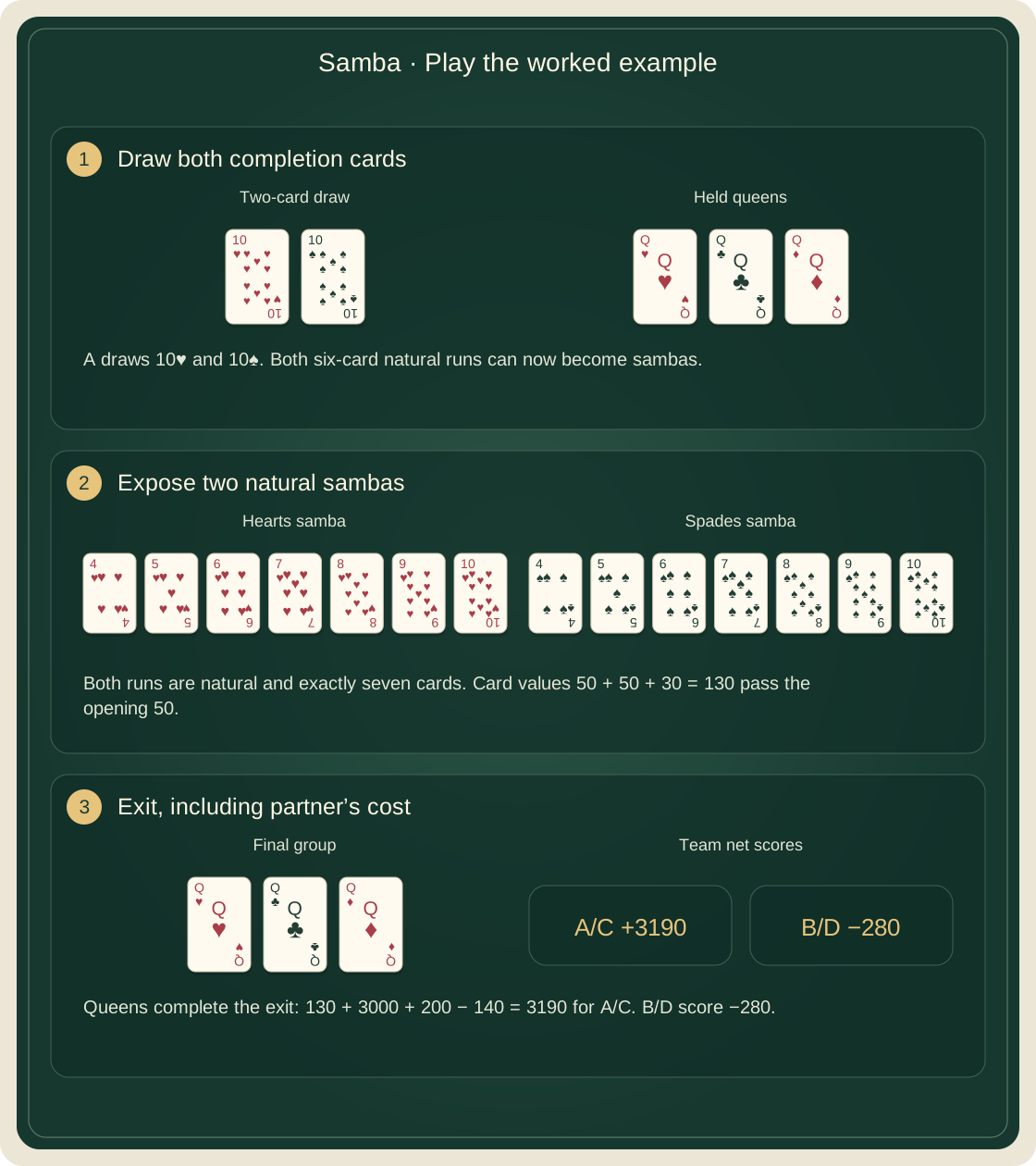
In the illustrated teaching deal A holds 4♥–9♥, 4♠–9♠ and three queens. The team starts at zero. A draws 10♥ and 10♠, then exposes both seven-card sequences and the queens. Card values total 50 + 50 + 30 = 130, exceeding opening 50. Two sambas already permit exit, so all 17 cards may be exposed without a discard. No partner permission was requested.
← On a small screen, scroll the diagram horizontally. →
11 /
Count the partner’s hand too
Bonuses are 3000 for the sambas and 200 for exit: 3330 before partner C’s remaining 140, giving A/C 3190. B/D hold 280 with no melds, so score −280. No red three is held or exposed in these hands. The lesson uses a deliberately strong starting hand to show a complete legal exit; it is not a probability claim.
12 /
Check your understanding
Can a joker complete a samba?
Reveal the answer
No. Sequences must be entirely natural.
Does a completed group allow any discard pickup?
Reveal the answer
No. Whole-pile pickup still needs two matching natural cards from hand.
13 /
History and other versions
Samba belongs to the Canasta family; the sequence meld explains the Dutch name Straat-Canasta. The selected account was contributed by Harrie Wiering. Other games called Samba, Bolivia or Black Samba change wild sequences and exit conditions. Their special features are not implied by this name. This guide does not assign an unverified inventor or invention year.
Common questions
Is a special pack required?+
No. Ordinary packs and the stated jokers suffice.
Must we have a samba to exit?+
No. Two canastas also qualify in this profile.
May I keep a red three?+
Yes, but retaining one when the deal ends triggers the stated held-red penalty.