← On a small screen, scroll the diagram horizontally. →
01 /
Your first round
Draw exactly one from stock or the top discard. Optionally expose complete melds and add cards to already exposed ones. End with one discard unless your last card has just been melded or laid off, which ends the hand immediately. The winner scores the value left in opponents’ hands. Keep playing new deals until someone reaches the agreed target.
02 /
The rules used here
Play to 100 scored by the hand winner. All cards in losing hands count, even valid combinations never exposed. There is no opening threshold, no joker and no need to open before laying off. Multiple melds are expressly allowed; some basic rulebooks allow only one. Aces are always low, so A–2–3 works but Q–K–A and K–A–2 do not.
03 /
Cards, seats and the deal
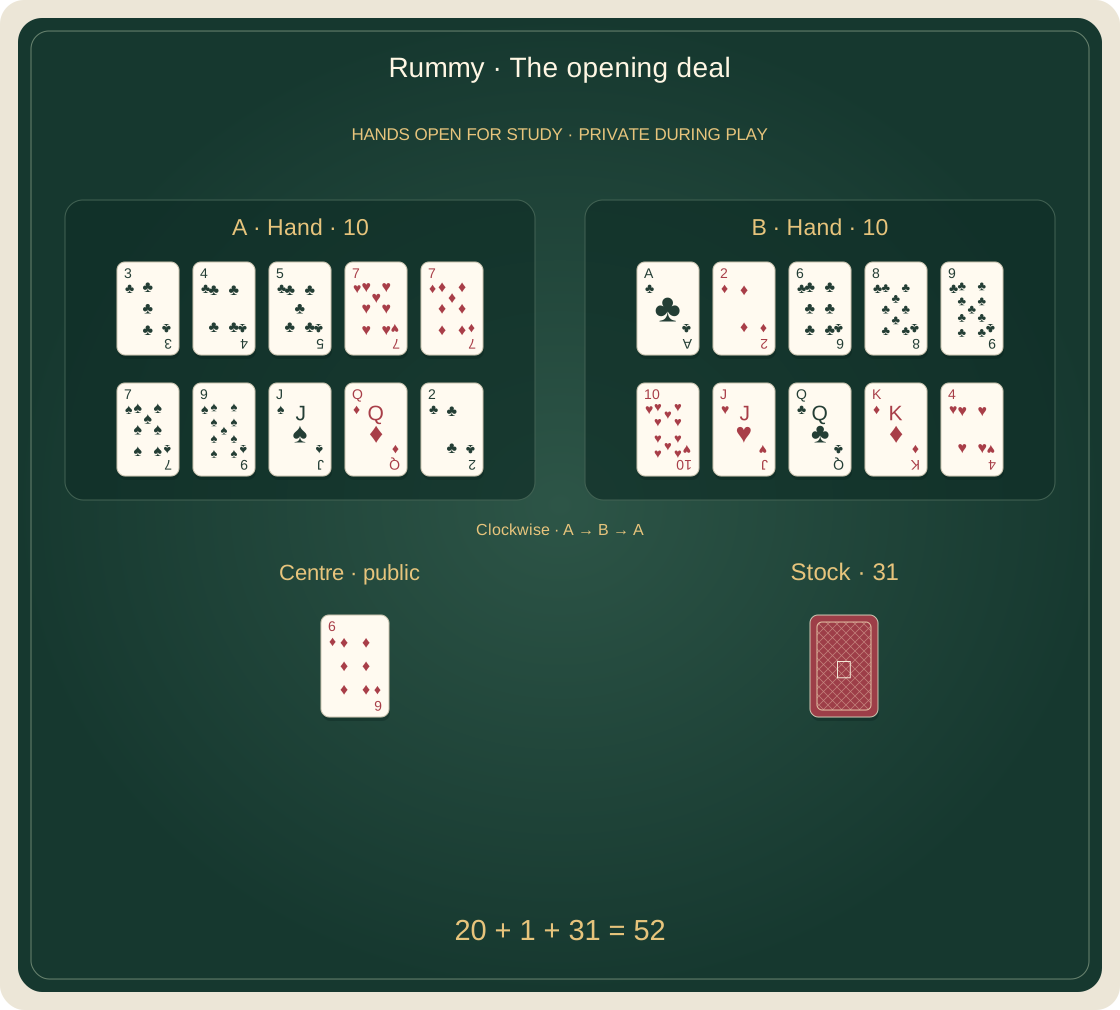
Shuffle fifty-two cards and cut. Two players receive ten each; three or four receive seven; five or six receive six. Deal singly clockwise from dealer’s left. Turn the next card face up to start the discard; the rest is stock. Nondealer starts at two players; eldest starts otherwise. We rotate dealer clockwise after each hand, including the two-player game.
04 /
Melds and layoffs
A set is three or four equal ranks of different suits. A run is at least three consecutive ranks of one suit. A card can belong to only one meld. Add the fourth matching card to a set or consecutive cards to either end of a run. You may lay off onto anyone’s meld, but cannot move a card between melds, split a run or take a card back into hand.
05 /
What happens on your turn
The draw is compulsory even if you could meld first. Expose as much or as little as you want, then discard one if still holding cards. A card taken from the discard cannot be discarded again that turn; a stock draw can. Only the top discard is available. You cannot pick up a deeper run of discards as in Rummy 500. Other players cannot claim out of turn.
06 /
When the round and match end
An empty hand ends play immediately, by melding, laying off or discarding. Otherwise, if stock is empty and the next player declines the top discard, turn the whole discard pile over without shuffling to become stock. Our finite house limit permits this once; on the next exhaustion and refusal, stop as blocked. Lowest hand value then scores the sum of opponents’ excess over that value; tied lowest divide that award equally.
07 /
Scoring and settlement
Courts are 10, ace 1, number cards face value. Add opponents’ entire remaining values to the player who went out. If that player had never exposed or laid off before this final turn, double the award for going rummy. Otherwise no double. A meld on the table scores no independent points. A blocked-hand award is not doubled, and reaching 100 through a completed settlement wins the match.
08 /
A complete worked example
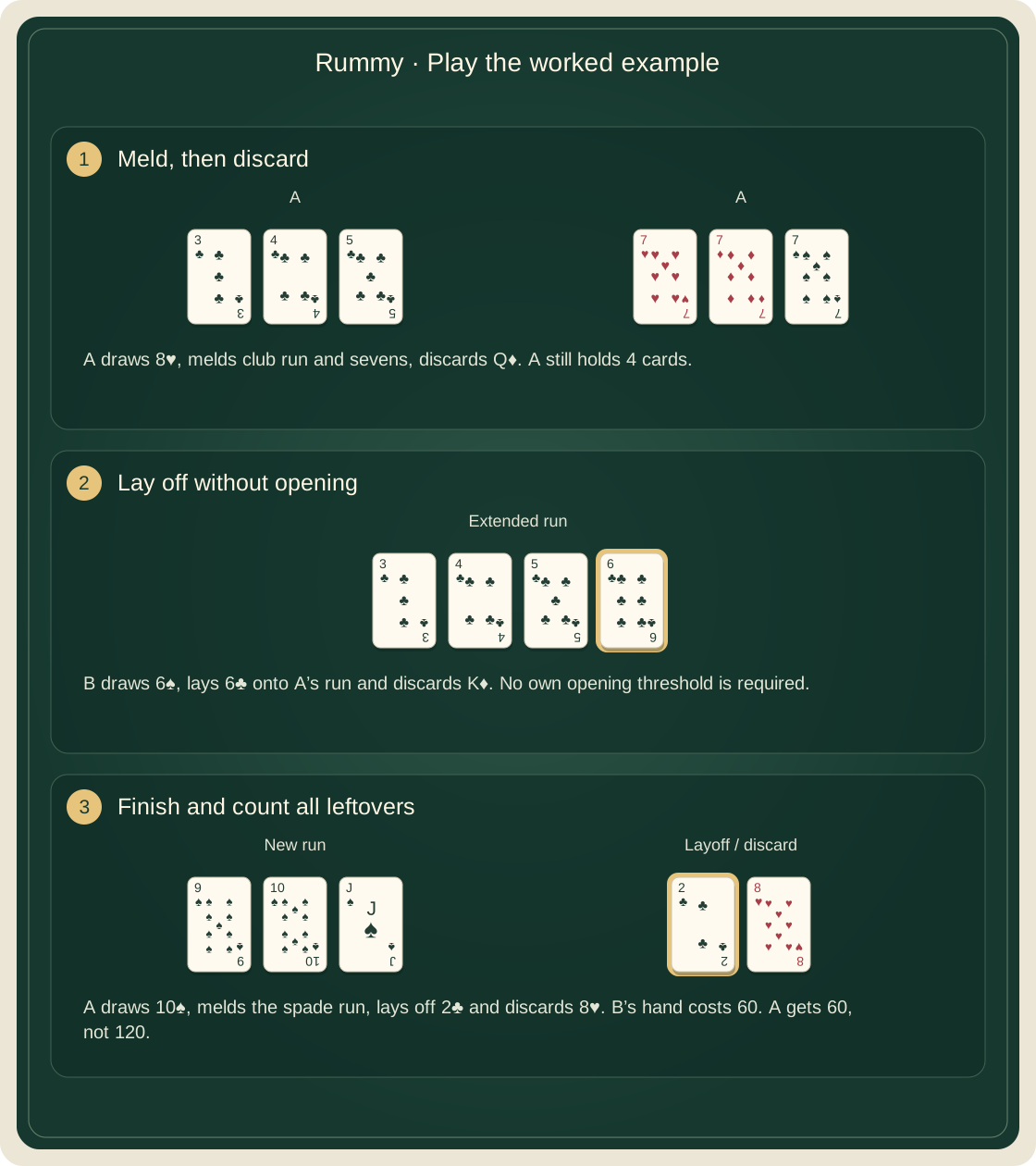
Discard starts 6♦. A draws 8♥, exposes 3♣ 4♣ 5♣ and 7♥ 7♦ 7♠, discards Q♦. B draws 6♠, adds 6♣ to A’s club run without needing an own opening, discards K♦. A draws 10♠, melds 9♠ 10♠ J♠, adds 2♣ to the club run and discards 8♥: out. B still holds A♣ 2♦ 8♣ 9♣ 10♥ J♥ Q♣ 4♥ 6♠: value 60. A scores 60, not 120, because A exposed cards earlier. Final inventory: table 11, B hand 9, discard 4, stock 28, total 52.
← On a small screen, scroll the diagram horizontally. →
09 /
Check your understanding
May you split a long exposed run to make a set?
Reveal the answer
No. Basic rummy only extends existing melds; it does not manipulate them.
Can an unexposed valid run avoid a hand penalty?
Reveal the answer
No. Every card still in the hand counts when an opponent goes out.
10 /
History and other versions
Rummy describes a broad family built around sets and sequences. Basic or Straight Rummy is a useful starting point for understanding its descendants, but Gin, Rummy 500, contract games and manipulation games change important procedures. Accounts often connect the family to Conquian while its exact development is debated. This page teaches one stated basic profile rather than claiming those other games follow it unchanged.
11 /
Mistakes to avoid
Before discarding, check whether the card could extend any exposed meld. Do not confuse the winner’s cumulative score with leftover-card penalties used by other variants. When taking a discard, plan a different discard unless you can go out. Agree recycling before play; an unlimited stock loop can prevent an otherwise finished lesson from ending.
Common questions
Must the last card be discarded?+
No in this profile. Melding or laying off the last card also ends the hand.
Can I use jokers?+
Not in this selected basic pack. Wild-card variants need a separate agreement.
Is ace high?+
No. Ace is low and worth one in this profile.