← On a small screen, scroll the diagram horizontally. →
01 /
Your first round
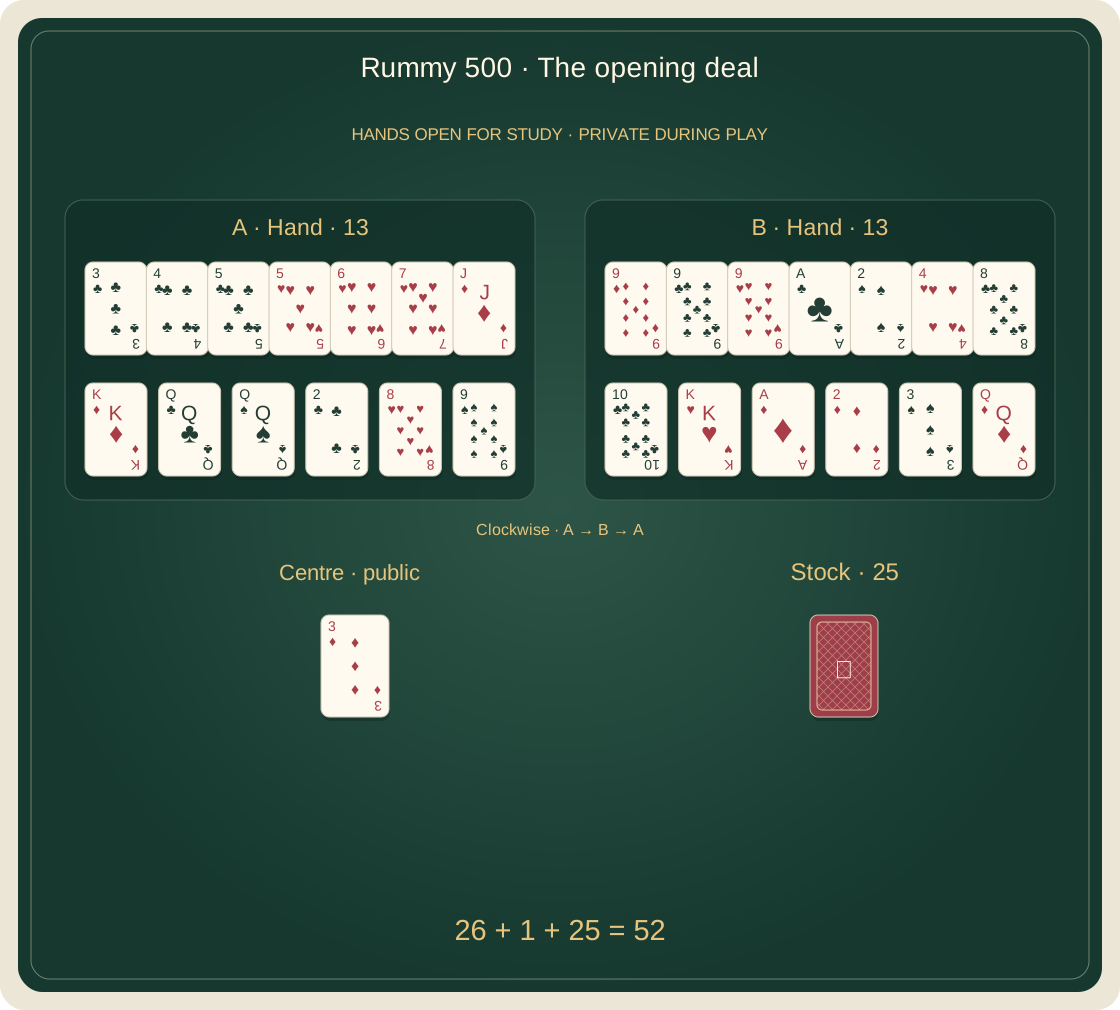
Draw once, expose any legal melds or additions you want, then discard one card unless your hand is already empty. Going out by melding is allowed. There is no opening minimum and you may extend another player’s meld without first making your own. Reaching the target depends on net points, not on winning every deal.
02 /
Cards, seats and the deal
Use 52 cards. With two players deal 13 each; with three or four deal 7 each. Turn one card up beside the face-down stock. Spread successive discards so all remain visible. The player left of dealer starts and play runs clockwise. Rotate dealer after each deal. There are no partners or trumps.
03 /
Melds and additions
A set has three or four equal ranks in different suits. A run has at least three consecutive cards of one suit. Ace may be low in A–2–3 or high in Q–K–A; K–A–2 is forbidden. You may extend either end of a run or add the fourth suit to a set. Never split or rearrange exposed melds.
04 /
What happens on your turn
Take the stock’s top card or take from the discard pile. Choosing a buried card means lifting it and every card above it; immediately use the chosen card in a new meld or a legal extension. Other collected cards may stay in hand. Taking only the top card needs no immediate meld here, but you cannot throw that same card straight back. After a multiple pickup you may discard a different card that came with it.
05 /
Who owns the points?
Keep your laid-off cards in your own scoring area and state which meld they extend. An added heart belongs logically to that run but its points belong to you. It cannot also complete a set. Use a note or marker to avoid counting an extension twice or giving its points to the original meld’s owner.
06 /
When the round and match end
The deal stops immediately when a hand empties, by a meld, extension or discard. If the stock is empty and a player chooses it rather than a legal discard pickup, stop and score; do not recycle. At the end of a deal, a total of 500 or more can win. If several qualify, highest total wins; an exact tie continues with another deal.
07 /
Scoring and settlement
Numbers count their printed value; J, Q and K count 10. An ace in hand or in a high run or set is 15. An ace exposed at the low end with 2 and 3 is 1. For each player, subtract all held values from the value personally melded. Negative deal scores and negative cumulative totals are allowed. No extra prize or doubling merely for going out.
08 /
A complete worked example
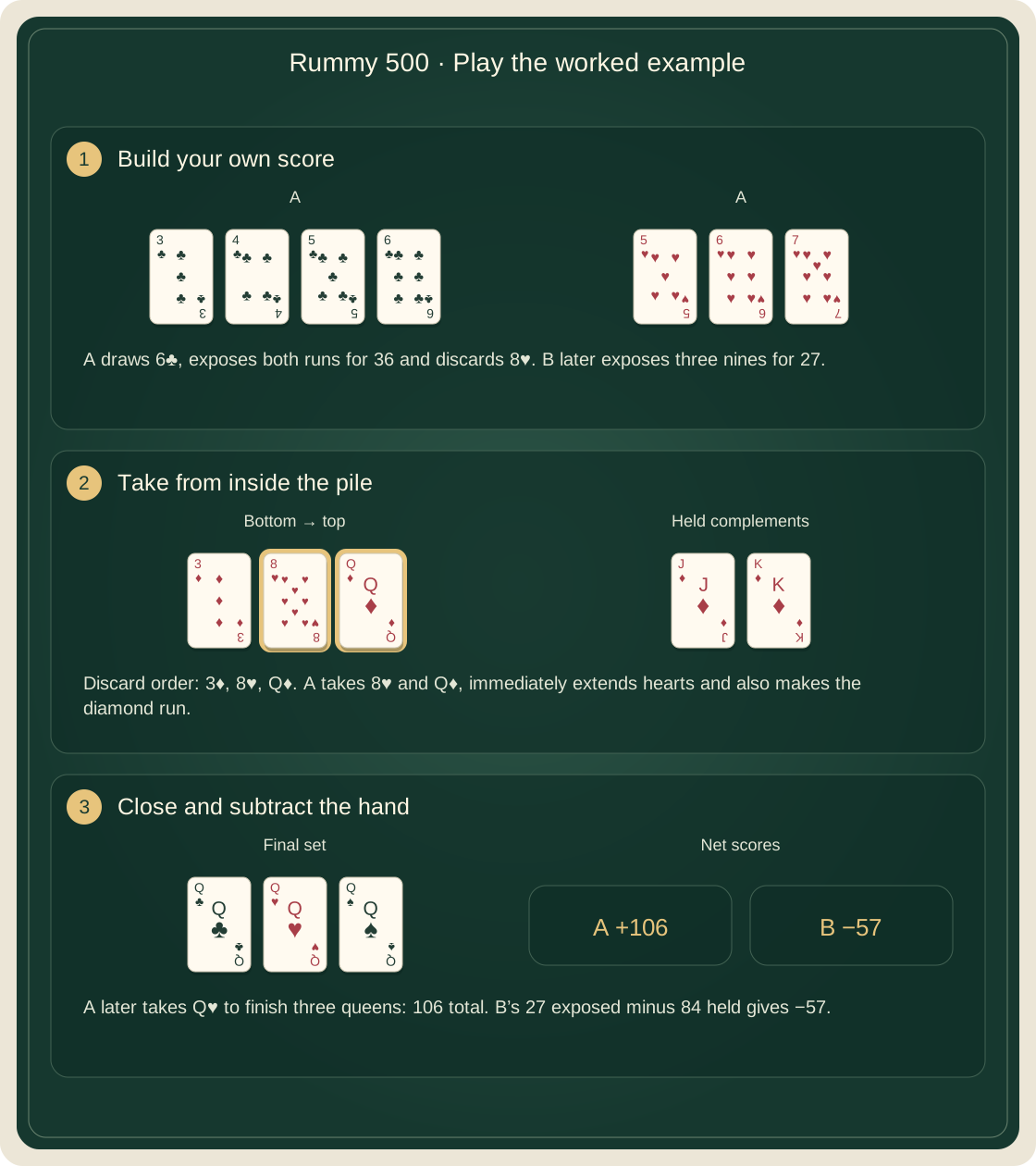
A starts by drawing 6♣, exposes 3♣–6♣ and 5♥–7♥ for 36, then discards 8♥. B draws A♥, exposes three nines for 27 and discards Q♦. A takes the buried 8♥ together with Q♦: 8♥ immediately extends the heart run. A also exposes J♦–Q♦–K♦, adds 2♣ to the club run and discards 9♠, keeping Q♣ and Q♠. B draws Q♥ and discards it. A takes Q♥, exposes three queens and goes out.
← On a small screen, scroll the diagram horizontally. →
09 /
Check the final inventory
A’s poses total 36 + 8 + 30 + 2 + 30 = 106. B has exposed 27 but holds cards worth 84, giving 27 − 84 = −57. All 52 cards remain accounted for: 18 exposed, 10 in B’s hand, 2 discards and 22 in stock. This is a completed deal, not a claim that A has already won the match.
10 /
Check your understanding
May the buried card stay in hand?
Reveal the answer
No. The chosen buried card must immediately enter a meld or extension; accompanying cards may stay.
Can a legal held meld avoid the penalty?
Reveal the answer
No. Everything still held is subtracted when play stops.
11 /
History and other versions
This belongs to the American rummy family and appears under the names 500 Rum and Pinochle Rummy. The shared target does not make it a version of trick-taking Pinochle. Published rules differ over jokers, out-of-turn calls and whether the top discard must be melded. This guide fixes those choices explicitly rather than combining incompatible habits.
12 /
Mistakes to avoid
Before a deep pickup, count the unwanted cards as well as the useful ones. Keep extensions assigned to exactly one meld. Do not move exposed cards to rebuild your hand, and do not copy the all-pips-five scoring from a different table without changing the whole agreement.
Common questions
Does going out double the score?+
No. Score your own exposed cards minus your own remaining hand.
Are jokers required?+
Not in this selected profile. Joker Rummy is another common agreement.
Can I add to someone else’s run?+
Yes, on your turn. The points for that added card belong to you.