← On a small screen, scroll the diagram horizontally. →
01 /
Your first round
Play a card. If it matches the opponent’s visible pile top, take the whole pile and put your played card on top. Otherwise capture all loose centre cards of that rank, adding your played card on top of your own pile. With no match leave the card in the centre. After both hands empty, deal new small hands without refreshing the centre. Largest pile at the end wins.
02 /
The rules used here
The article uses two active players so the full forty-card deal divides evenly into three-card batches. Larger tables exist but can need a different last-batch arrangement. Our stated tie-break for competing capture types is steal first; some families allow choice instead. No capture by adding two ranks, no sweep points, no special seven and no suit majority. Every physical captured card counts exactly one.
03 /
Cards, seats and the deal
Choose a dealer, shuffle and offer a cut. Deal three singly to the right-hand opponent and dealer, then four face up in the centre, leaving thirty in stock. Unlike Ronda, opening ranks may repeat. Opponent leads; turns alternate. After six plays both receive three more from the same dealer. Keep capture piles and the centre as they are. The next full deal changes dealer.
04 /
What happens on your turn
Choose any held card: there is no following suit. You must use a legal match under the selected priority. A loose match takes the played card and all equal-ranked loose cards; do not add neighbouring ranks. Put each new capture on your own pile, played card uppermost. Never turn a pile face down or search through it during play. Only its top rank is available for a steal.
05 /
Stealing and stealing back
For a steal, lift the entire opponent pile without changing its order, place it on top of your existing pile and put your matching card uppermost. Their pile becomes empty. The opponent may steal it back on the very next turn with another matching rank; there is no protection period. A match to your own top does not let you take an opponent’s unrelated pile. A new capture can change your top and thus the rank required to steal it.
06 /
When the round and match end
After the last batch, no replacement cards remain and everyone plays out. Loose centre cards go to the player who last captured or stole; this final transfer has no bonus. Count cards, not rank values, in the two piles. They must total forty. Most cards wins the deal; an equal count is a draw. For a session, agree a full dealer circuit and award one win per deal.
07 /
A complete worked example
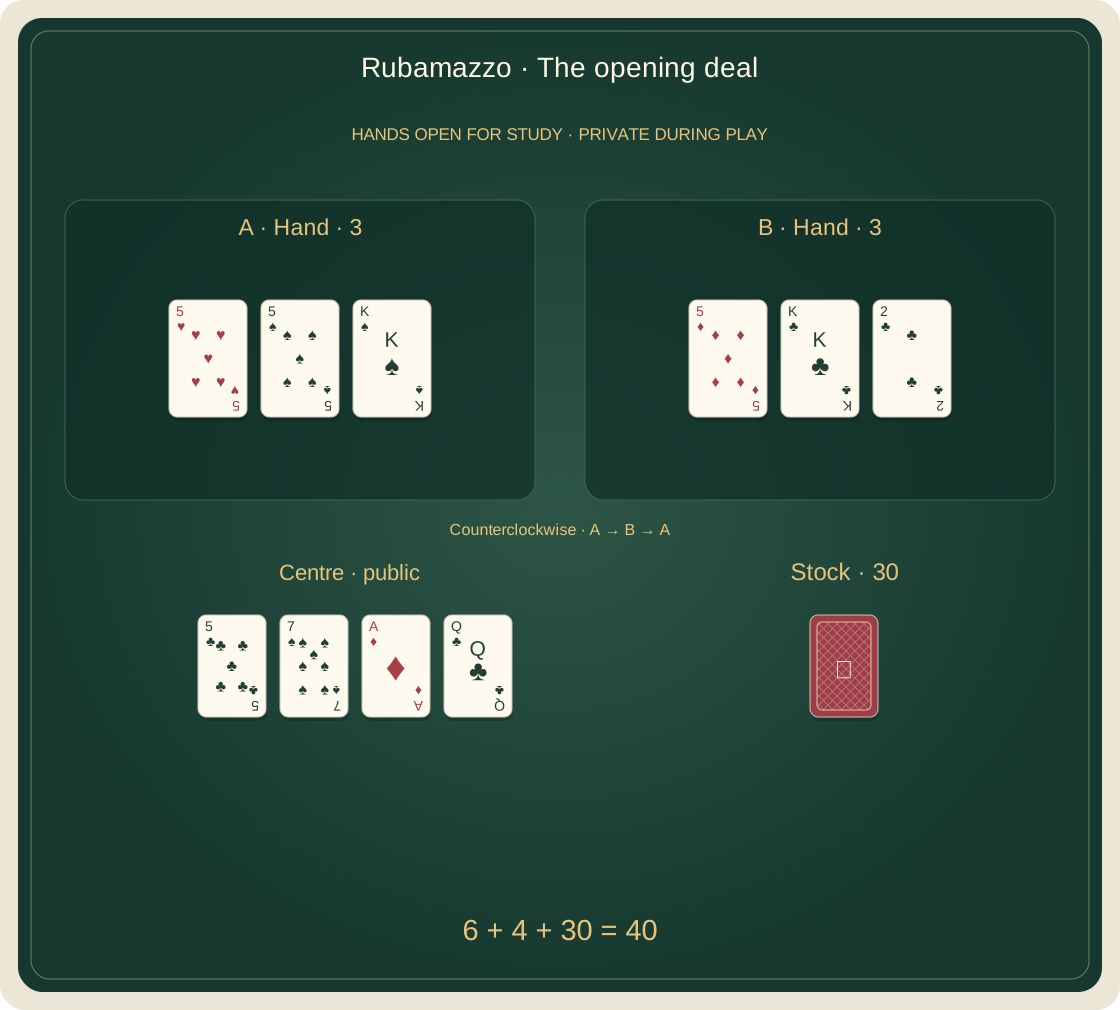
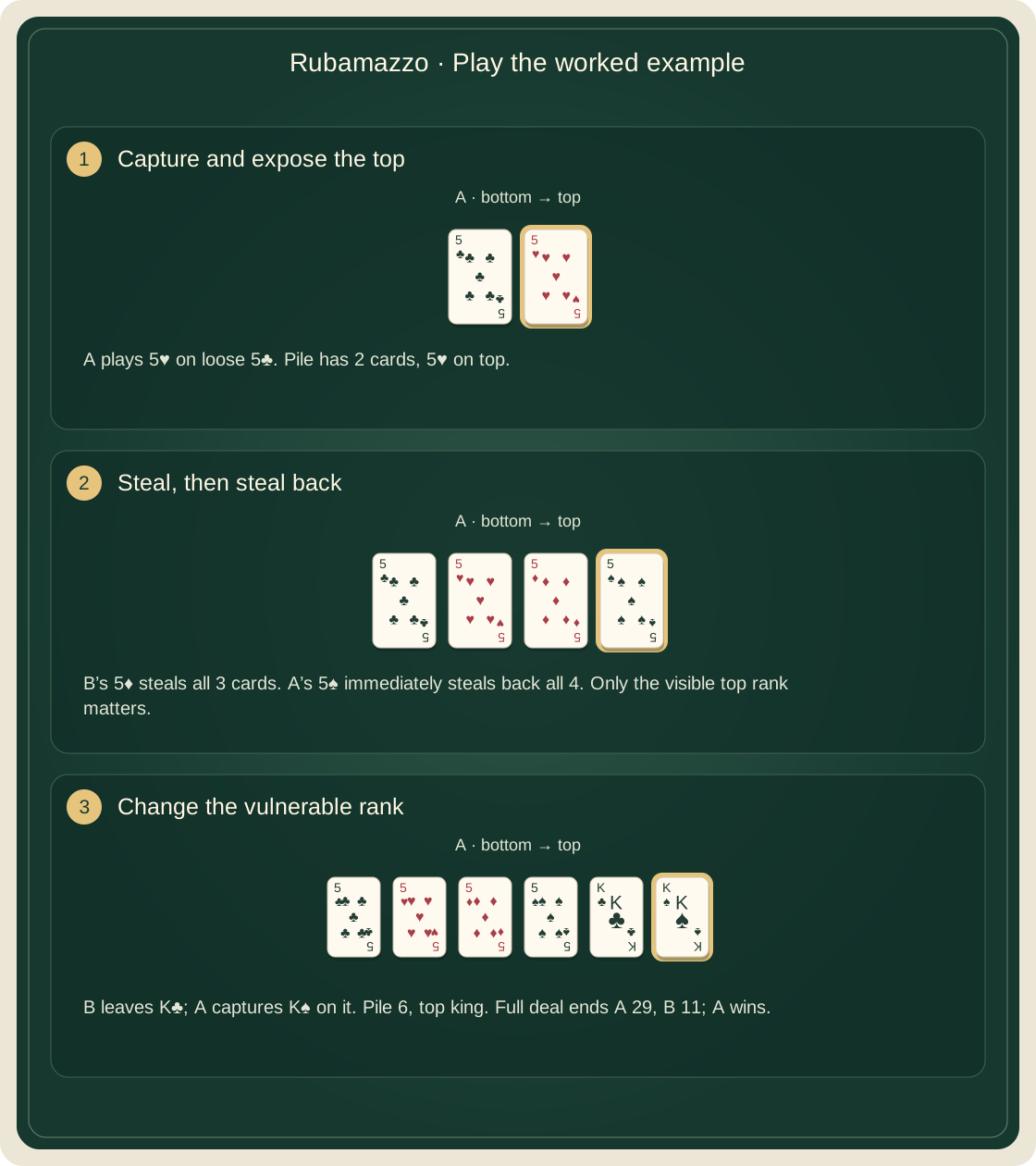
A has 5♥ 5♠ K♠; B 5♦ K♣ 2♣. Centre 5♣ 7♠ A♦ Q♣. A captures 5♣ with 5♥, pile size 2. B steals with 5♦, size 3. A steals back with 5♠, size 4. B leaves K♣. A uses K♠ to capture it and adds both to the pile: size 6, new top K♠. B’s 2♣ cannot steal a king and remains loose. The complete continuation ends A 29, B 11 cards, all 40 accounted for. A wins, although the pile changed hands twice at the start.
Show the complete deal
| Batch | Player | Card | Taken | Bonus |
|---|---|---|---|---|
| 1 | A | 5♥ | 5♣ | 0 |
| 1 | B | 5♦ | Steal pile | 0 |
| 1 | A | 5♠ | Steal pile | 0 |
| 1 | B | K♣ | — | 0 |
| 1 | A | K♠ | K♣ | 0 |
| 1 | B | 2♣ | — | 0 |
| 2 | A | 4♥ | — | 0 |
| 2 | B | Q♦ | Q♣ | 0 |
| 2 | A | K♥ | — | 0 |
| 2 | B | 7♣ | 7♠ | 0 |
| 2 | A | 6♠ | — | 0 |
| 2 | B | Q♥ | — | 0 |
| 3 | A | 3♠ | — | 0 |
| 3 | B | 6♦ | 6♠ | 0 |
| 3 | A | 6♥ | Steal pile | 0 |
| 3 | B | J♠ | — | 0 |
| 3 | A | A♥ | A♦ | 0 |
| 3 | B | 2♦ | 2♣ | 0 |
| 4 | A | A♠ | — | 0 |
| 4 | B | 4♦ | 4♥ | 0 |
| 4 | A | 3♥ | 3♠ | 0 |
| 4 | B | 2♠ | — | 0 |
| 4 | A | J♣ | J♠ | 0 |
| 4 | B | 4♠ | — | 0 |
| 5 | A | Q♠ | Q♥ | 0 |
| 5 | B | J♦ | — | 0 |
| 5 | A | 7♦ | — | 0 |
| 5 | B | 3♣ | — | 0 |
| 5 | A | 7♥ | 7♦ | 0 |
| 5 | B | 6♣ | — | 0 |
| 6 | A | K♦ | K♥ | 0 |
| 6 | B | 3♦ | 3♣ | 0 |
| 6 | A | J♥ | J♦ | 0 |
| 6 | B | 2♥ | 2♠ | 0 |
| 6 | A | 4♣ | 4♠ | 0 |
| 6 | B | A♣ | A♠ | 0 |
← On a small screen, scroll the diagram horizontally. →
08 /
Check your understanding
May a pile be stolen back immediately?
Reveal the answer
Yes, with another card matching the new visible top rank.
Can K take 4 and 6 by addition here?
Reveal the answer
No. This selected version matches ranks only. Sum captures belong to a different family profile.
09 /
History and other versions
Rubamazzo literally describes stealing a pack or pile and is also called Rubamazzetto or Rubamonte. Italian families use it as an accessible capture game, while regional rule accounts differ on sums and capture priority. Related Stealing Bundles and Casita Robada use other packs or hand sizes. We keep the Italian small-hand deal and explicitly identify the rank-only version rather than importing every Scopa rule.
10 /
Mistakes to avoid
Protect your pile by remembering which copies of its top rank have appeared. Do not hide the top or combine two separate piles into a pretend sum capture. Counting only capture actions instead of physical cards undervalues a large steal. A late change of top can matter more than a small extra capture.
Common questions
Do suits matter?+
No. Equal rank is enough, regardless of suit.
Does a king count more at the end?+
No. Each captured card counts one toward the pile size.
Can I steal a buried rank?+
No. Only the current visible top of the opponent’s pile is eligible.