← On a small screen, scroll the diagram horizontally. →
01 /
Your first round
Receive three cards, announce a pair or triple without naming its rank, and play one card each turn. A matching rank must capture and continue upward through every consecutive table rank. Otherwise leave your card on the table. Refill hands only after both are empty. Score declarations and special captures immediately, then count captured cards at the pack’s end.
02 /
The rules used here
Suits do not affect captures. The sequence is A, 2, 3, 4, 5, 6, 7, J, Q, K in our ordinary-pack illustrations; J immediately follows 7. A is lowest for comparing declarations here. Keep counter scores separate from capture piles. We use the basic game, excluding the advanced last-card duty that can award five extra points to either side.
03 /
Cards, seats and the deal
Shuffle and have dealer’s left cut. Deal three to the right-hand opponent, then three to dealer; expose four in the centre. They must have distinct ranks and must not be a consecutive four-rank chain: return offending cards to the stock, shuffle them in and replace. Opponent starts. After six plays, deal another three each without replenishing the table. Warn before the last batch. Six batches use all forty cards. Next deal passes right.
04 /
Ronda and tringa declarations
Before playing the first card of each batch, call ronda for a pair, worth 1, or tringa for three alike, worth 5, without naming rank. If both announce, higher combination wins their combined value: any triple beats a pair, otherwise higher rank wins. Equal pairs score 1 each. Delay contested awards until the cards prove the winner. Missing a real announcement or making a proved false one gives the opponent the corresponding 1 or 5; cancel any points incorrectly awarded for it.
05 /
What happens on your turn
Choose a card from hand. If its rank exists on the table, take that card, your played card and every successive higher rank until the first gap. Capture is compulsory, and it cannot begin merely by adding values. Thus 6 takes 6–7–J, but cannot also take K when Q is missing. A nonmatching card stays face up and ends your turn. Captured cards are kept face down; opponents cannot steal that pile.
06 /
Caida and mesa
Directly matching the opponent’s immediately preceding noncapture scores caida 1. Taking that card only as part of an ascending chain does not. The first play after a fresh batch cannot claim caida on the dealer’s preceding last card. Clearing the entire table scores mesa 1, except on the dealer’s very last card of the final batch. A legal direct caida and mesa on the same play score 2. That final dealer card can still score caida.
07 /
When the round and match end
At the last play, leftover table cards go to the last capturer without a sweep bonus. Each side with more than 20 captured cards scores one per excess card: 23 cards give 3. First to 41 wins immediately, including through a declaration or caida before the pack ends. An uncontested announcement scores immediately; contested announcements wait. Early challenge exposes the claimant’s cards: a proved false claim incurs its normal penalty, but a wrong challenge loses the whole match. Deliberately disputed announcements can therefore delay points; they are not a free bonus.
08 /
A complete worked example
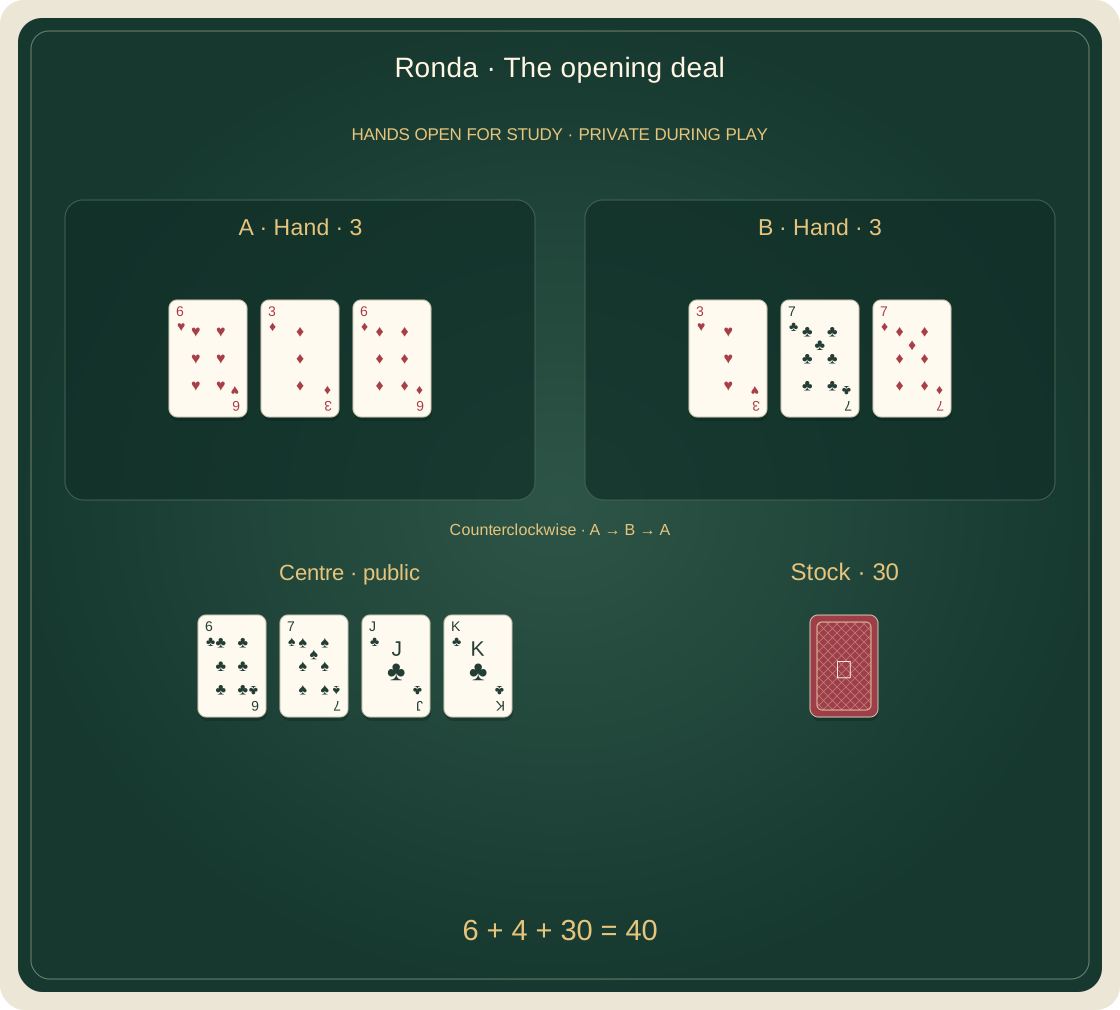
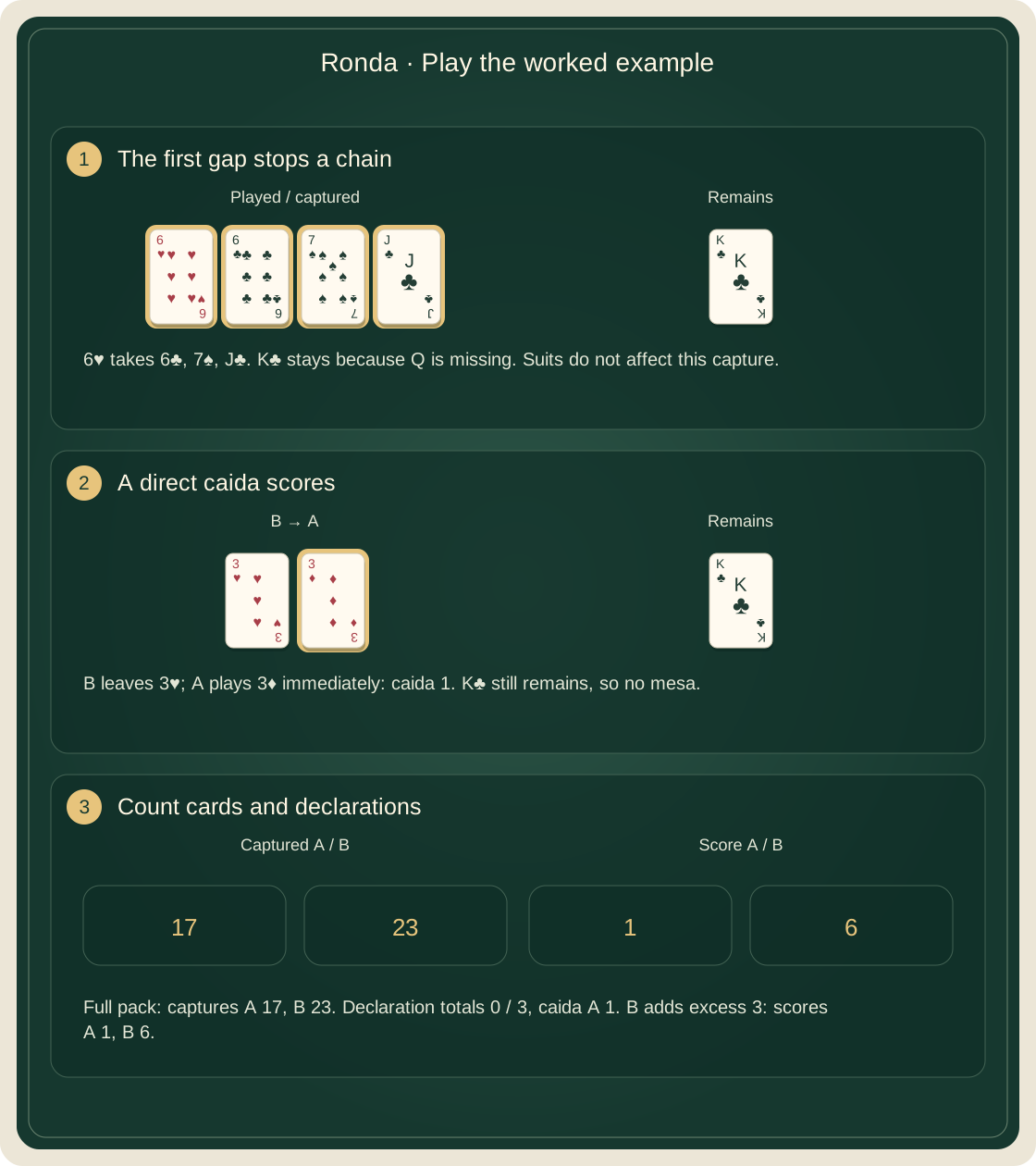
A holds 6♥ 3♦ 6♦, B 3♥ 7♣ 7♦. Both call ronda; B’s higher sevens eventually earn 2. Centre 6♣ 7♠ J♣ K♣. A’s 6♥ takes 6♣, 7♠ and J♣; K♣ stays because Q is missing. B leaves 3♥, A immediately takes it with 3♦ for caida 1; K♣ still prevents mesa. The expandable table follows every card of all six batches. Final captures A 17, B 23; declaration points A 0, B 3, caida A 1. B adds 3 for captured excess, so this complete pack ends A 1, B 6. Neither has reached the match target.
Show the complete deal
| Batch | Player | Card | Taken | Bonus |
|---|---|---|---|---|
| 1 | A | 6♥ | 6♣ 7♠ J♣ | 0 |
| 1 | B | 3♥ | — | 0 |
| 1 | A | 3♦ | 3♥ | 1 |
| 1 | B | 7♣ | — | 0 |
| 1 | A | 6♦ | — | 0 |
| 1 | B | 7♦ | 7♣ | 0 |
| 2 | A | Q♠ | — | 0 |
| 2 | B | 2♣ | — | 0 |
| 2 | A | A♦ | — | 0 |
| 2 | B | J♠ | — | 0 |
| 2 | A | 4♣ | — | 0 |
| 2 | B | K♦ | K♣ | 0 |
| 3 | A | 4♥ | 4♣ | 0 |
| 3 | B | Q♥ | Q♠ | 0 |
| 3 | A | 5♣ | — | 0 |
| 3 | B | 6♠ | 6♦ | 0 |
| 3 | A | K♥ | — | 0 |
| 3 | B | 5♥ | 5♣ | 0 |
| 4 | A | 2♦ | 2♣ | 0 |
| 4 | B | 3♣ | — | 0 |
| 4 | A | Q♦ | — | 0 |
| 4 | B | J♦ | J♠ Q♦ K♥ | 0 |
| 4 | A | 4♠ | — | 0 |
| 4 | B | 3♠ | 3♣ 4♠ | 0 |
| 5 | A | 5♠ | — | 0 |
| 5 | B | 7♥ | — | 0 |
| 5 | A | 2♥ | — | 0 |
| 5 | B | J♥ | — | 0 |
| 5 | A | 4♦ | — | 0 |
| 5 | B | A♠ | A♦ 2♥ | 0 |
| 6 | A | A♣ | — | 0 |
| 6 | B | 2♠ | — | 0 |
| 6 | A | K♠ | — | 0 |
| 6 | B | A♥ | A♣ 2♠ | 0 |
| 6 | A | 5♦ | 5♠ | 0 |
| 6 | B | Q♣ | — | 0 |
Check the declarations in every batch
| Batch | A | B | Points A / B |
|---|---|---|---|
| 1 | 6♥ 3♦ 6♦ | 3♥ 7♣ 7♦ | 0 / 2 |
| 2 | Q♠ A♦ 4♣ | 2♣ J♠ K♦ | 0 / 0 |
| 3 | 4♥ 5♣ K♥ | Q♥ 6♠ 5♥ | 0 / 0 |
| 4 | 2♦ Q♦ 4♠ | 3♣ J♦ 3♠ | 0 / 1 |
| 5 | 5♠ 2♥ 4♦ | 7♥ J♥ A♠ | 0 / 0 |
| 6 | A♣ K♠ 5♦ | 2♠ A♥ Q♣ | 0 / 0 |
← On a small screen, scroll the diagram horizontally. →
09 /
Check your understanding
Does J follow 7 in these diagrams?
Reveal the answer
Yes. It substitutes for the Spanish ten; there are no intervening ranks in the active pack.
A chain collects the opponent’s last card. Always caida?
Reveal the answer
No. The played rank must directly match that immediately preceding card.
10 /
History and other versions
Ronda is a living Moroccan fishing tradition, known in several cities and neighbouring communities. Its vocabulary reflects Arabic, Spanish and French usage: caida and mesa also appear under local names. That diversity explains different targets, declaration ranks and card-transfer scoring. This guide records one coherent two-player version and does not claim a known inventor or a single compulsory national code.
11 /
Mistakes to avoid
Do not capture by sums as in Scopa. Announce a real combination before its first card is played and do not reveal its rank early. Remember a batch boundary breaks the direct-caida link. Count all captured cards, including the card used to capture, but never convert ordinary card ranks into extra points.
Common questions
Is every sweep worth a point?+
No. The dealer’s final card of the pack cannot score mesa.
Can I decline a matching capture?+
No. A direct match and its full ascending chain are compulsory.
Who gets leftover centre cards?+
The last capturer, after the final play, without an extra mesa.