← On a small screen, scroll the diagram horizontally. →
01 /
Your first round
Draw, form or extend combinations, then discard one card. Before manipulating anything already exposed, open with enough of your own cards. After opening, you may split, merge or rebuild public melds while adding a card from hand. You win the deal by discarding your last card, leaving the entire table valid. Drawing alone is a legal turn if you finish with a discard.
02 /
The rules used here
We use the discard-pile operator profile, with no taking table cards back into a hand. No wraparound K–A–2. An ace may end a high run or start a low run. Use a three-deal match with lowest penalties winning; exact ties share victory. For an unfinished rearrangement restore the previous table before discarding; a photograph or written card list helps avoid accidental theft.
03 /
Cards, seats and the deal
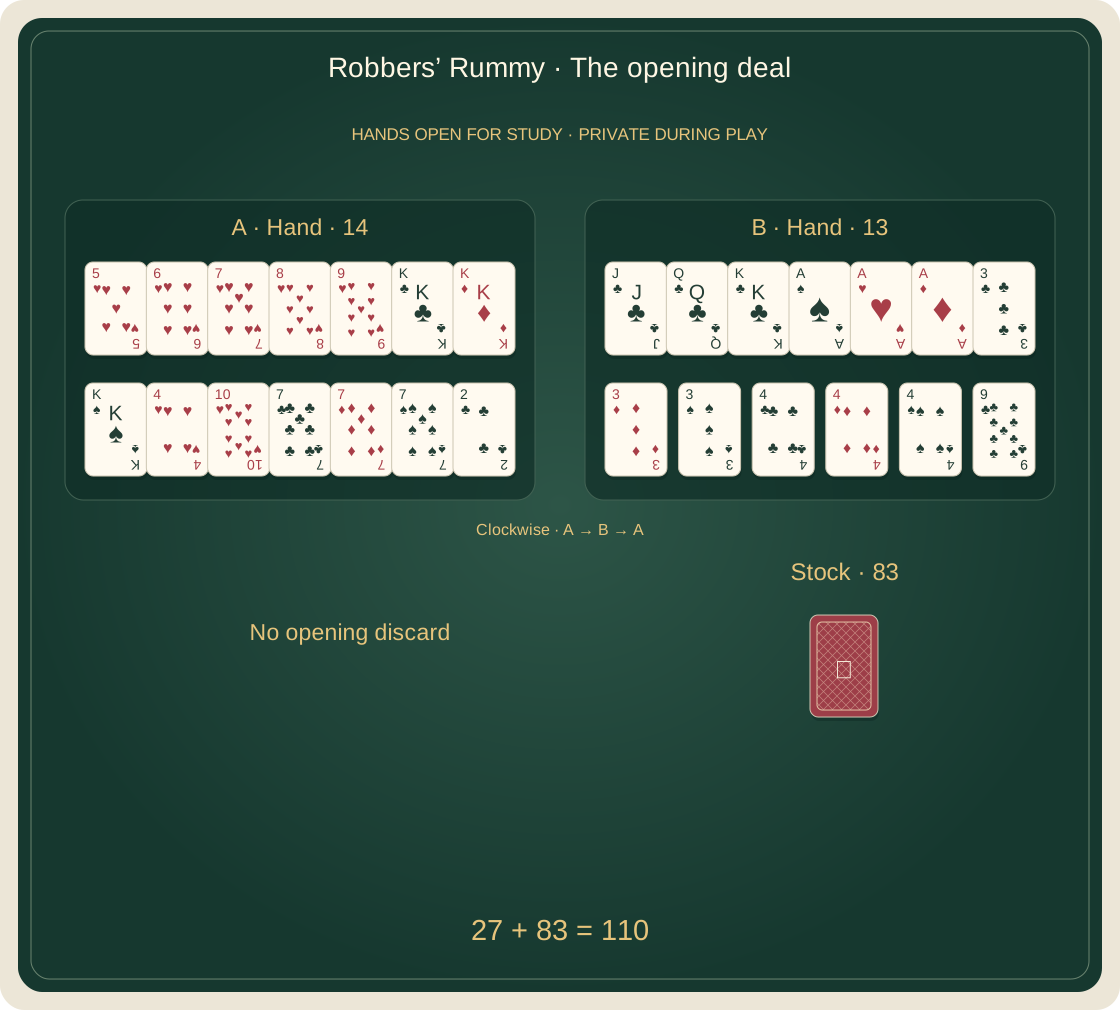
Shuffle all cards together. Choose a dealer randomly, deal clockwise thirteen each, and give the first player to dealer’s left one extra. That player begins without drawing; everyone else starts each turn by drawing. The remaining stock is face down; the discard pile begins empty and is created by the first discard. Dealer moves left after a deal.
04 /
Legal melds and jokers
A run has at least three consecutive ranks of one suit. A set has three or four equal ranks of different suits. Two copies of 7♥ cannot occupy the same set. A joker represents a specified rank and suit, and counts as that represented card in the opening. Once opened, jokers may move to new representations if every final meld is valid. They may never be pocketed. State their assignments so nobody mistakes a wild card for a natural duplicate.
05 /
What happens on your turn
Take the top stock card or top discard. A discard taken cannot be returned unchanged that turn. Opening requires 40 from complete new melds in your own hand: ace 11, or 1 in a low run, courts 10, pips face value. Only after opening may you lay off, reclaim a joker or manipulate. To rearrange, add at least one held card, preserve every table card and finish with valid disjoint melds. Always reserve a last card for the mandatory discard.
06 /
When the round and match end
The last discard ends the deal immediately. No opponent may save penalties by laying cards afterwards. If the stock empties, finish that drawing player’s turn and end without recycling; everyone counts the remaining hand. Opening and going out in one turn without earlier melding is Handrommé: no opening minimum, double opponents’ penalties. A player who already opened cannot claim it later.
07 /
Scoring and settlement
Unplayed jokers cost 20, aces 11, courts 10 and number cards their number. The player who goes out scores zero. Add penalties over 3 deals; lower is better. Exposed cards have no end penalty and do not belong to their original owner for scoring. A useful-looking sequence still in hand counts against you exactly like unrelated cards.
08 /
A complete worked example
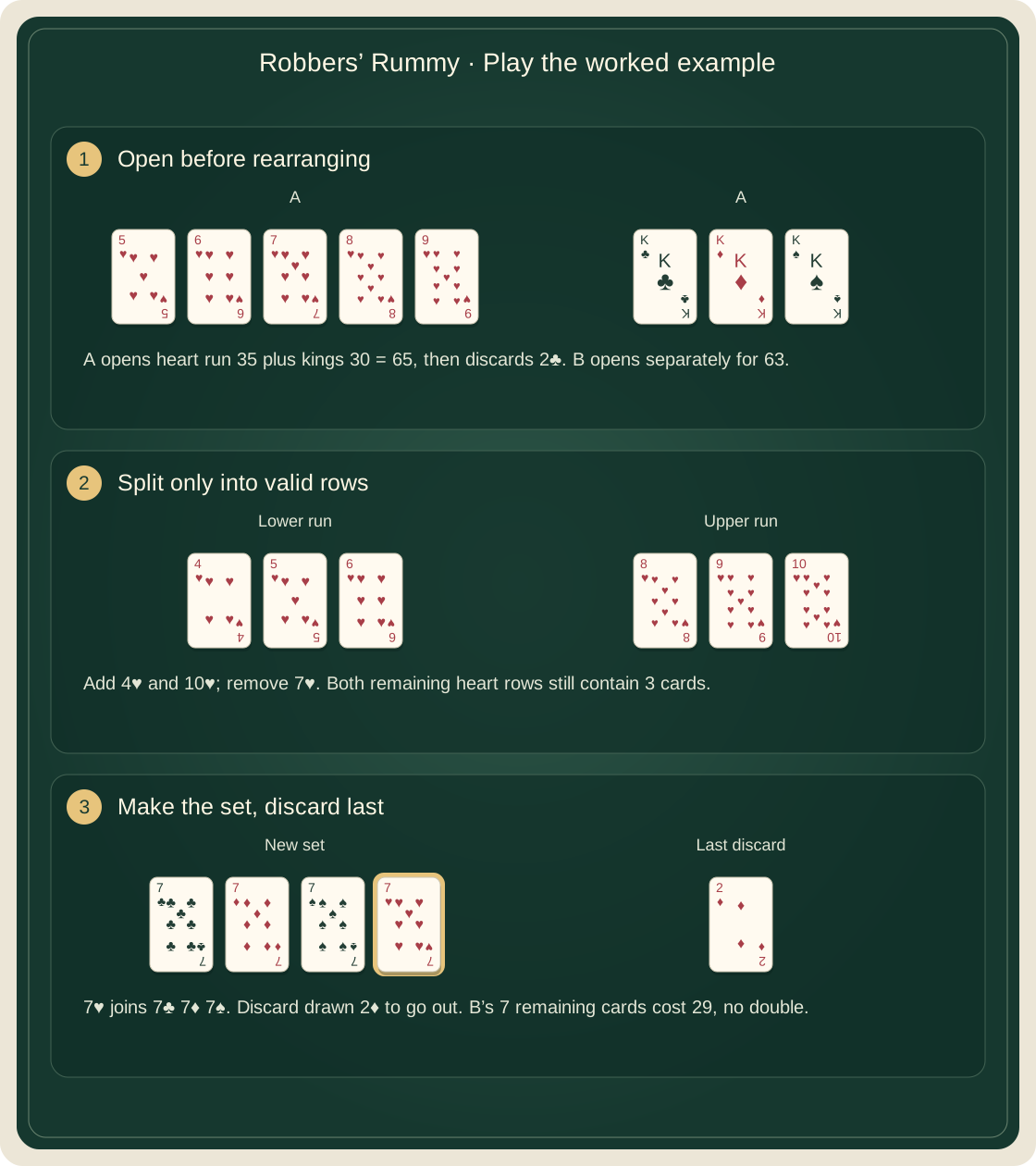
A opens 5♥–9♥ for 35 and K♣ K♦ K♠ for 30: total 65, then discards 2♣. B draws 8♦, opens J♣ Q♣ K♣ for 30 and A♠ A♥ A♦ for 33, then discards 9♣. The second K♣ is legal: two packs. A draws 2♦. Add 4♥ and 10♥ to the heart row, remove its 7♥ and combine that card with held 7♣ 7♦ 7♠. Final rows 4♥ 5♥ 6♥ and 8♥ 9♥ 10♥ each have three; the four sevens form a set. Discard 2♦ to go out. B retains 3♣ 3♦ 3♠ 4♣ 4♦ 4♠ 8♦: penalty 29. A already opened, so no doubling. All table cards remain present.
← On a small screen, scroll the diagram horizontally. →
09 /
Check your understanding
Can you take a table card into your hand?
Reveal the answer
No in this profile. Reuse it only inside valid table melds.
May two identical kings share one set?
Reveal the answer
No. Sets require different suits even though the pack contains duplicates.
10 /
History and other versions
Robbers’ Rummy names a family of manipulation games rather than one universal rulebook. German Rommé, no-discard Italian Machiavelli and tile games share the idea of rebuilding exposed combinations but differ in opening thresholds, draws and exits. The selected version documents those differences instead of treating a forty-point opening as a law of all rummy or claiming a single inventor.
11 /
Mistakes to avoid
Plan the whole rearrangement before moving the first card. Never leave a two-card fragment behind. Count identical physical cards separately and keep the discard distinct from exposed melds. A spectacular manipulation is not a legal exit if you used every card and forgot to leave the required last discard.
Common questions
Is this the same as Rummikub?+
No. This selected card profile has its own opening, deal and compulsory discard.
Must I use a joker when I have one?+
No, but an unplayed joker carries a heavy end penalty.
Can the last card be melded instead?+
Not here. Reserve a final discard to go out.