← On a small screen, scroll the diagram horizontally. →
01 /
Your first round
Everyone attempts the same contract in each round, from 1 through 15. Draw, expose the entire contract when ready, extend exposed melds if allowed, then discard unless the hand is already empty. A player’s first legal exit ends that round. Only cards left in hands score penalties; lowest accumulated score wins the session.
02 /
Cards, seats and the deal
Shuffle all 108 before each round. Deal 11 each clockwise, expose one discard, leave stock 63 at four players. First dealer random, next dealer left; left of dealer begins. Keep hands private. Identical cards from the two packs are separate physical cards and may share a set. Jokers need not appear in our natural-card teaching deal.
03 /
The complete contract schedule
Each number denotes the required minimum length of a separate meld; “+” separates melds. Round 14 also needs a pair of 2 equal-rank cards. Buying is unavailable where the table says 0. In rounds 12 and 13 each purchase adds the discard AND one blind stock card. These are purchase allowances, not a requirement to buy needlessly after already opening.
| Stage | Sets | Runs | Minimum cards | Buys |
|---|---|---|---|---|
| 1 | 3+3 | — | 6 | 0 |
| 2 | 3 | 4 | 7 | 0 |
| 3 | 4+4 | — | 8 | 0 |
| 4 | — | 4+4 | 8 | 0 |
| 5 | 3+3 | 4 | 10 | 0 |
| 6 | 4 | 5 | 9 | 0 |
| 7 | 5+5 | — | 10 | 0 |
| 8 | — | 5+5 | 10 | 0 |
| 9 | 3+3+3+3 | — | 12 | 1 |
| 10 | — | 4+4+4 | 12 | 1 |
| 11 | 4+4+4 | — | 12 | 1 |
| 12 | — | 3+3+3+3+3 | 15 | 2 |
| 13 | 3+3+3+3+3 | — | 15 | 2 |
| 14 | 5 | 5 | 12 | 1 |
| 15 | 3+3 | 5 | 11 | 0 |
04 /
Sets, runs and fixed wild cards
A set is equal ranks, duplicates allowed. A run is consecutive ranks of one suit. A may be high OR low, never both or wrapping. Adjacent runs of one suit and separate sets of the same rank are legal, but exposed melds cannot be joined or split. Jokers and 2s can fill any missing positions, with no wild-count cap here. Declare what each represents. Once exposed, wild cards cannot move or be reclaimed by substitution.
05 /
What happens on your turn
Take stock top or discard top. You may open only by exposing the whole current contract together; no partial opening. After opening, add cards to existing melds, yours or others’, even in that SAME turn. Do not create new extra melds beyond the contract. End with one discard if cards remain. Going out by melding every card is also legal, including round 15: there is no compulsory final discard.
06 /
Buying before the normal draw
Only rounds 9–14 permit buying. A purchase costs 1 counter to a separate kitty and adds discard top to your hand, plus one blind card only in rounds 12–13. It does not replace your normal draw or give a meld/discard turn. Current player has first choice to take or buy; competing requests favour the soonest normal turn. A purchase exposes the older discard for another legal purchase. Track each player’s allowance for that round.
07 /
Scoring and settlement
At an exit, hand penalties are: joker or 2 = 20, A = 15, K/Q/J = 10, 3 through 10 = 5 each. Winner scores 0; exposed melds score nothing. Add all 15 rounds. Keep buy-counter accounting separate: the lowest penalty total wins the kitty. For four players, optional traditional counter settlement is winner +12, others −2, −4, −6 in finishing order. Our teaching session omits that extra settlement; tied lowest share the kitty equally on paper.
08 /
When the round and match end
When a stock card is needed from an empty stock, keep discard top and shuffle older discards into new stock. If no required draw can be supplied, our table ends the round and scores every remaining hand, with no zero-score winner. Advance to the next contract even if some players never opened. After the final round compare totals, not the last-round winner.
09 /
A complete worked example
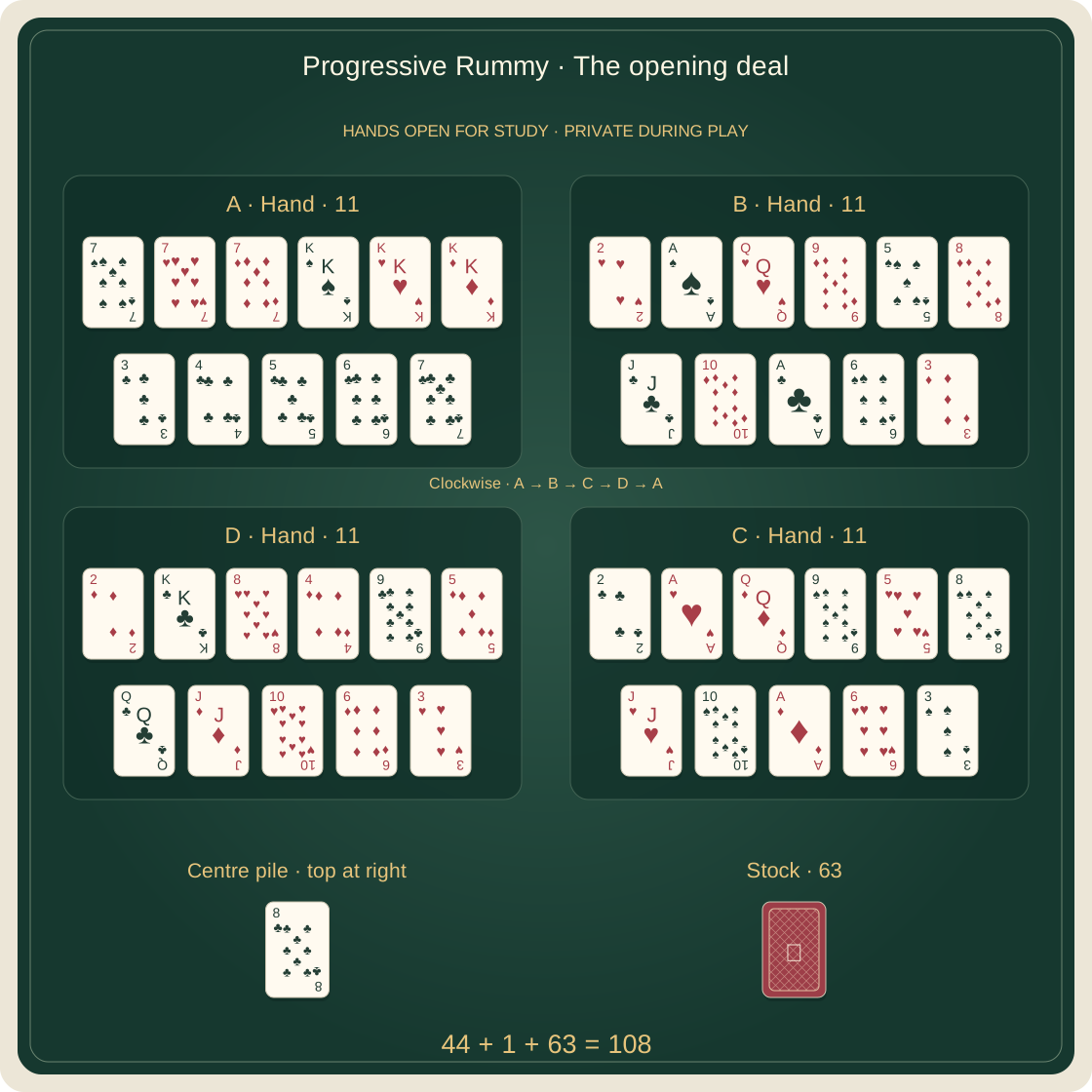
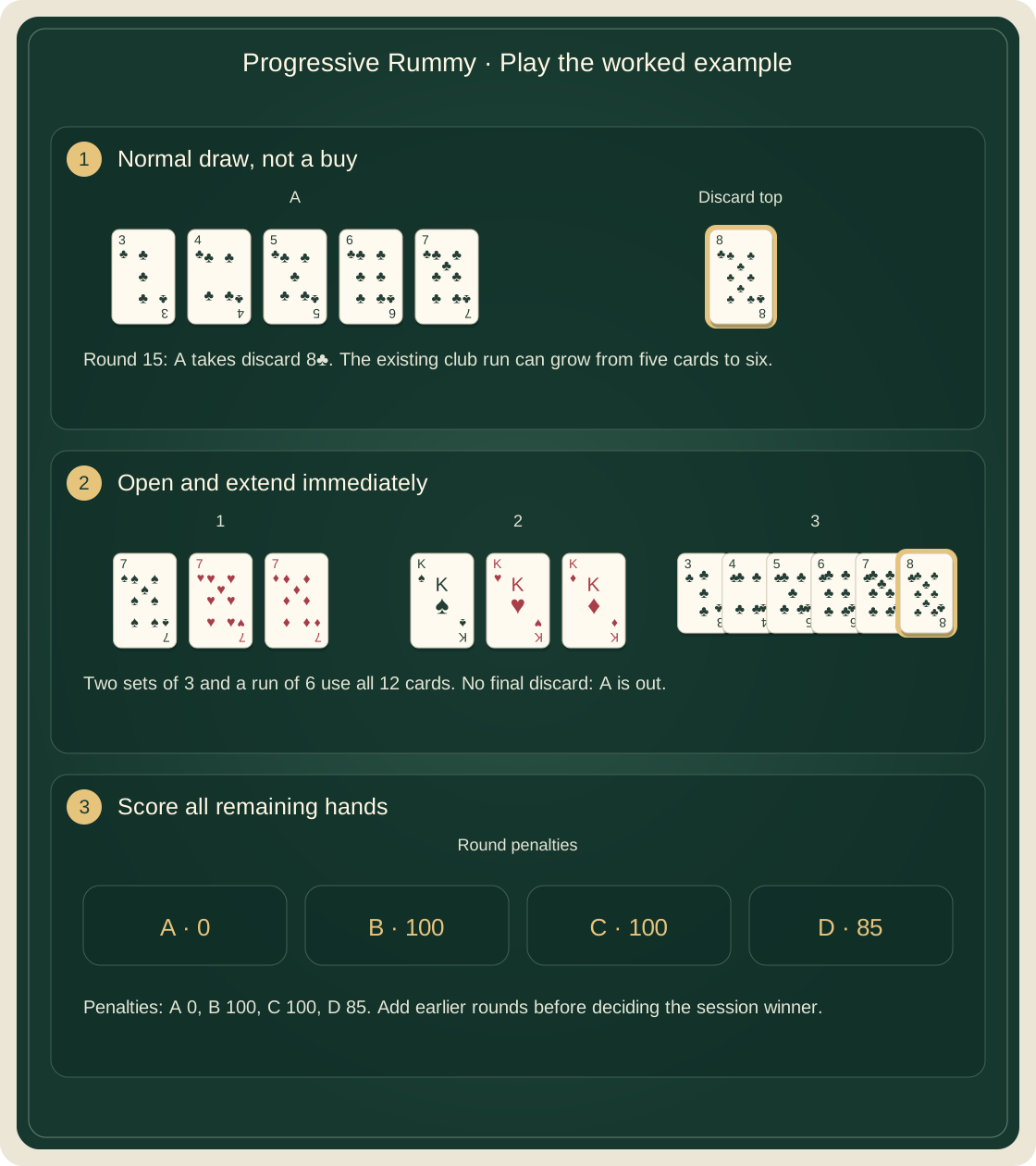
Round 15 needs two sets of 3 and a run of 5. D deals, A starts. Open hands for study; 8♣ is discard top. A takes 8♣ as the NORMAL draw, not a purchase, which is forbidden this round. Expose sevens, kings and 3♣–7♣; immediately extend that run with 8♣. All 12 cards are used, so A is out without discarding.
Player A
7♠ 7♥ 7♦ K♠ K♥ K♦ 3♣ 4♣ 5♣ 6♣ 7♣
Player B
2♥ A♠ Q♥ 9♦ 5♠ 8♦ J♣ 10♦ A♣ 6♠ 3♦
Player C
2♣ A♥ Q♦ 9♠ 5♥ 8♠ J♥ 10♠ A♦ 6♥ 3♠
Player D
2♦ K♣ 8♥ 4♦ 9♣ 5♦ Q♣ J♦ 10♥ 6♦ 3♥
← On a small screen, scroll the diagram horizontally. →
10 /
Count even an unopened hand
B and C each retain one wild 2, two aces, two pictures and six other numerals: 20 + 30 + 20 + 30 = 100 each. D retains one wild, three pictures and seven other numerals: 20 + 30 + 35 = 85. Round penalties A 0, B 100, C 100, D 85. Add them to the earlier totals; A’s round win alone does not prove the match win.
11 /
History and other versions
Progressive belongs to the Contract Rummy family. The particular extended schedule here is credited by Pagat to contributor John Eveleigh, not to an established original inventor. Seven-round Progressive, Shanghai and Liverpool share vocabulary but change buying, wild cards and contracts. A separate page is justified here by the materially different fifteen-round schedule.
12 /
Check your understanding
May a natural card free a melded wild?
Reveal the answer
No. Wild positions stay fixed in this profile.
Can I buy in the last round?
Reveal the answer
No. Take a normal draw; the buying schedule excludes that round.
13 /
Mistakes to avoid
Do not import the seven-round contract list, natural twos, joker recovery or a one-turn delay before laying off. Keep opening melds separate even when same-suit runs become adjacent. Record purchased cards and limits immediately. The lowest hand penalty total decides the winner, not the largest collection of exposed cards or the buy-counter purse.
Common questions
How many rounds here?+
Fifteen, with eleven cards dealt every round.
Are twos wild?+
Yes, together with jokers.
May I lay off immediately after opening?+
Yes, in the same turn under this profile.