← On a small screen, scroll the diagram horizontally. →
01 /
Your first round
Your card objective is four cards of one rank. Once anyone has them, the objective for everyone becomes copying the nose signal before being last. Do not call out a quartet or reveal the cards to start the signal. Rank order and suit strength have no role; all four suits of the chosen rank are equally necessary.
02 /
Cards, seats and the deal
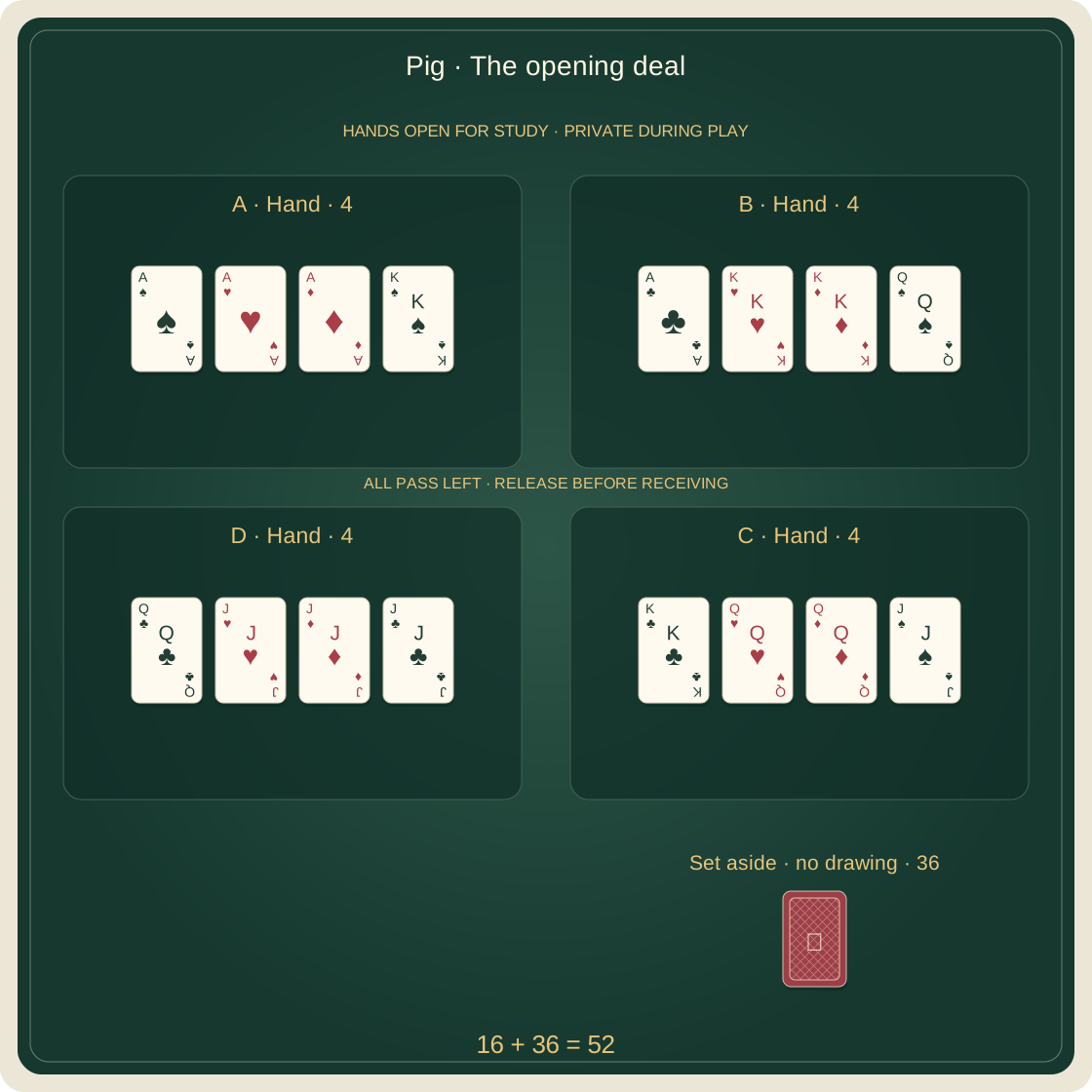
Sit in a circle so neighbours are clear. Choose a dealer, select the ranks and shuffle only those cards. Deal 4 each clockwise. For four, use all A K Q J: 4 × 4 = 16; no stock and no centre discard. Keep the unused 36 away from play. Choose a pace: a spoken pass–take count is useful initially. Everyone can see faces but not private hands.
03 /
What happens on your turn
Everyone chooses 1 unwanted card, puts it face down to their left, then takes the card passed from the right. Release before receiving: briefly hold 3, then return to 4, never 5. Only one card travels in each pass. There is no waiting for dealer’s turn and no extra draw. A received card may be passed in the next cycle. Start slowly so an unnoticed queue of cards cannot build beside a hand.
04 /
The silent signal ends the round
A quartet holder quietly places a finger on their nose and keeps it there. Anyone who notices copies immediately, without needing a quartet. Stop passing as you signal. The last to copy loses this round. After stopping, show the initiating quartet to verify it. Agree before play that a false initiating signal loses the round; copying an already valid signal is always allowed. If the last-place order cannot be distinguished, replay without a loss.
05 /
Scoring and settlement
Add 1 loss to the last reactor, shuffle the same selected ranks and rotate dealer left. After 5 rounds compare losses, not collected quartets. Example A 1, B 2, C 0, D 2 totals 5: C wins. Equal fewest losses share first place. A drawn replay is not one of the scored rounds. The nose signal determines the loss; the quartet holder earns no separate point.
06 /
When the round and match end
In the elimination alternative, remove the loser and one whole rank before redealing. The no-stock version can stop with the final two as joint winners; do not silently replace this by a single winner. The P–I–G alternative gives three lost lives before elimination. A full-pack stock version feeds cards through dealer and uses a different finish at two players. Spoons replaces the nose signal with central tokens and is a distinct equipment variant.
07 /
A complete worked example
Player A
A♠ A♥ A♦ K♠
Player B
A♣ K♥ K♦ Q♠
Player C
K♣ Q♥ Q♦ J♠
Player D
Q♣ J♥ J♦ J♣
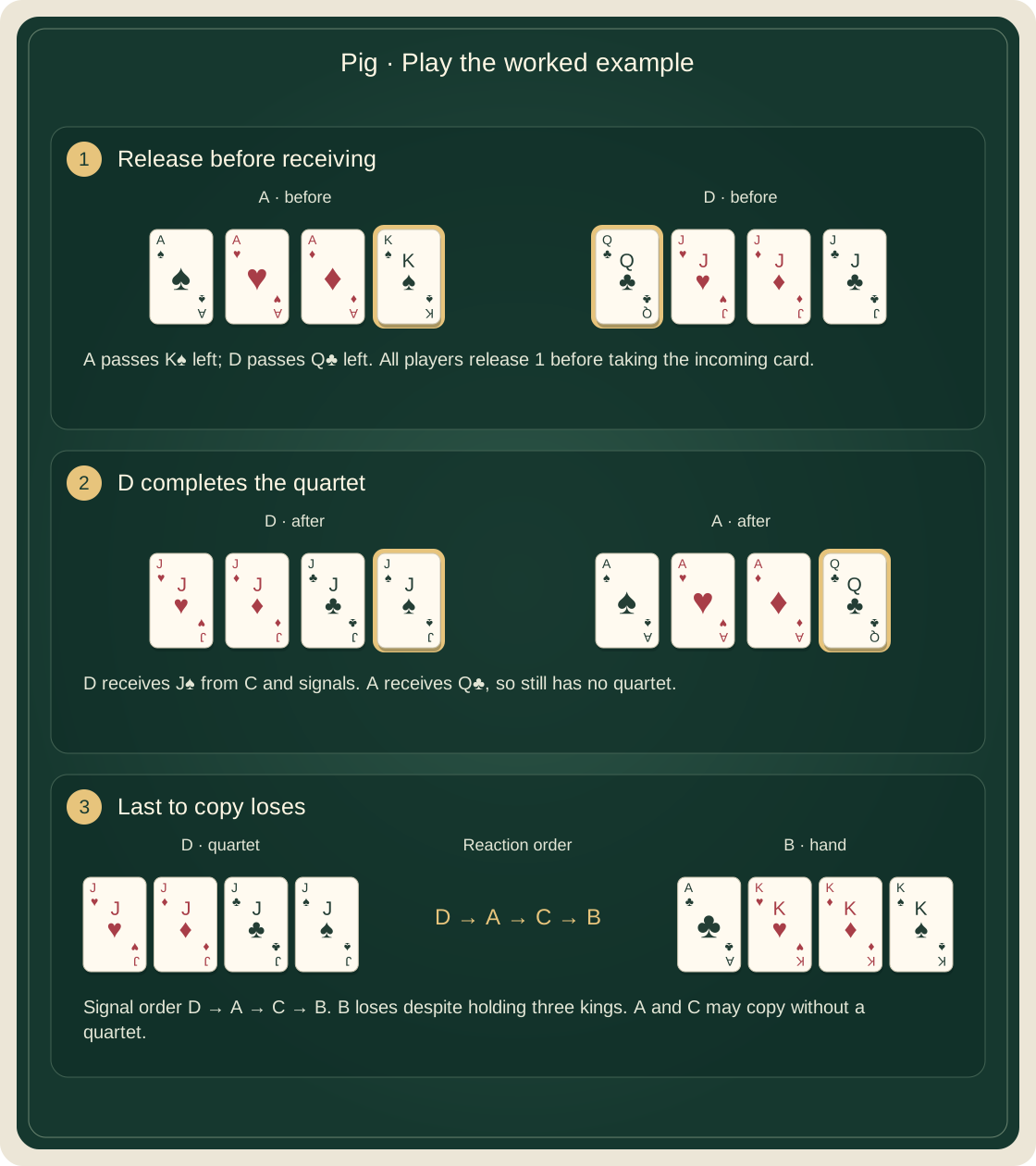
The left-neighbour order is A → B → C → D → A. All release together: A passes K♠, B Q♠, C J♠, D Q♣. Then receive. D now has J♥ J♦ J♣ J♠ and signals. A has A♠ A♥ A♦ Q♣, B A♣ K♥ K♦ K♠, C K♣ Q♥ Q♦ Q♠: none has a quartet, but all may copy. Reaction order D, A, C, B means B loses. B’s three kings do not protect them. All 16 cards remain accounted for.
← On a small screen, scroll the diagram horizontally. →
08 /
Check your understanding
No quartet: may I copy the signal?
Reveal the answer
Yes, once a valid initiating signal is visible.
Can I pick up before passing?
Reveal the answer
No. Release first so the hand never exceeds 4.
09 /
History and other versions
Pig is part of the card-passing party-game family, with names such as Hog and related Donkey traditions. The quiet gesture makes attention as important as collecting cards. Similarity does not establish one inventor or prove that every named version uses the same ending. We keep this nose-signal game separate from the dice game also called Pig.
10 /
Mistakes to avoid
Do not use random cards without complete ranks: a quartet could become impossible. Do not pass two cards or quietly accumulate a fifth. Keep watching faces instead of treating this as a turn-based draw game. When practising, agree a slow shared rhythm and verify the quartet before recording a loss.
11 /
A reminder for the table
Release left before receiving right; check your new hand, then watch faces. A valid first signal allows everyone to copy. For our fixed-round session keep all ranks and players throughout, rather than removing cards merely because somebody lost a round.
Common questions
Do I need a special deck?+
Use one ordinary 52-card pack, no jokers. Select one complete rank per player; 4 players use 16 cards, leaving 36 aside. Each chosen rank must include all four suits.
Does collecting the quartet guarantee the only win?+
It initiates the signal. Our session scores only the last reactor’s loss.
Do I need spoons or tokens?+
No. The nose-signal version needs only cards, people and a score sheet.