← On a small screen, scroll the diagram horizontally. →
01 /
Cards, seats and the deal
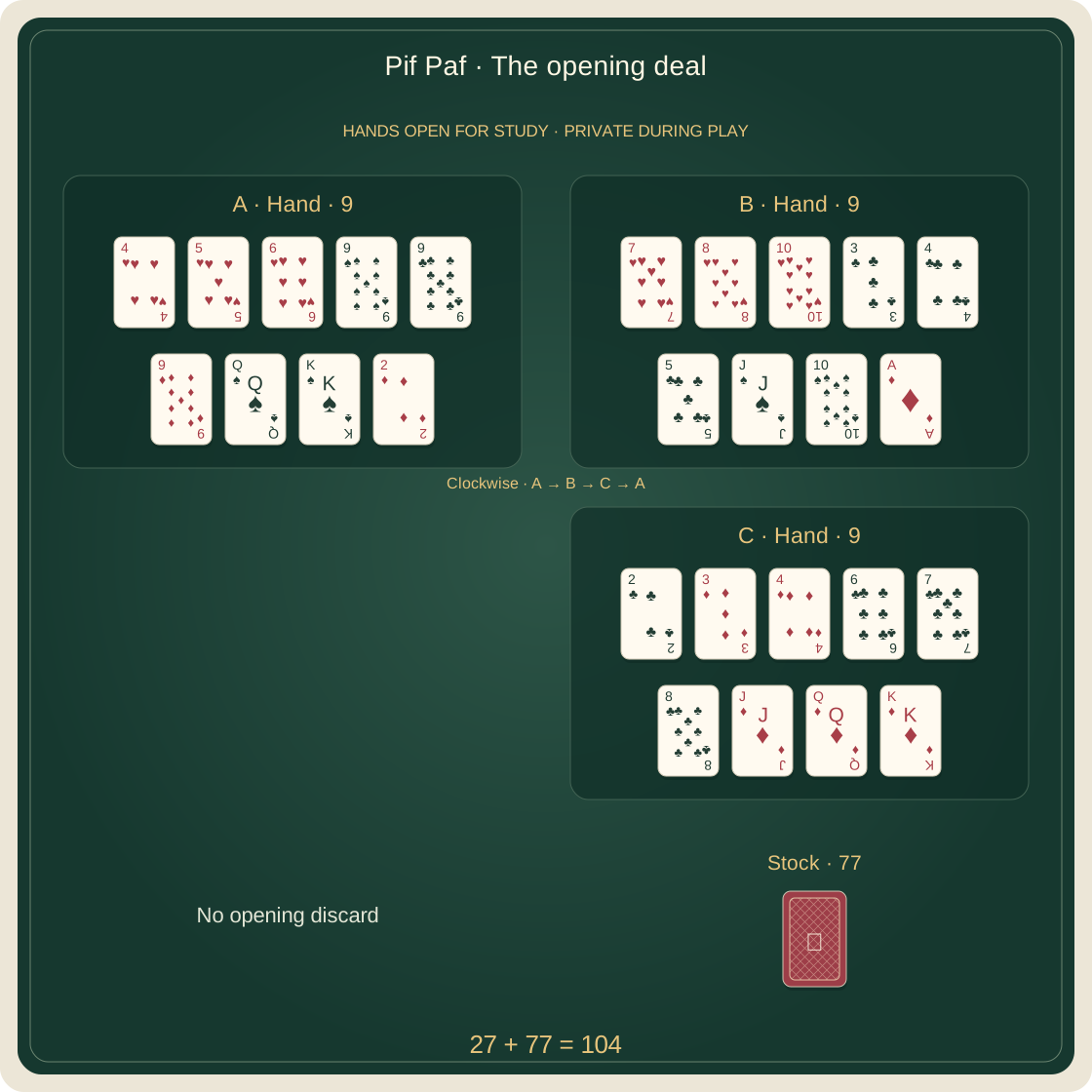
Choose a dealer; shuffle and offer the cut to the right, leaving at least 5 cards in either part. Deal clockwise from the left in packets of 3 until each has 9. The rest is a face-down stock; do not turn up a starter discard in this profile. With 3 players: 27 hands + 77 stock = 104. Keep completed groups private. The first player draws from stock because the discard pile is empty.
02 /
Sets, runs and the ace
A valid group has at least 3 cards: a set of the same rank in different suits, or a consecutive run in one suit. A set may have 4 suits, but two copies of the same suit do not substitute for different suits. Ace is low in A–2–3 or high in Q–K–A; K–A–2 is not a run. Partition all 9 remaining cards into disjoint groups. Three groups of 3 work, but so do runs of 4 and 5, or one run of 9. Each physical card belongs to one group only.
03 /
What happens on your turn
On your turn take 1 from stock or the most recent discard, then discard 1 face up. You temporarily hold 10 and return to 9. You cannot take buried discards or add cards to another player’s groups. If the remaining hand is fully grouped, reveal it with your final discard and call the win. An out-of-turn discard take is permitted only to win immediately, never just to improve a partial group. Declare the winning claim before the next draw.
04 /
The winning-discard exception
Independent variation of the same opening: if A drew 2♠ instead of A♠ and discarded 2♦, B would be the normal next player. If B then drew and discarded A♠, A could claim it before C’s turn and discard the spare 2♠ to win. That does not let A intercept a useful card without a complete finish. If two correct claims are genuinely simultaneous, our tie agreement gives priority to the first seat clockwise after the discarder.
05 /
When the round and match end
A valid declaration ends the round immediately; no other player gets a final draw. Our session awards 1 round win and plays 5 rounds, sharing an equal final total. If stock empties before anyone wins, finish the current turn and declare a drawn round; do not recycle silently. These are table agreements, not Copag’s wagering system. An incorrect exposed finish is a rebate: take the hand back and, for the rest of that round, win only by drawing from stock. Verify before opponents gather their cards.
06 /
A complete worked example
Player A
4♥ 5♥ 6♥ 9♠ 9♣ 9♦ Q♠ K♠ 2♦
Player B
7♥ 8♥ 10♥ 3♣ 4♣ 5♣ J♠ 10♠ A♦
Player C
2♣ 3♦ 4♦ 6♣ 7♣ 8♣ J♦ Q♦ K♦
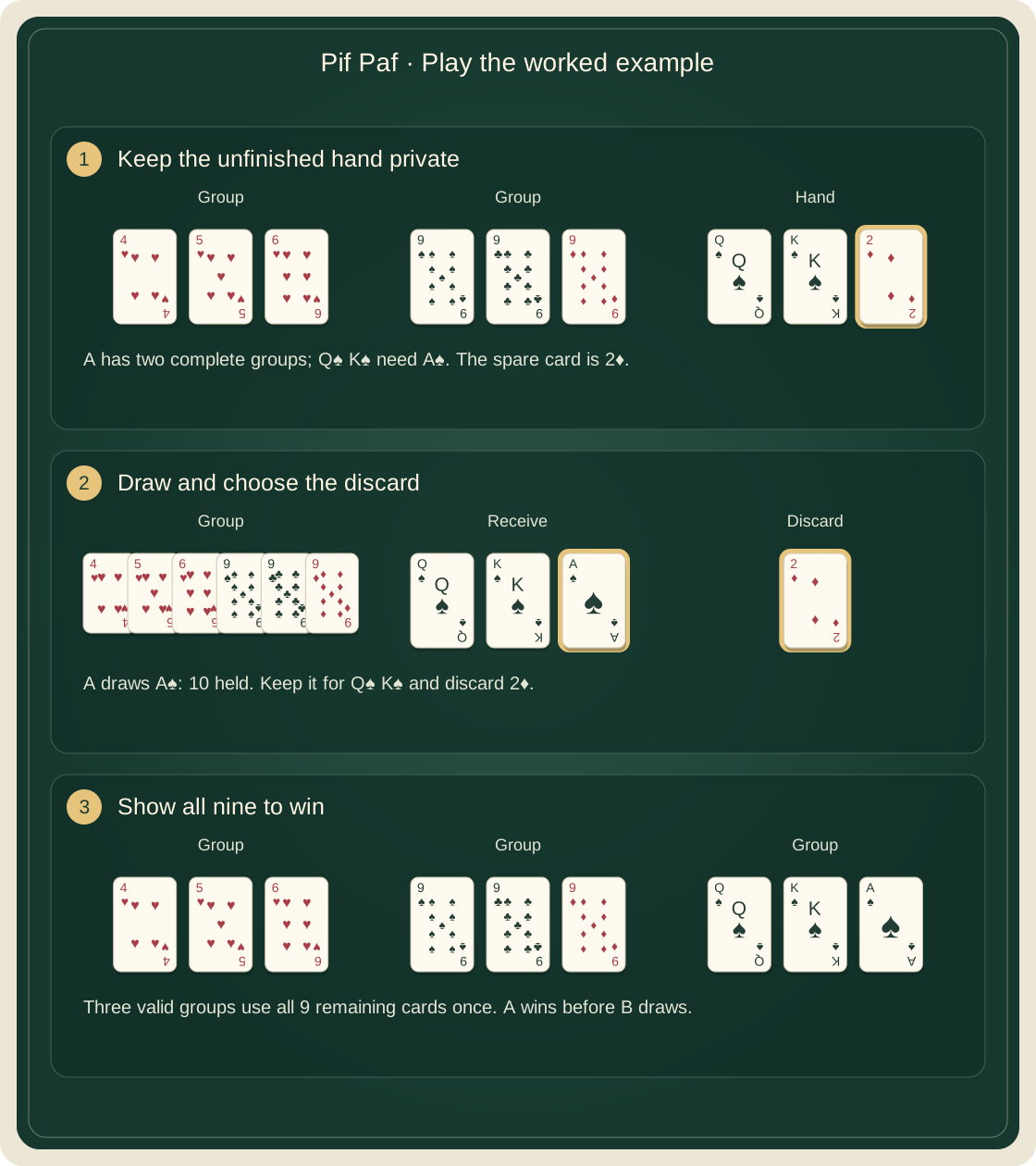
C deals; A goes first. A’s three near-groups are 4♥ 5♥ 6♥, 9♠ 9♣ 9♦, and Q♠ K♠, with 2♦ unwanted. A draws A♠: 10 cards. Discard 2♦ and reveal 4♥–6♥, the three 9s and Q♠ K♠ A♠: all 9 used once. A wins before B draws. The final position has 27 private/group cards, 1 discard and 76 stock: 27 + 1 + 76 = 104. No penalty total is inferred from this free-play round.
← On a small screen, scroll the diagram horizontally. →
07 /
Check your understanding
Can 9♠ 9♠ 9♦ make a set?
Reveal the answer
No. The suits in a set must differ.
May I take a discard out of turn for a pair?
Reveal the answer
No. The exception requires an immediate valid finish using the whole hand.
08 /
History and other versions
Pif Paf is a Brazilian rummy tradition, also called Pife. Copag’s published version documents both nine-card play and winning from any player’s discard; it does not establish an inventor or a precise birth year. Other tables add jokers, a chosen wild rank, penalty scoring or wagering. Those change this profile. A beginner should first learn natural groups and the distinction between ordinary taking and an immediate winning claim.
09 /
Mistakes to avoid
Do not count a card twice in overlapping groups or treat K–A–2 as consecutive. Do not expose partial groups as if this were an open rummy game. The winner must show the full legal hand, not simply say that the missing card was useful. With two identical packs, keep physical copies distinct during checks even when they look alike.
10 /
A reminder for the table
Draw, choose the discard, check the entire remaining hand. Keep natural groups closed until finishing. A winning out-of-turn claim is an exception to turn order, not a general permission to buy discards. Agree whether the session counts round wins or uses a different scoring system.
Common questions
Do I need a special deck?+
Mix two ordinary 52-card packs with matching backs, removing all jokers: 104 cards, two copies of each suit and rank. No proprietary deck is required.
Must every winning group have the same size?+
No. Every group needs the minimum length, and all remaining cards must be used exactly once.
Are jokers or wild ranks used here?+
No. Natural cards only; other published versions must be agreed separately.