← On a small screen, scroll the diagram horizontally. →
01 /
Cards, seats and the deal
Play individually with 2–6. Set reference cards aside, choose dealer, shuffle and deal 10 each. Put the rest face down and turn 1 up to start discards. Left of dealer starts clockwise. An opening Skip skips that first player; an opening Wild may be taken. Everyone starts the match on Phase 1. Later players may have different current phases; keep a written record of both phase and cumulative penalty score.
02 /
All ten phases
| Phase | Required combination |
|---|---|
| 1 | 2 sets of 3 |
| 2 | set of 3 + run of 4 |
| 3 | set of 4 + run of 4 |
| 4 | run of 7 |
| 5 | run of 8 |
| 6 | run of 9 |
| 7 | 2 sets of 4 |
| 8 | 7 cards of one colour |
| 9 | set of 5 + set of 2 |
| 10 | set of 5 + set of 3 |
A set repeats one number in any colours; two required sets may share that number. A run uses consecutive numbers in any colours, without gaps or wrapping 12 → 1. A one-colour group may repeat or skip numbers. Lay the whole current phase together, never a partial component. Only 1 phase per round: a long run does not simultaneously clear later phases.
03 /
What happens on your turn
Draw 1 from stock or the top discard, never a discarded Skip. Then you may lay your complete current phase. Only after your own phase is down may you hit: add matching cards to any laid phase, including opponents’, during your turn. Extend a set by its number, a run at either end without gaps, or a colour group by its colour. Hit repeatedly, including on the turn you lay down. Normally discard 1 to end. If hitting empties your hand first, the round ends without a final discard.
04 /
Wild and Skip without ambiguity
Wild replaces a number or colour. You may use several if the whole phase includes at least 1 numbered card; this requirement is not stated separately for each component. Announce its role and leave it there for the round, without swapping it back out. Skip is discarded to name any other player who must miss the next turn; it cannot form a phase or be picked up. A skipped player must get a normal turn before being skipped again. In this printed profile Skip goes on discards, not in front of its target.
05 /
Scoring and settlement
First empty hand stops the round immediately. Every player who laid their phase advances; everyone else repeats it. Only cards remaining in hand score penalties: numbers 1–9 cost 5 each; 10–12 cost 10; Skip 15; Wild 25. Laid cards cost nothing. Record totals, gather everything and rotate dealer left. Low points break ties between phase finishers, but low points alone do not outrank finishing more phases.
06 /
When the round and match end
Laying Phase 10 does not stop play immediately: finish the round when someone goes out. Among players completing Phase 10 in that round, lowest cumulative penalty wins. Tied leaders replay Phase 10; first of those to go out wins. Added table agreement for exhausted stock: keep top discard, shuffle below it into stock. If stock and recyclable cards are both absent and the top is an unpickable Skip, agree to void and redeal that round with pre-round phases and totals unchanged.
07 /
A complete worked example
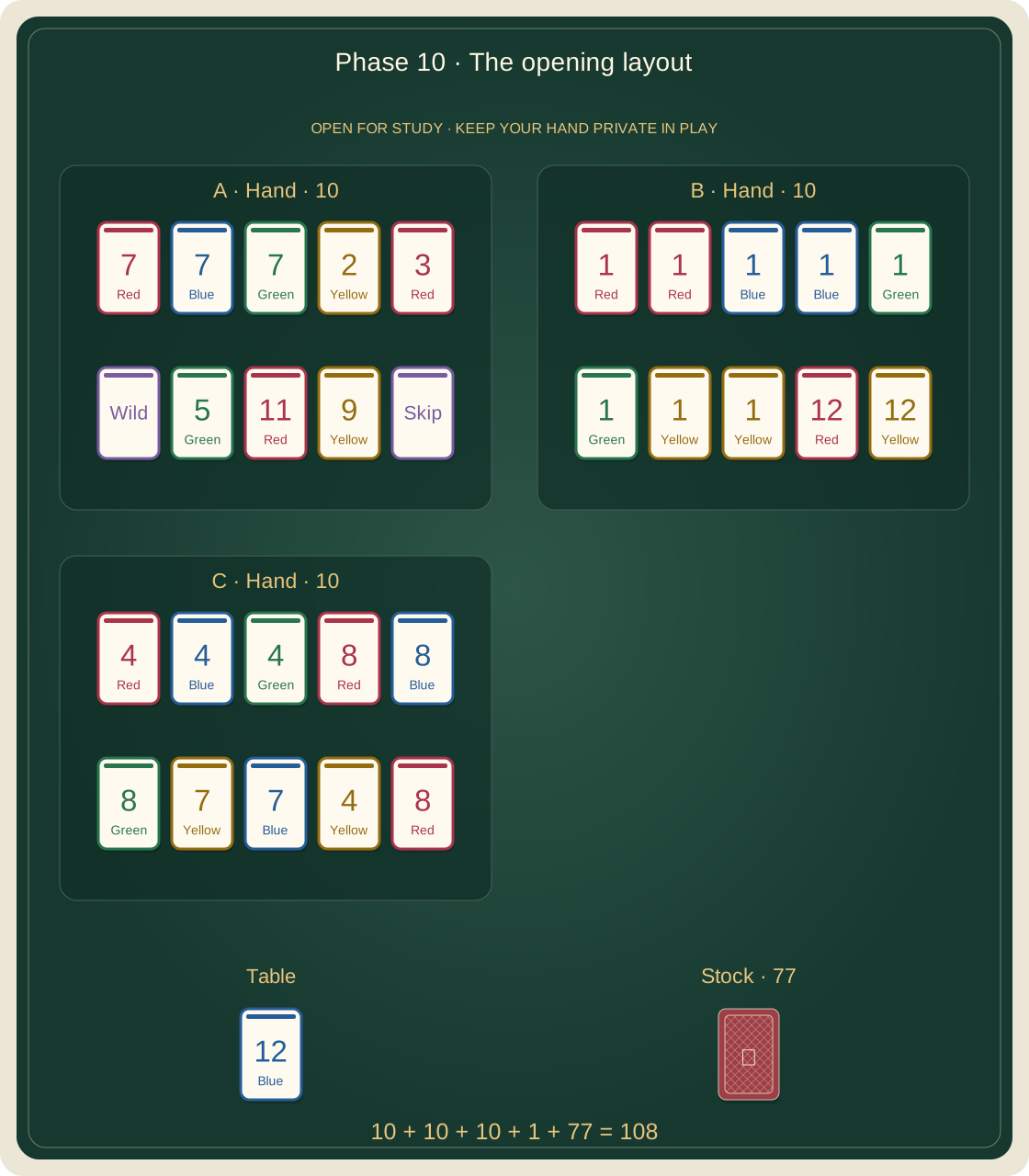
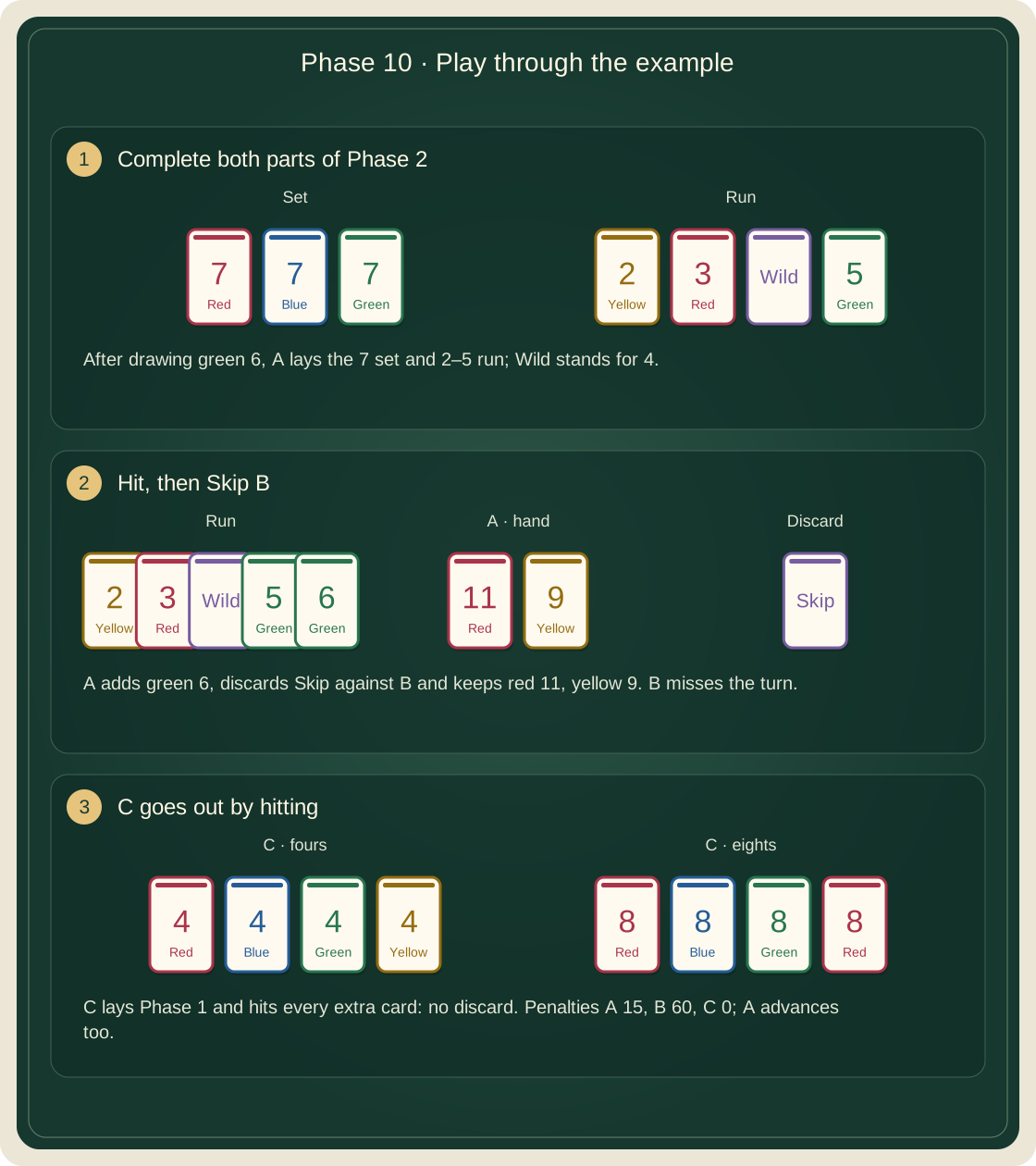
A, B, C play clockwise in a later round: A is on Phase 2, B and C on Phase 1. The initial diagram shows all 10-card hands for study; stock 77, upcard blue 12. A holds red 7, blue 7, green 7; yellow 2, red 3, Wild, green 5; red 11, yellow 9, Skip. A draws green 6, lays three 7s plus run 2–3–Wild–5, declaring Wild as 4. A hits green 6 onto that run, discards Skip naming B, and keeps red 11 and yellow 9. B misses the turn.
← On a small screen, scroll the diagram horizontally. →
08 /
A complete ending and score
C draws green 7, the other copy, and lays Phase 1: red–blue–green 4s and red–blue–green 8s. C adds yellow 4 to their fours and the second red 8 to their eights. C then adds yellow 7, the second blue 7 and the drawn green 7 to A’s set. C’s hand is empty without discarding: round over. A scores 10 + 5 = 15, B’s eight 1s and two 12s cost 8 × 5 + 2 × 10 = 60, C scores 0. Next phases: A 3, B 1, C 2. Stock 75, discards 2, laid cards 19, remaining hands 12: 75 + 2 + 19 + 12 = 108.
09 /
Check your understanding
Another player goes out. Your phase is laid: advance?
Reveal the answer
Yes. Score leftover cards and advance next round.
Can hitting your last cards end without discarding?
Reveal the answer
Yes. The empty hand ends the round immediately.
10 /
History and other versions
Phase 10 is associated with creator Kenneth R. Johnson and published in this edition by Mattel. It adapts rummy-style groups into a progression of required tasks. Classic paper rules, anniversary editions and mobile adaptations can handle details differently; check your edition’s sheet before importing Skip placement or a digital win condition. Shorter matches may agree a smaller phase list beforehand. Phase 10 is a trademark; the instructional diagrams here are independently drawn.
11 /
Mistakes to avoid
Do not count reference cards as playing cards. Do not split a phase across turns, hit before your phase, reclaim a Wild or pick up Skip. Colour is irrelevant to sets and runs, but decisive in the colour phase. Do not award the match simply because the first player laid Phase 10; complete that round and compare eligible finishers.
Common questions
Does an ordinary pack work?+
Not directly. The numbered colours, duplicates and special cards require the dedicated 108-card composition.
Can two required sets have the same number?+
Yes. Keep each physical card in only one component.
Can a Wild be replaced and reused?+
No. A Wild laid in a phase stays there until the round ends.