← On a small screen, scroll the diagram horizontally. →
01 /
Your first round
Collect valuable cards, not tricks. On each turn play 1 card; capture if that card permits it, otherwise leave it face up. The captured cards and your played card go into your own face-down pile. The first score of at least 62 wins after the agreed count; a higher tied-threshold score beats a lower one.
02 /
Cards, seats and the deal
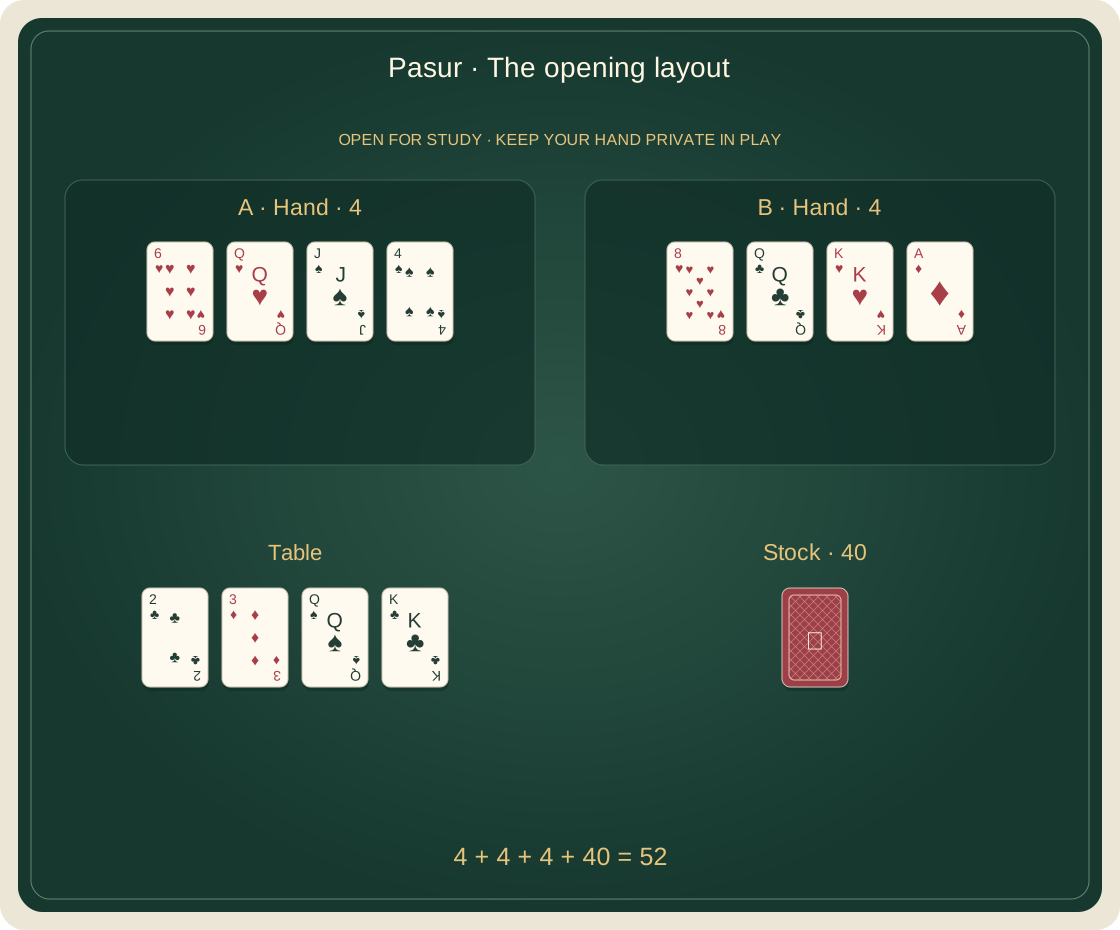
Use 52 cards without jokers. Choose a dealer; deal 4 to each player and 4 face up centrally, starting to dealer’s right. The stock contains 40. Redeal if the opening table has more than 1 jack, more than 2 queens or more than 2 kings. Otherwise bury any single opening jack in the stock and replace it. After both hands empty, deal another 4 each, without replenishing the table. There are 6 batches in all. Rotate dealer right after the full deal.
03 /
What happens on your turn
Ace counts 1 and number cards their face value. A played number takes one chosen set of table numbers whose sum, including the played card, is 11. You do not take several independent sets at once. A queen pairs with a queen; a king with a king. A jack takes all numbers and all jacks, leaving queens and kings. If no eligible card is there, the jack stays. You may choose a noncapturing card even when another card could capture, but cannot refuse a capture available to the card you actually play.
04 /
Sur: a bonus that can disappear
A non-jack capture clearing the table earns a sur worth 5. If the opponent already has a sur marker, cancel one of theirs instead of adding your own. Only one side can hold markers. No sur is earned or cancelled during the entire final batch of 4-card hands, or by a side already at 50 or more on the last recorded score. Current uncounted captures do not change that threshold. A jack clearance and the final gift of leftovers never earn sur.
05 /
Scoring and settlement
At the end, the last capturer receives every card still on the table. Count clubs across the whole capture pile: at least 7 clubs earn 7 points, not a point per club. Count each ace and jack separately, then the special cards and surviving sur markers. Ordinary card points total 20 between two sides. A remaining 2 sur markers raises the combined deal total to 30.
| Club majority / card / marker | Points |
|---|---|
| 7+ | 7 |
| A | 1 |
| J | 1 |
| 2♣ | 2 |
| 10♦ | 3 |
| Sur | 5 |
06 /
Counting without double-counting
Independent end-of-deal ledger: A has 8 clubs, 2 aces, 3 jacks, 2♣, no 10♦ and 1 surviving sur: 7 + 2 + 3 + 2 + 0 + 5 = 19. B gets the other 6 card points, so 19 + 6 = 25. To see cancellation, let A, B, A clear legally in that order: A gains a marker, B cancels it, A gains one again. These three clearances give only 1 scored sur, not 3.
07 /
When the round and match end
After all 52 cards, add the deal score to the running total. If neither reaches 62, shuffle and continue. If totals tie at or above 62, play another full deal. An optional traditional early claim allows a player to stop and count captured points already sufficient for 62; it is unavailable during a tie-break deal. Agree to use that option before starting rather than stopping an opponent mid-turn unexpectedly.
08 /
A complete worked example
Player A
6♥ Q♥ J♠ 4♠
Player B
8♥ Q♣ K♥ A♦
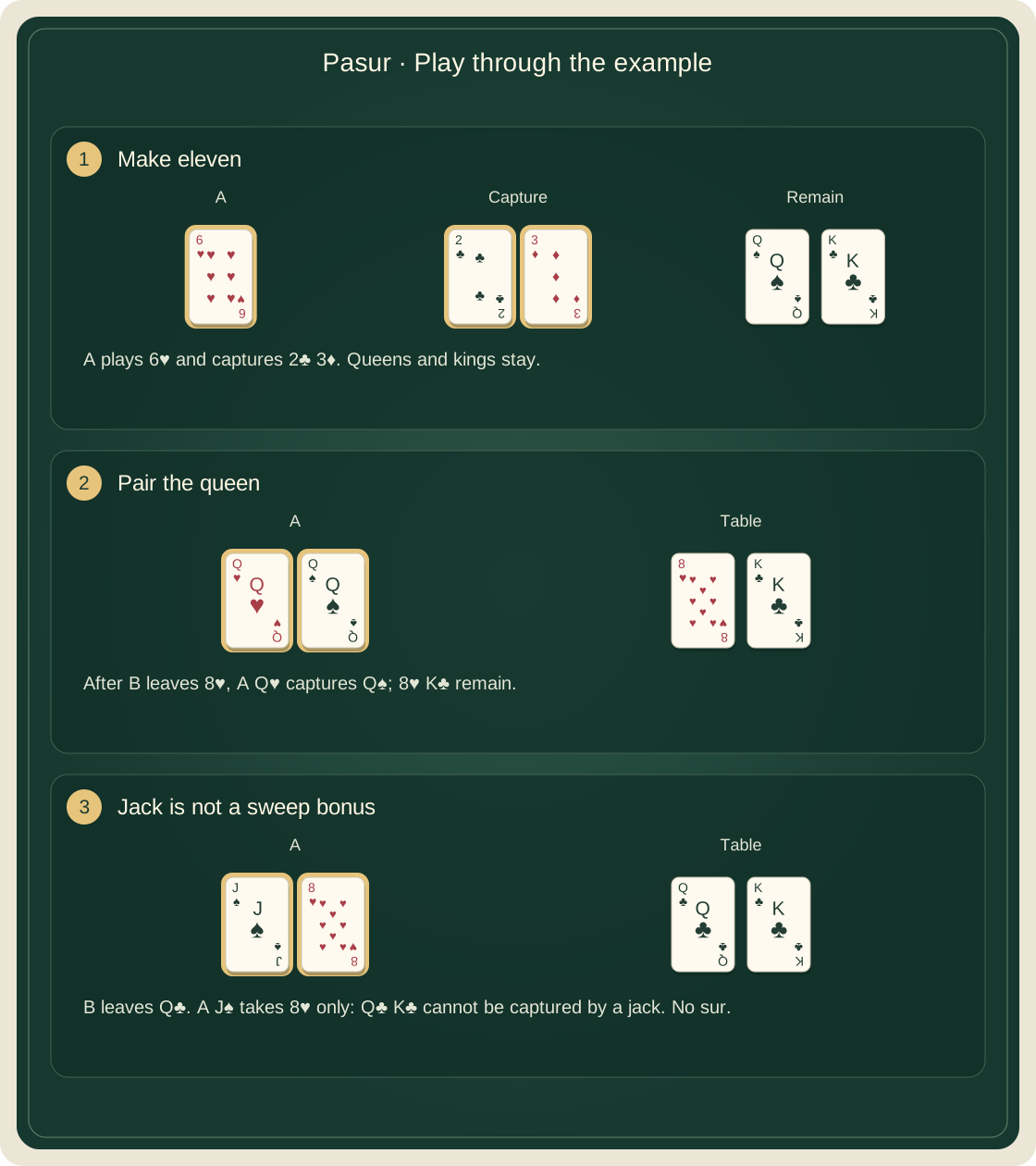
Opening table: 2♣ 3♦ Q♠ K♣; A starts. Follow these 8 turns: A 6♥ takes 2♣ + 3♦ because 6 + 2 + 3 = 11. B leaves 8♥. A Q♥ pairs Q♠. B leaves Q♣. A J♠ takes 8♥ only; Q♣ K♣ stay, so no sur. B K♥ takes K♣. A leaves 4♠; B leaves A♦. Both hands are empty, but Q♣ 4♠ A♦ remain for the next batch. Deal fresh hands, not fresh table cards. This is an opening sequence, not the full-deal final score.
← On a small screen, scroll the diagram horizontally. →
09 /
Check your understanding
A jack empties the table. Sur?
Reveal the answer
No. It captures eligible cards but never earns sur.
Recorded score 50: can you cancel a sur?
Reveal the answer
No. The restriction prevents both creation and cancellation.
10 /
History and other versions
Pasur belongs to Iranian fishing games and is also known as Chahar Barg. Its capture arithmetic links it to a wider family rather than proving a precise inventor or year. At 4 players, partners sit opposite and pool captures: 3 batches. At 3, play individually through 4 batches; the club award has a special rule: if two players tie in clubs, the third gets 7, even with fewer clubs, as in 5–5–3. Otherwise the sole club leader wins it. Sur cancellation still depends on actual order.
11 /
Mistakes to avoid
Do not treat queens as numerical twelve or kings as thirteen. Before a capture compare alternative subsets and count the clubs you would gain. Do not award sur merely because a new batch starts with an empty table. Put bonus markers beside captures, never into a separate scoring pile that would accidentally remove their cards from the final club count.
Common questions
Do I need a special deck?+
Use one ordinary 52-card pack without jokers. No special or proprietary cards are required.
Does a jack take queens?+
No. Queens and kings remain; each is captured only by its own rank.
Are all cleared tables worth a bonus?+
No. Check jack, final-batch and recorded-score restrictions, then cancel an opposing marker before creating your own.