← On a small screen, scroll the diagram horizontally. →
01 /
Your first round
Draw one, keep useful melds hidden and discard one. To knock, your unmatched-card value after discarding must meet the limit set by the first upcard. Zero unmatched value is gin. On an ordinary knock the opponent may add cards to your melds before comparison; this can reverse the winner.
02 /
The rules used here
Choose 2 players, 10 cards each and target 200. Gin and undercut bonuses are 25. The first upcard remains the limit and suit reference for the whole deal, even if taken. An ace starter means gin only; otherwise its value is the limit, with courts worth 10. A spade doubles the hand score, including its bonus.
03 /
Cards, seats and the deal
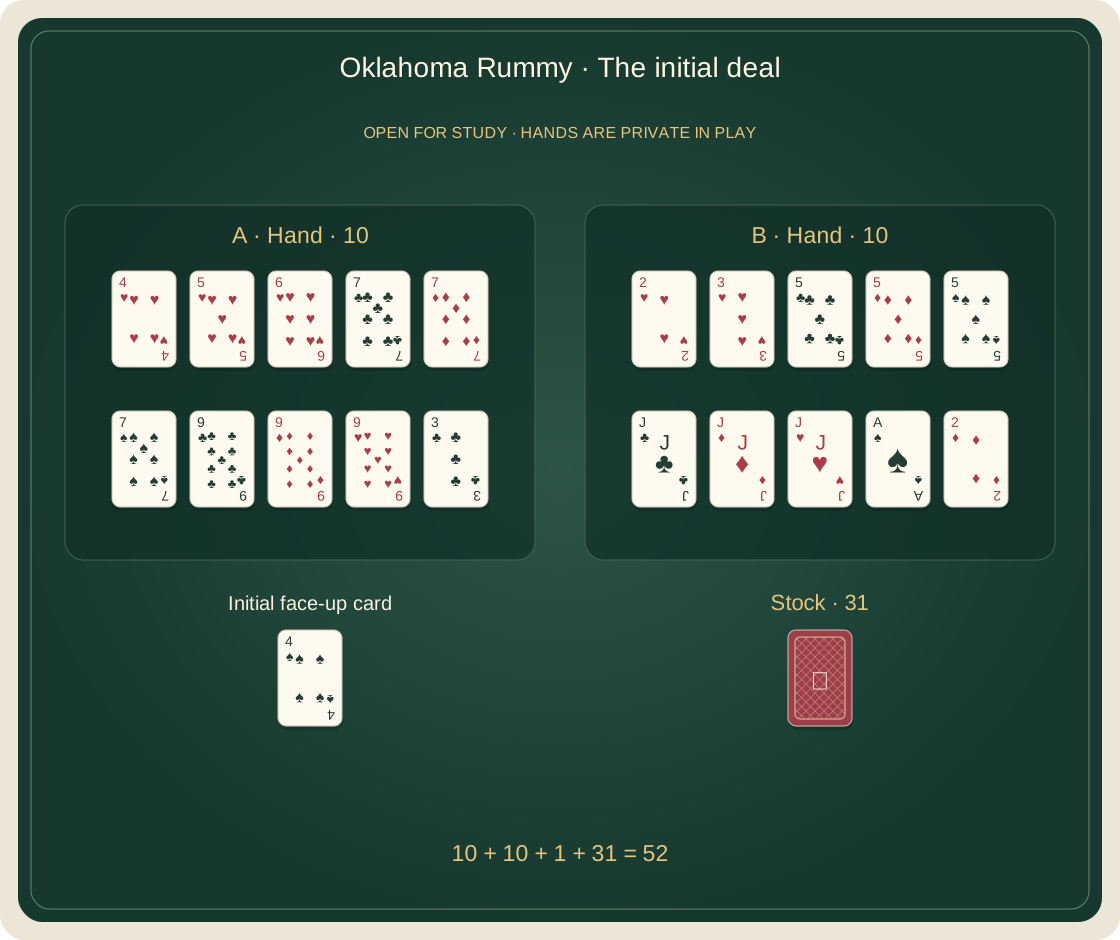
Shuffle 52 cards without jokers; choose a first dealer by agreement, then alternate. Deal 10 each singly, turn one up and leave 31 in stock: 20 + 1 + 31 = 52. Non-dealer may take the upcard or decline; dealer then has the same option. If both decline, non-dealer draws from stock. Whoever takes a card discards, then turns alternate.
04 /
Melds and unmatched cards
A set is 3 or 4 equal ranks; a run is at least 3 consecutive cards of one suit. A is low only, so A–2–3 works and Q–K–A does not. A card can belong to only one meld in your final arrangement. Unmatched values: A = 1, 2–9 = face value, 10 J Q K = 10. Choose the non-overlapping arrangement with lowest unmatched total.
05 /
What happens on your turn
Begin a normal turn by drawing the stock top or the discard top, then discard to return to 10 cards. You may not immediately return a card just taken from the discard. Keep melds private; there are no mid-hand table melds. You may knock after a legal draw and discard, even on the first turn, but are never required to. Declare it before the opponent draws.
06 /
The opponent’s right to attach cards
After a knock, show your melds and unmatched cards. The opponent makes their own melds, then may attach unmatched cards to your melds, including successive extensions; never attach to your loose cards. The knocker cannot attach to the opponent. After gin there is no attaching at all. Compare the remaining unmatched totals only after all legal attachments.
07 /
Knock, gin and undercut
Let K be the knocker’s unmatched value and D the defender’s after attachments. Only the hand winner adds points; the other adds none. First calculate the whole hand award, then double it if the original upcard was a spade. Equality after an ordinary knock is an undercut, not a draw.
| Result | Who scores | Award |
|---|---|---|
| Ordinary knock, K < D | Knocker | D − K |
| Ordinary knock, D ≤ K | Defender | 25 + K − D |
| Gin | Gin player | 25 + D |
08 /
When the round and match end
Stop a deal at a knock or gin. Also cancel it without points if the player drawing the third-last stock card discards without knocking, leaving 2 cards; the same dealer deals again. No recycling or final-chance exception here. A scored deal passes the deal to the other player. A hand award reaching at least 200 wins the match immediately.
09 /
The final score sheet
Keep two columns: hand points and hands won. After the match, record a 100 game bonus for the winner and 25 per won hand for each player. These are finishing entries, not points toward 200, and are never doubled by a spade. We do not add a separate shutout multiplier. They do not reopen the match; its winner was decided by hand points.
10 /
A complete worked example
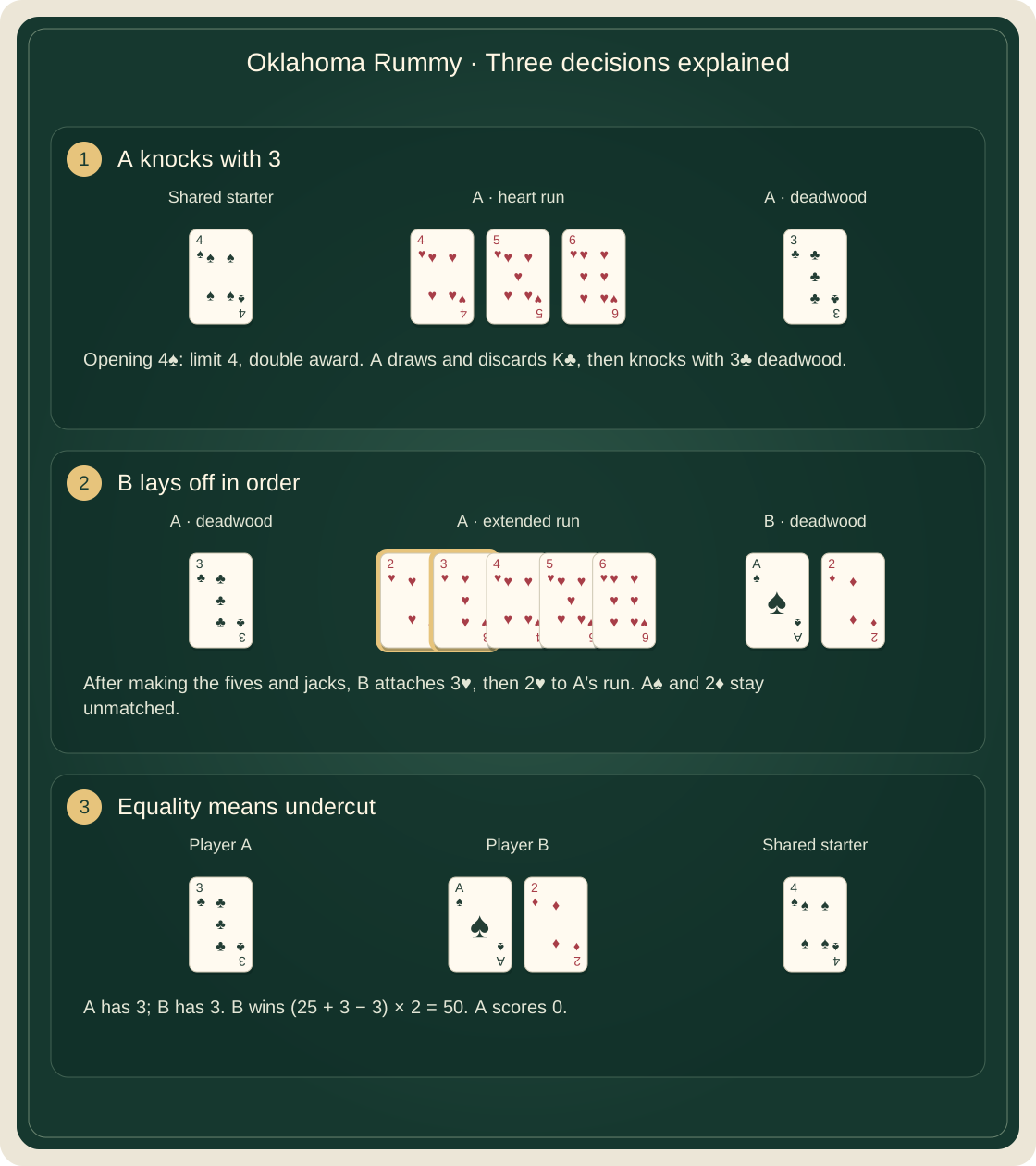
A is non-dealer, B deals. The opening 4♠ fixes the knock limit at 4 and doubles the hand award. Both decline it. A draws K♣ from stock and discards that same stock-drawn card, leaving the original hand below. A knocks with 3 unmatched points.
Player A
4♥ 5♥ 6♥ 7♣ 7♦ 7♠ 9♣ 9♦ 9♥ 3♣
Player B
2♥ 3♥ 5♣ 5♦ 5♠ J♣ J♦ J♥ A♠ 2♦
A lays out 4♥–5♥–6♥, 7♣–7♦–7♠, 9♣–9♦–9♥ and leaves 3♣. B lays out 5♣–5♦–5♠ and J♣–J♦–J♥, then attaches 3♥ followed by 2♥ to A’s heart run. B’s only remaining cards are A♠ and 2♦, totaling 3. Equal deadwood is an undercut, not a draw: B scores (25 + 3 − 3) × 2 = 50; A scores 0. The spade multiplier includes the bonus.
← On a small screen, scroll the diagram horizontally. →
11 /
Check your understanding
Who wins equal deadwood after a knock?
Reveal the answer
The defender undercuts. In our example the equal 3 gives B 25 before the spade doubling, hence 50.
May you attach cards after gin?
Reveal the answer
No. Form your own melds, but keep all other cards as deadwood. The gin winner adds the bonus to that deadwood.
12 /
History and other versions
Oklahoma belongs to American gin rummy, whose documented history reaches the early twentieth century. The sources do not establish a secure inventor or first date for this particular variation. Its defining changes are the variable knock limit and spade multiplier. Other tables use a different match target, different bonuses or allow a low ace knock instead of requiring gin.
13 /
Mistakes to avoid
Keep the original upcard visible as a reference in the score record, not as an extra card in either hand. Do not count one card in two melds, forget an available attachment or call equality a safe knock. An ace limit is gin only here. Gin forbids all attachments; even an opponent with no unmatched points cannot undercut it.
14 /
A reminder for the table
Before drawing, remember the limit and multiplier. Draw, arrange without overlap, discard. If knocking, expose and permit attachments unless gin. Compare, award the hand and apply the spade multiplier. Update the match before finishing bonuses. A cancelled stock-exhausted hand gives no points and no won-hand entry.
Common questions
Can I knock with an ace left unmatched?+
Only if the starter’s limit permits it. With an ace starter this profile requires gin, so no unmatched card is allowed.
Does a spade double the gin bonus too?+
Yes. Double the full hand award, but not the later game and won-hand finishing entries.
Can the opponent attach after gin?+
No. The opponent counts their own unmatched cards without adding anything to the gin hand.