← On a small screen, scroll the diagram horizontally. →
01 /
Your first round
Score combinations in your 3 cards plus the shared starter. Then take turns playing your own cards into a running count no higher than 31. You can gain more points during this play. The match score and running count are different: the first person to reach 31 match points wins immediately.
02 /
The rules used here
Historical descriptions disagree; follow this complete profile rather than importing modern cribbage. Count fifteen, pairs, runs, flushes and the matching jack as below. We omit the optional twenty-five bonus. For overlapping runs or flushes score the longest feature, not its nested fragments; distinct equal-length hand combinations count separately.
03 /
Cards, seats and the deal
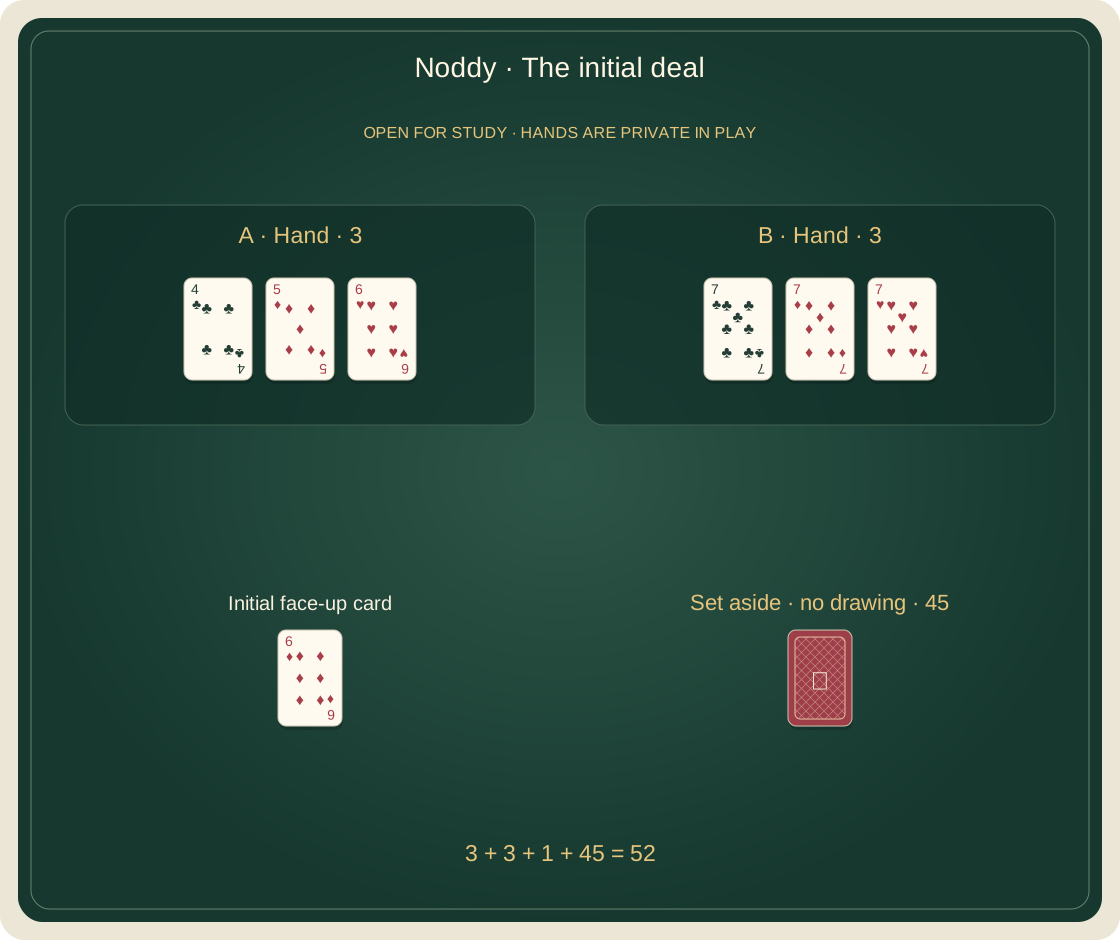
Use 52 cards, no jokers. Cut for first deal: lower rank deals, A lowest; recut a tie. Alternate dealers afterwards. Deal 3 each singly, turn one starter and set the remaining 45 aside without drawing. The starter is shared for hand scoring, not a card either player can play. A = 1, numerals face value, J Q K = 10; A is always low in runs.
04 /
Combinations and their exact values
Count all valid hand combinations before playing; a card may contribute to different features. The starter does not create a trump suit for beating cards. “Knave Noddy” simply identifies the jack of its suit.
| Feature | Points |
|---|---|
| Any distinct subset totalling 15 | 2 |
| Pair / three / four of a rank | 2 / 6 / 12 |
| Run of 3 / 4 cards | 2 / 4 |
| Run of 5 or more in play | One per card |
| At least 3 cards of one suit | One per card |
| Held jack of starter’s suit | 1 |
05 /
Score the hands before playing
If the starter is a jack, dealer immediately scores 2 in this reconstruction; do not also award both players a point for that exposed jack. Then non-dealer counts first, dealer second. Announce combinations without revealing the whole hand; verify them when revealed later. Score only the longest flush and longest runs, but count separate fifteen subsets and duplicate-card alternatives.
06 /
What happens on your turn
Non-dealer leads; alternate single cards and announce the running total. No obligation to follow suit. On reaching 15 score 2. A terminal pair, run or flush scores its table value; run order need not be sorted, but ranks must be distinct and consecutive. A matching-suit jack can score again when played, under the reconstruction’s rule that hand features also score in play.
07 /
When the round and match end
Never exceed a running total of 31. If unable to play, say go; the opponent may keep playing while able. Exact 31 scores 2 for ending, otherwise the final player scores 1 when no card can follow. Add any separate combination earned on that last play, but not both ending awards. The play then stops permanently: no reset and no second hand count. Deal again if nobody has reached 31 match points.
08 /
A complete worked example
A is non-dealer; B deals. The shared starter is 6♦. Keep it separate from the play pile. These are all the cards available for play, with no replacements.
Player A
4♣ 5♦ 6♥
Player B
7♣ 7♦ 7♥
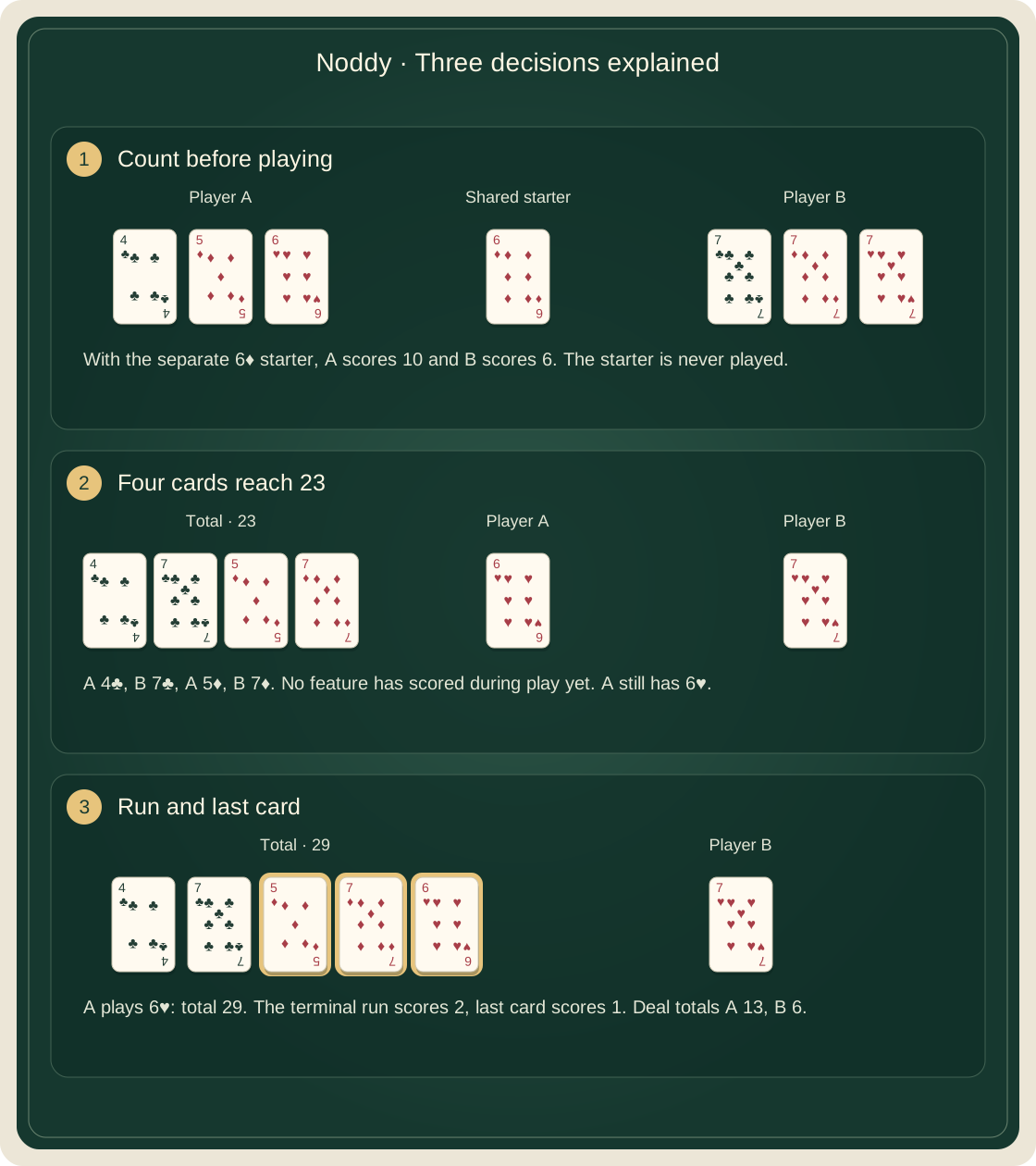
A counts two fifteens (4 + 5 + either 6), worth 4, the pair of sixes worth 2, and two distinct runs 4–5–6 worth 2 each: 4 + 2 + 4 = 10. B’s three sevens score 6; the starter adds nothing. No flush or matching jack occurs.
| Step | Player | Card | Running total |
|---|---|---|---|
| 1 | A | 4♣ | 4 |
| 2 | B | 7♣ | 11 |
| 3 | A | 5♦ | 16 |
| 4 | B | 7♦ | 23 |
| 5 | A | 6♥ | 29 |
The final three played cards, 5♦–7♦–6♥, form a run in any order, scoring A 2. B cannot play the remaining 7♥ at 29 because it would make 36. A has no card left, so the sequence ends: A gets 1 for last card. Deal result A 13, B 6. Do not reset the count to play B’s leftover seven, and do not count the hands again.
← On a small screen, scroll the diagram horizontally. →
09 /
Check your understanding
How much is a run of three here?
Reveal the answer
It scores 2, not the modern cribbage value of 3. A run of 4 scores 4 in this reconstruction.
Can the common starter be played?
Reveal the answer
No. It helps score each hand but belongs to neither player’s playable hand. The unused pack also stays out of play.
10 /
History and other versions
Noddy is attested in England in 1589 and is an ancestor of cribbage. Our profile follows a reconstruction based chiefly on Willughby, around 1665. Holme’s account and Parlett’s later reconstruction use different awards or beneficiaries. They should not be combined unnoticed. In particular, a modern crib, scoring hands after play and restarting the count would change the selected game.
11 /
Mistakes to avoid
Separate match points from the running total. The starter counts in each hand but never enters the play pile. A sequence of three earns fewer points here than in modern cribbage. Do not count a short run inside a longer one again. Keep the played cards visible so the final sequence can be checked; reveal a claimed winning combination before collecting the cards.
12 /
A reminder for the table
Deal, turn the starter, resolve a turned jack, count non-dealer’s hand then dealer’s. Play alternately within the cap, scoring only newly made features. Resolve go or the exact finish, then stop the play series. Check the match target after every award. If needed, alternate the dealer and start another deal; unused cards have no further score.
Common questions
Is this modern cribbage with fewer cards?+
No. The scoring order, short-run values and single play series differ; there is no crib.
Who receives the turned-jack bonus?+
In our selected du Coeur profile the dealer receives 2 immediately. Other reconstructions differ.
Must every dealt card be played?+
No. Cards that cannot fit before the play series closes remain unused and do not start a new series.