← On a small screen, scroll the diagram horizontally. →
01 /
Your first round
Start at 0. Play one card, announce the result, replace the card and follow the current direction. Never exceed 99. With no legal card, lose 1 token and end the round. Begin again with everyone still holding tokens; the last survivor wins. A zero-value card still counts as your play.
02 /
The rules used here
Give each of 3–4 players 3 tokens. Use the card values below throughout; suits have no power. Our housekeeping rules allow negative totals, preserve the count while recycling, and correct errors before the next play. This is the adding game, not David Parlett’s unrelated trick-taking game with the same name.
03 /
Cards, seats and the deal
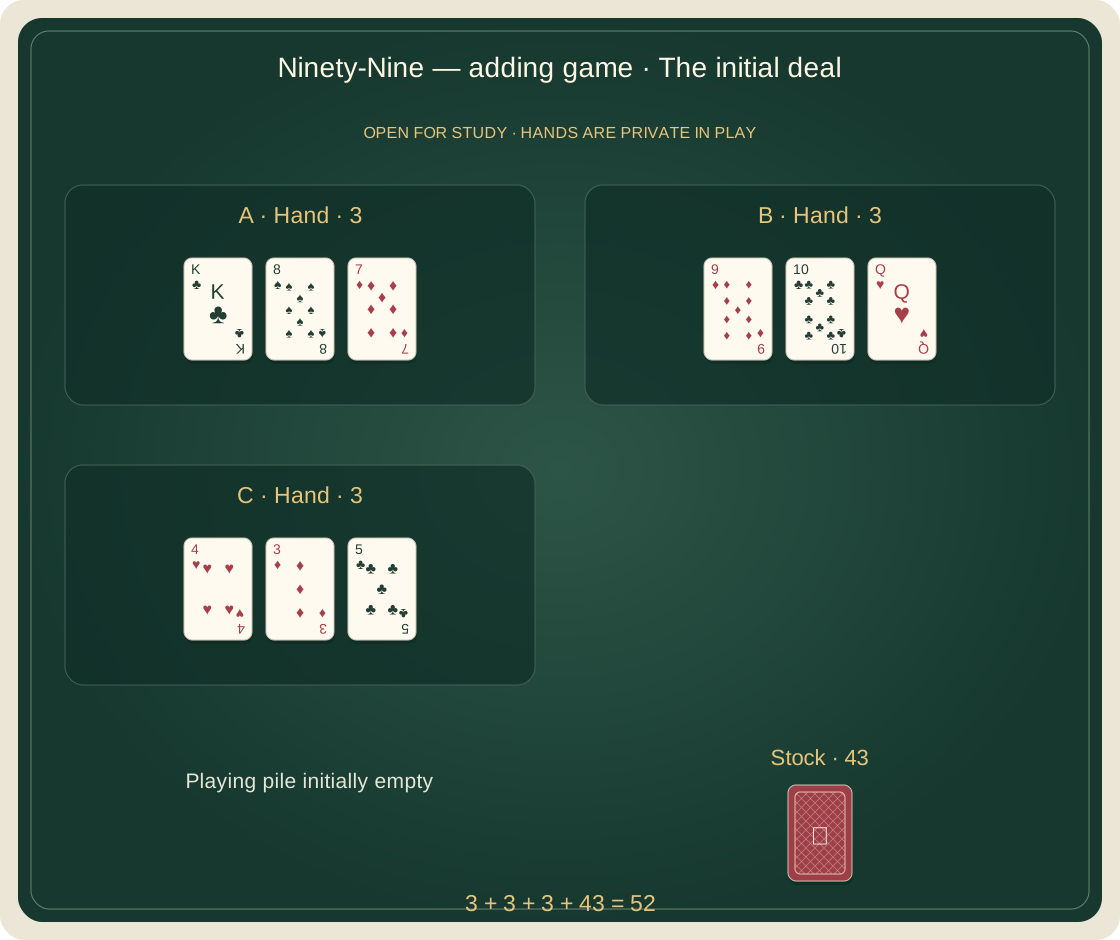
Shuffle 52 cards without jokers, offer a cut and deal 3 each clockwise from the dealer’s left. Keep the hands hidden. The rest forms the stock and the play pile is empty: with three players, 9 + 43 = 52. Set the count to 0 and begin clockwise on the dealer’s left. At every new round reset the direction as well as the count.
04 /
Ordinary cards and exceptions
Announce the chosen ace value before drawing. Rank determines the effect; the printed suit does not. Read the exceptions before applying ordinary face values.
| Cards | Effect on the total |
|---|---|
| A | Add 1 or 11 |
| 2 / 3 / 5 / 6 / 7 / 8 | Add face value |
| 4 | Same total; reverse direction |
| 9 | Same total; normal next turn |
| 10 | Subtract 10 only |
| J / Q | Add 10 |
| K | Set to 99 |
05 /
What happens on your turn
Play exactly one legal card, state the new count and draw one replacement. You cannot pass without a card or draw to search for a safe play. A four changes who acts next: with clockwise A–B–C–D, a four by C sends the turn to B, not D. A nine leaves the count alone but does not skip the next player.
06 /
Recycling without losing the count
When stock empties, preserve the top played card and the current count, shuffle the other played cards into stock and continue. Do not reset to 0. If no card is available, do not invent a replacement. Correct a forgotten draw before the next play; after that our agreement leaves you with the reduced hand until the next deal. A player with no card on their turn loses.
07 /
When the round and match end
If every held card would take the count over 99, show the hand and lose 1 token. The round ends immediately. At 0 tokens you leave; survivors keep their remaining tokens. Collect all cards, pass the deal left among survivors, shuffle and deal again. The last person with a token wins. No bonus is paid for reaching the ceiling safely.
08 /
A complete worked example
Initial hands, opened only for study
Player A
K♣ 8♠ 7♦
Player B
9♦ 10♣ Q♥
Player C
4♥ 3♦ 5♣
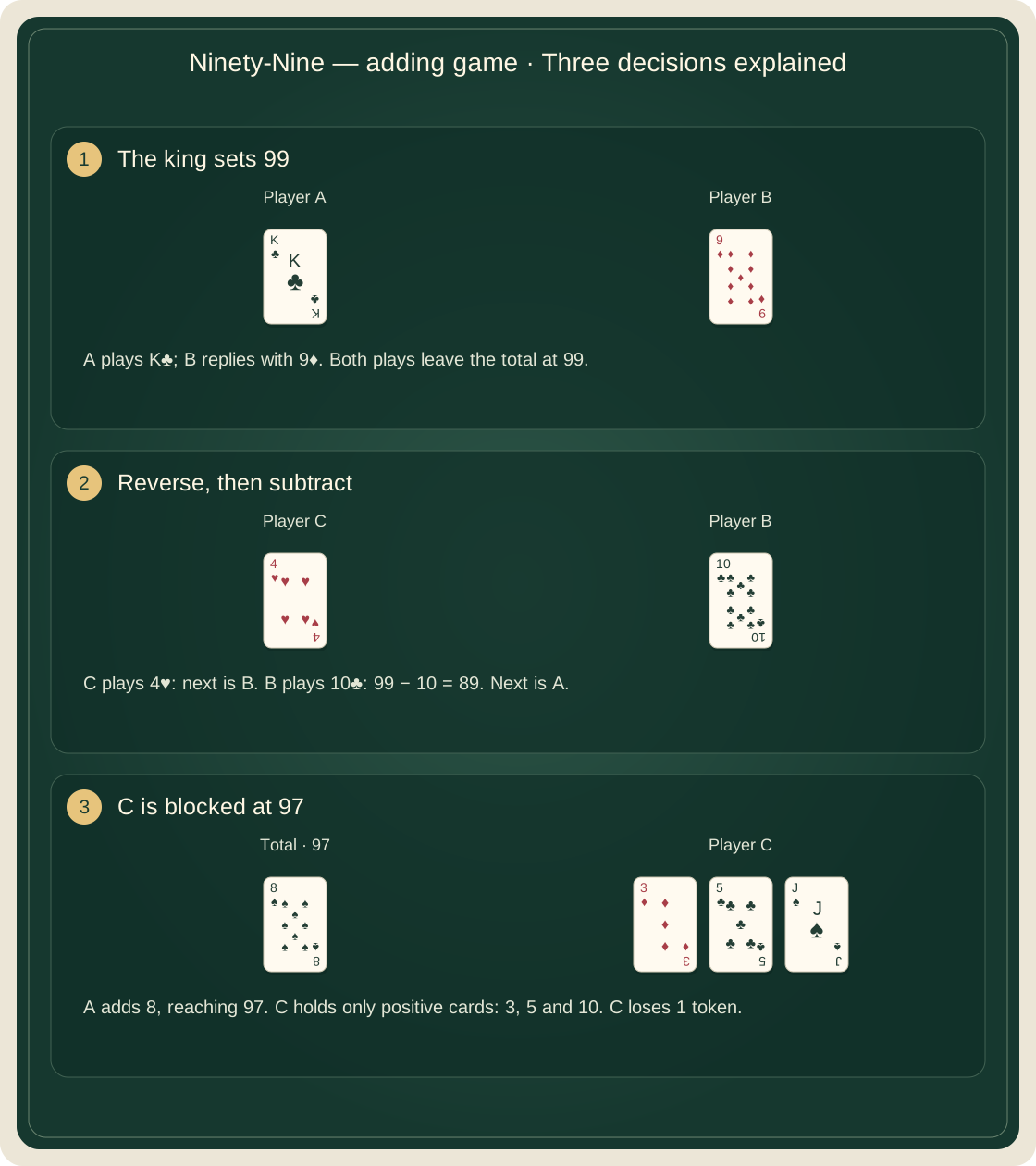
| Step | Player | Card | Running total | Replacement drawn |
|---|---|---|---|---|
| 1 | A | K♣ | 99 | 2♠ |
| 2 | B | 9♦ | 99 | 6♦ |
| 3 | C | 4♥ | 99 | J♠ |
| 4 | B | 10♣ | 89 | A♦ |
| 5 | A | 8♠ | 97 | Q♣ |
Start at 0. C’s four keeps 99 but reverses play: B acts again, then A, then C. At 97, C has 3♦, 5♣ and J♠, worth 3, 5 and 10. All exceed the ceiling; C loses 1 token, from 3 to 2. The nine did not skip C and the four did not add 4.
← On a small screen, scroll the diagram horizontally. →
09 /
Check your understanding
Can a court card always save you?
Reveal the answer
No. At 99 a J or Q adds 10 and is illegal; K remains safe. A 4 or 9 also leaves the count unchanged.
Can you draw first to find a safe card?
Reveal the answer
No. Play from your existing hand, then replace. If every card would exceed the limit, the round has already ended.
10 /
History and other versions
Family accounts place these adding games in North American home play; they do not establish a sole inventor. The Bicycle table is one documented version, not a universal standard. Other versions swap K and 9, allow 10 to add or subtract, or change the token count. Decide before dealing. Parlett’s Ninety-Nine uses bids and tricks, a different mechanism.
11 /
Mistakes to avoid
Do not add 4 when reversing or skip a player after a 9. Keep a direction marker beside the total. At 97, an ace declared as 1 is safe while 11 is not. A player cannot change the ace’s announced value after seeing the replacement. If the arithmetic is disputed, restore the last agreed total and verify before another card is played.
12 /
A reminder for the table
Check the total and direction, choose a legal card, announce its effect, draw and send the turn the right way. At the ceiling look for K, 9, 4 or 10. When stuck, show the hand and remove a token; do not ask the next player to continue. A new deal starts a fresh count and clockwise order.
Common questions
Does nine set the total to the ceiling?+
Not in this profile. K sets 99; 9 leaves the current total unchanged.
Can ten add instead of subtracting?+
No. Here 10 only subtracts 10; positive tens belong to another version.
Is the total scored as match points?+
No. The total controls legal plays; tokens control survival.