← On a small screen, scroll the diagram horizontally. →
01 /
Your first round
Play one card, announce the new total, draw one replacement. The total begins at 0 and must not exceed 98. If none of your cards is safe, the round stops and you lose a token. The last player with tokens wins the match.
02 /
The rules used here
Use this card table throughout. Give everyone 3 tokens and use one pack for 2–5 players. A failed turn ends the whole round; other players do not continue from the same count. These match conditions are our teaching agreement, not the Arizona elimination version.
03 /
Cards, seats and the deal
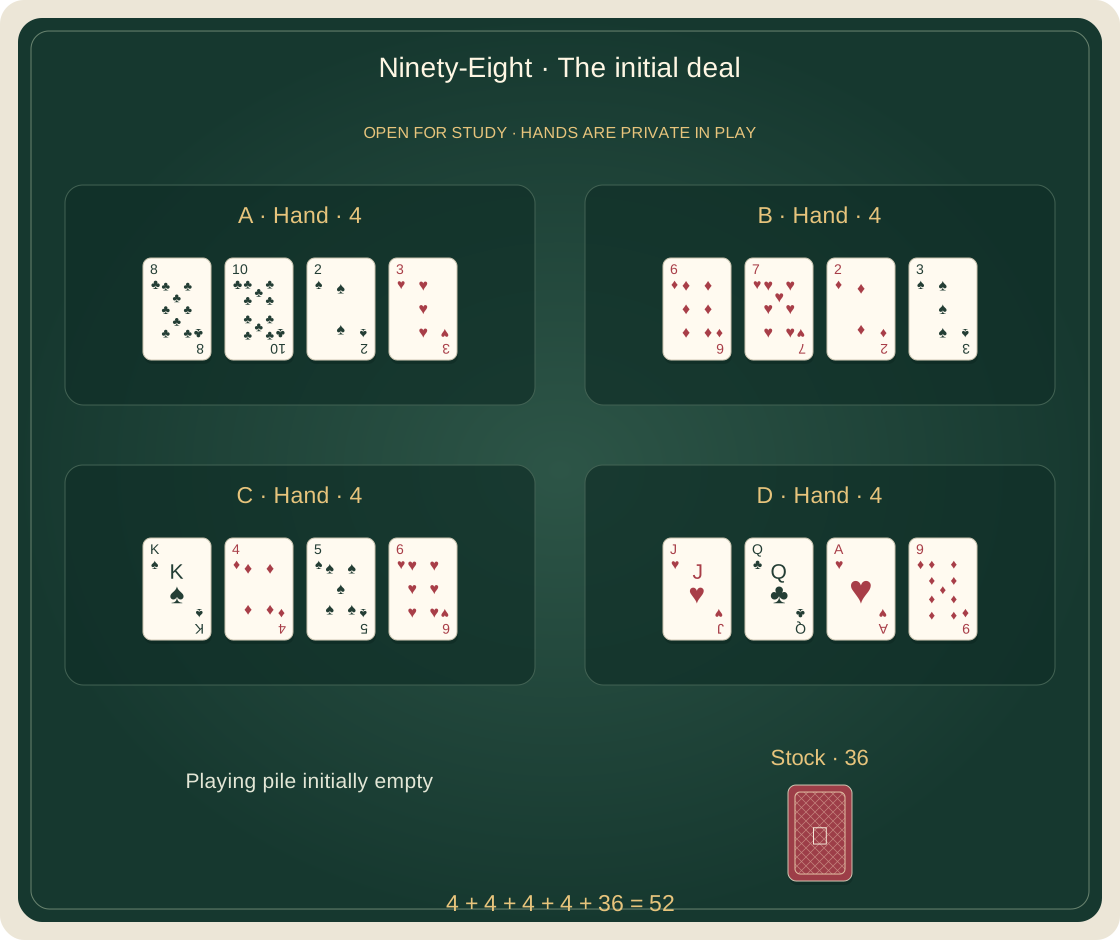
Remove jokers from 52 cards. Choose a first dealer by agreement, shuffle and offer a cut. Deal 4 each, one at a time clockwise, starting on the dealer’s left. The rest is stock; the play pile starts empty. At a four-player table: 16 + 36 = 52. Dealer’s left starts; all hands are private.
04 /
The complete card-value table
Only rank affects the count; suits never have to match. A is an ace, J a jack, Q a queen and K a king. An ordinary addition is legal only if its resulting total stays within the ceiling.
| Cards | Effect on the total |
|---|---|
| A–9 | Add the printed value; A = 1 |
| 10 | Subtract 10 |
| J / Q | No change |
| K | Set to 98, not add 98 |
05 /
What happens on your turn
Choose one legal card, place it face up and say the new total before drawing. Then draw one unseen top card and end the turn. No passing, multi-card plays or drawing first. With 98 showing, J, Q, K or 10 still work. Here a total below zero is allowed: 6 followed by 10 becomes −4, not 0.
06 /
Stock exhaustion and missed draws
If the stock empties, keep the top played card and the announced total. Shuffle the other played cards into a new stock; do not recalculate from the recycled cards. If no replacement is available, continue with the remaining hand. Having no card at your turn loses the round. Correct a missed draw before the next play; afterwards the smaller hand stands.
07 /
When the round and match end
When no held card can keep the total at 98 or less, reveal the hand to confirm the loss. Remove 1 token; the other players lose none. At 0 tokens, leave the match. Collect and reshuffle all cards, rotate the dealer left among survivors and restart at 0. Do not carry the old count forward. The sole remaining player wins, with no comparison of card points.
08 /
A complete worked example
Initial hands, opened only for study
Player A
8♣ 10♣ 2♠ 3♥
Player B
6♦ 7♥ 2♦ 3♠
Player C
K♠ 4♦ 5♠ 6♥
Player D
J♥ Q♣ A♥ 9♦
| Step | Player | Card | Running total | Replacement drawn |
|---|---|---|---|---|
| 1 | A | 8♣ | 8 | A♠ |
| 2 | B | 6♦ | 14 | 2♥ |
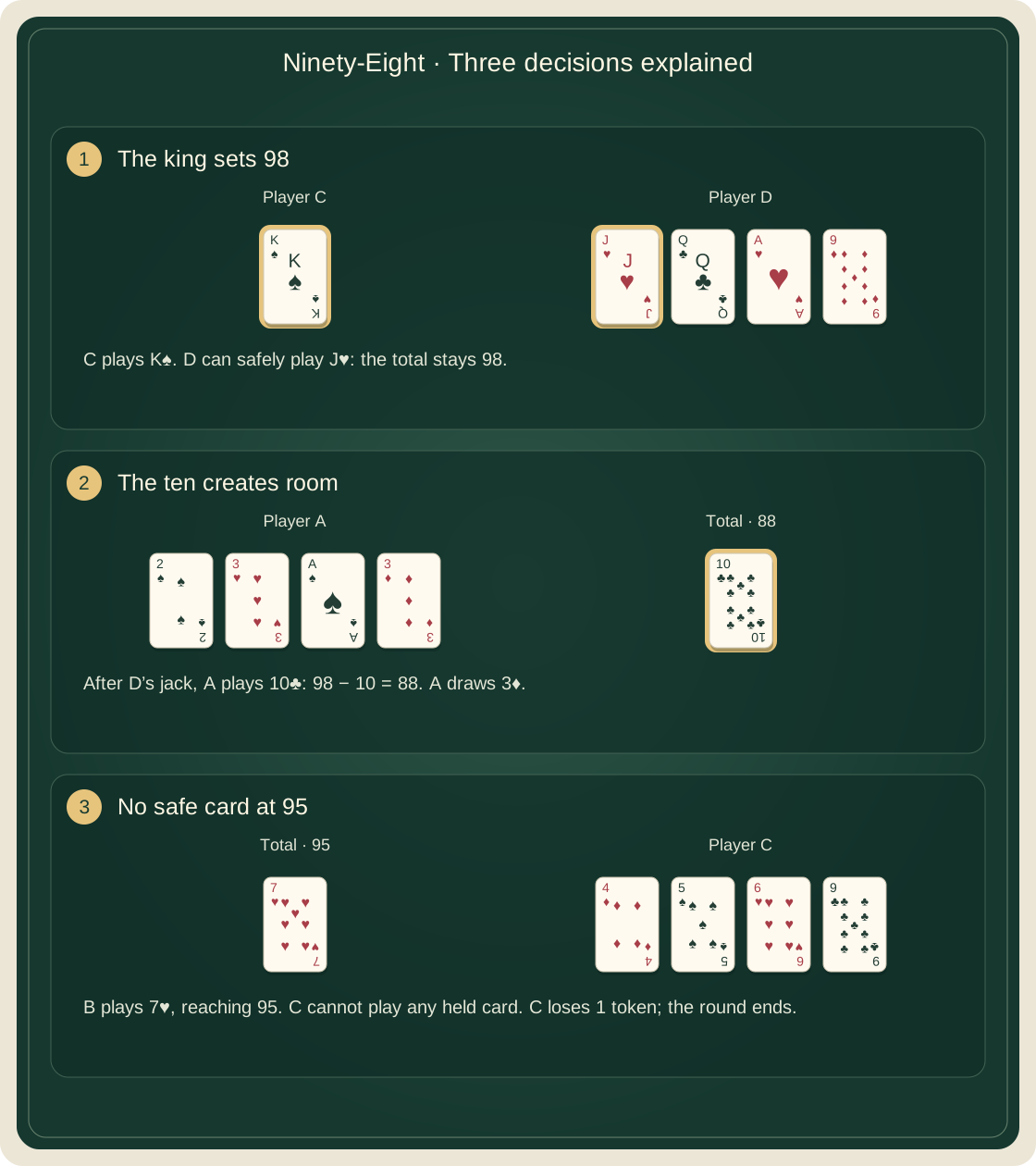
| 3 | C | K♠ | 98 | 9♣ |
| 4 | D | J♥ | 98 | 4♣ |
| 5 | A | 10♣ | 88 | 3♦ |
| 6 | B | 7♥ | 95 | 5♦ |
Start at 0. At 98, D’s jack adds nothing; A’s ten later subtracts 10. After B reaches 95, C holds 4♦, 5♠, 6♥ and 9♣: every card would exceed 98. C reveals this hand, loses 1 token, going from 3 to 2, and the round ends. None of the drawn replacements is played before it belongs to its owner.
← On a small screen, scroll the diagram horizontally. →
09 /
Check your understanding
Can a court card always save you?
Reveal the answer
Here J and Q leave the count unchanged, and K sets 98. All are legal at 98. Do not import the other game’s table.
Can you draw first to find a safe card?
Reveal the answer
No. Play from your existing hand, then replace. If every card would exceed the limit, the round has already ended.
10 /
History and other versions
Ninety-Eight belongs to the same adding family as Ninety-Nine. Player reports collected by Pagat describe several incompatible card tables. Its simple Jepson profile differs from the Arizona game, which uses jokers and extra effects. The name does not identify one universal code; a secure invention date for the whole family is not established.
11 /
Mistakes to avoid
Do not import powers from another version: J and Q do not add 10 here, A cannot count 11, and 10 never adds. Say the total before drawing so others can check it. Keep the last announced total visible on paper; recycling changes the physical pile, not that number. A king already at the ceiling is legal, not a bust.
12 /
A reminder for the table
Check the count; choose a safe card; announce; play; replace; pass the turn clockwise. If stuck, reveal, remove a token and redeal. The special cards do not change direction or skip anyone in this profile. Agree on any alternative before the first deal, especially the values of court cards and tens.
Common questions
Can a king be played at the limit?+
Yes. It sets the count to 98, including when the count is already 98.
Do jacks and queens add points?+
No. They leave the count unchanged in the selected simple version.
Does the losing player immediately leave?+
Only after losing the last of 3 tokens. Each failed round costs 1 token.