← On a small screen, scroll the diagram horizontally. →
01 /
Nepal’s three-pack rummy
Marriage is a large-hand rummy tradition of Nepal, especially the Kathmandu valley, also played in Bhutan and at Dashain and Tihar gatherings. It is distinct from the European king–queen game Mariage. A marriage here joins neighbouring cards around a secret indicator. Local packs and payments differ; this guide selects the no-printed-joker, three-pack form with restricted knowledge of wild cards and separate maal payments. A precise invention date is not established. Use a points ledger rather than monetary stakes.
02 /
Twenty-one cards each
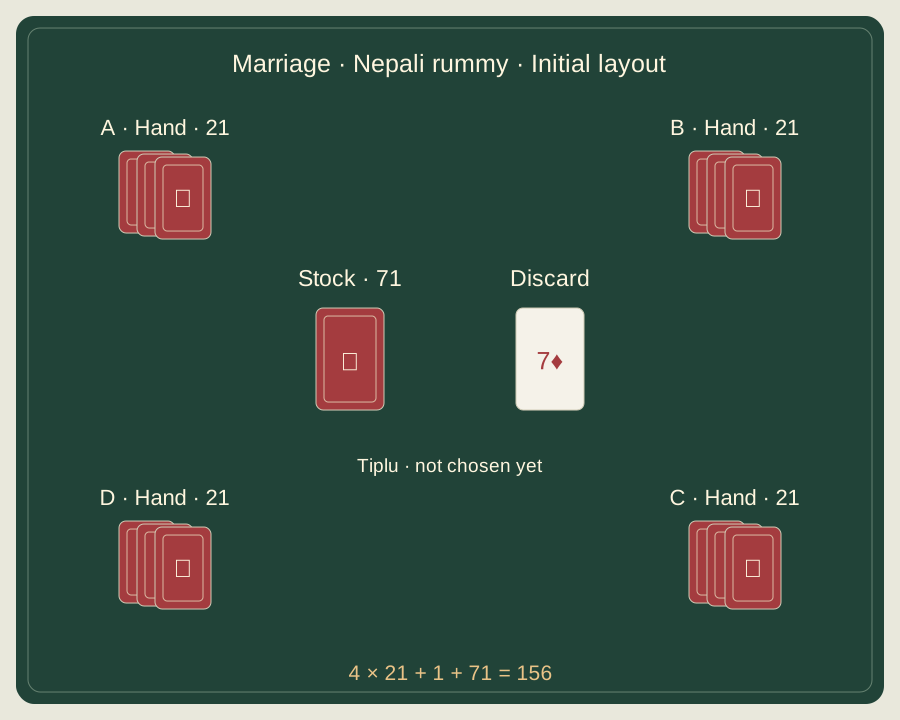
For 2–5 people combine 3 ordinary packs without printed jokers: 156 cards. Choose dealer randomly, rotate left, deal and play clockwise. Give 21 each, turn 1 starter discard, leave the rest face down. With 4 players: 84 in hands, 1 discard, 71 stock. Expose any dealt tunnela immediately if you want its later bonus; otherwise it remains a valid meld without that bonus. Nothing selects wild cards at the deal. Keep exposed cards associated with their owner: they still belong to that player’s original hand allocation.
03 /
Exact triples and natural qualification
Every ordinary meld has exactly 3 cards. Pure run: consecutive same suit, ace low or high, never K A 2. Tunnela: 3 genuinely identical cards. Triplet: same rank in 3 different suits. A wild can replace a missing card in a dirty run or triplet; 2 wilds plus a natural are allowed. Two identical cards plus a substitute cannot make a tunnela or a distinct-suit triplet. First qualify by exposing 3 pure runs or tunnelas in any mixture, using 9 cards; do not use substitutes. Other melds remain concealed until finishing, with no additions to another player’s melds.
04 /
Earn the right to see the indicator
The first qualifier draws an unseen card from inside the stock, privately checks it and places it hidden underneath as tiplu. Later qualifiers may inspect it privately. Its exact copies, all other cards of that rank, and the immediate lower jhiplu and higher poplu in its own suit are wild. For neighbours only, ranks cycle K A 2; runs still cannot wrap. If tiplu is J♣, then J of every suit plus 10♣ and Q♣ are wild. The reserved indicator stays out of hands. A player who has seen tiplu cannot pick up a discarded wild. Conceal the information from unqualified players.
05 /
Drawing, seven melds or eight pairs
Begin left of dealer. Draw 1 from stock or latest discard, then discard 1; never return that same picked-up discard immediately. After natural qualification finish by arranging 4 more triples, for 7 total using 21 cards, then discard the extra drawn card. Alternatively expose 7 dublees, exact natural pairs, to see tiplu; win with 8 dublees using 16 cards, leaving 5 unused plus a discard. No wild substitution in pairs; after seeing tiplu this route may take a discard only to complete the final pair and finish. Recycle old discards except the top over the reserved tiplu when stock runs low; never draw tiplu itself. If no refill is possible, our session convention ends without a finisher and settles only card values.
06 /
Maal and early tunnela values
Reveal tiplu at the end. A lone jhiplu or poplu scores 2; 2 identical score 5, all 3 score 10. Tiplu copies score 3 singly or 7 together. One natural jhiplu–tiplu–poplu marriage scores 10, two marriages 30. Count each physical card in only one scoring item, choosing the best non-overlapping grouping. A tunnela exposed immediately after dealing scores 5 for ordinary cards, 10 for ordinary jokers, 20 for jhiplu or poplu, instead of their duplicate-card value. That tunnela bonus requires the natural qualification route. Late tunnelas have no tunnela bonus, though their maal can still count. Ordinary jokers alone have no maal value. This is card-value accounting, not deadwood penalties.
07 /
A finisher can still lose points
Each opponent pays finisher 3 if they saw tiplu, otherwise 10; add 5 if the finish used dublees. Separately each pair of players exchanges the difference between their card values. Equivalently, with n players and total card values T, opponent of value S pays finisher T + w − n × S, where w is their finish fee. Negative means finisher pays them. Keep a zero-sum ledger. Play an agreed number of complete dealer rotations; highest net total wins, equal totals share. An invalid declaration is restored and the same turn completed; agree stronger penalties before play rather than inventing them.
08 /
Natural opening, then maal settlement
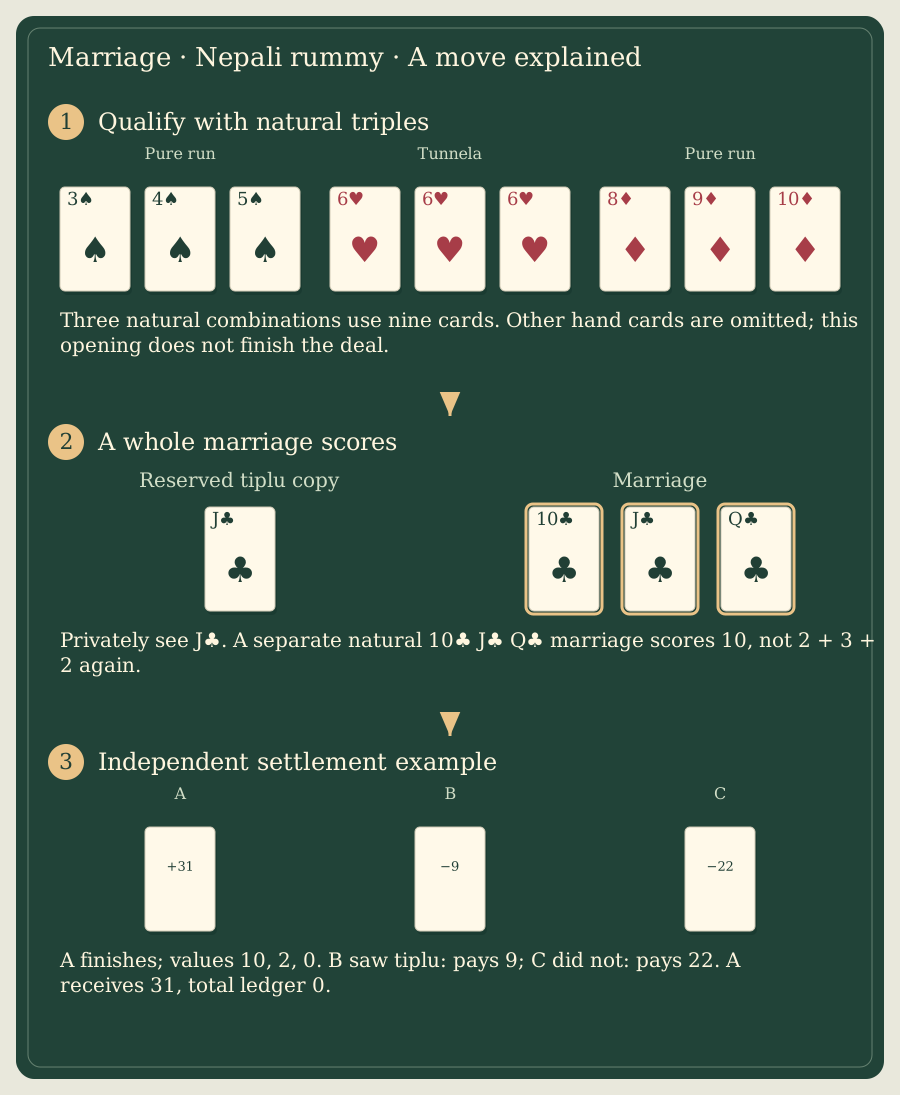
Expose 3♠ 4♠ 5♠, 6♥ 6♥ 6♥ and 8♦ 9♦ 10♦: 3 natural combinations, 9 cards. Privately see J♣ tiplu. The natural 10♣ J♣ Q♣ is a marriage worth 10, not 2 + 3 + 2 separately. For an independent 3-player score example, A finishes normally; card values A=10, B=2, C=0, so T=12. B saw tiplu and pays 12 + 3 − 3 × 2 = 9. C did not and pays 12 + 10 − 3 × 0 = 22. Ledger A +31, B −9, C −22 sums to 0. The picture is a local opening, not all the cards needed to finish.
← On a small screen, scroll the diagram horizontally. →
Common questions
Are printed jokers needed?+
No, this profile creates wild cards from the secret tiplu.
Can anyone inspect tiplu?+
Only after the stated natural-meld or dublee qualification.
Must the finisher gain points?+
No, opponents’ maal values can outweigh the finishing payments.