← On a small screen, scroll the diagram horizontally. →
01 /
Cards and deal
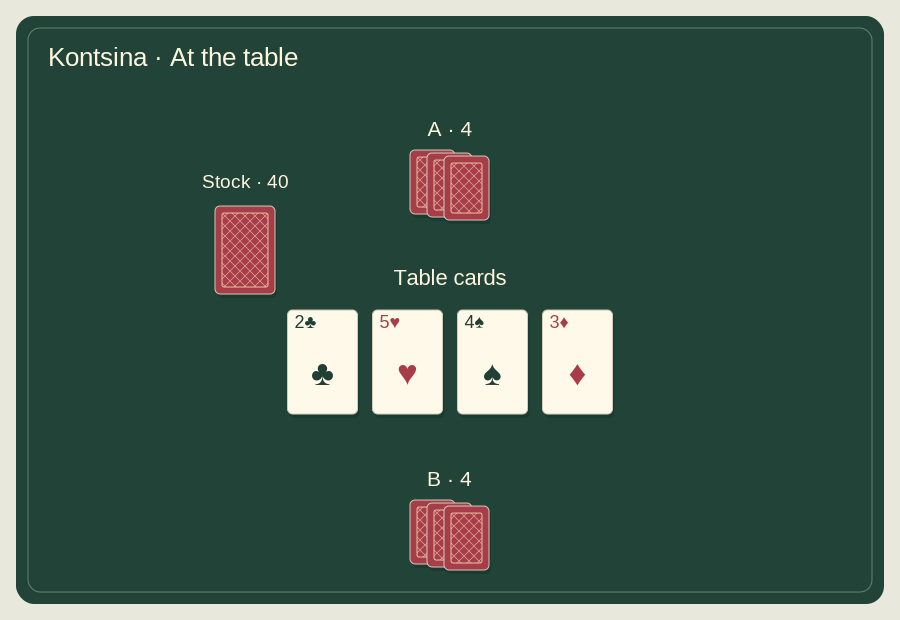
Shuffle 52 cards without jokers. Deal 4 per player and 4 face up to the table; the other 40 remain face down. The non-dealer plays first. Keep captured cards apart from both the stock and the live table.
02 /
Playing a turn
Play exactly one card. Match one card of its rank or take one group whose sum equals the played pip. Aces count as one, and suits do not matter. Courts only match a single identical rank. The played card joins its catches in your pile. You may lay a card instead, even when a capture exists.
03 /
When the stock runs down
Alternate until both hands are empty. Deal 4 more to each without adding anything to the table; the non-dealer opens each batch. There are 6 batches altogether. The last player to make a capture sweeps the leftovers after the final card, even if the other player laid that final card.
04 /
A deal from first card to settlement
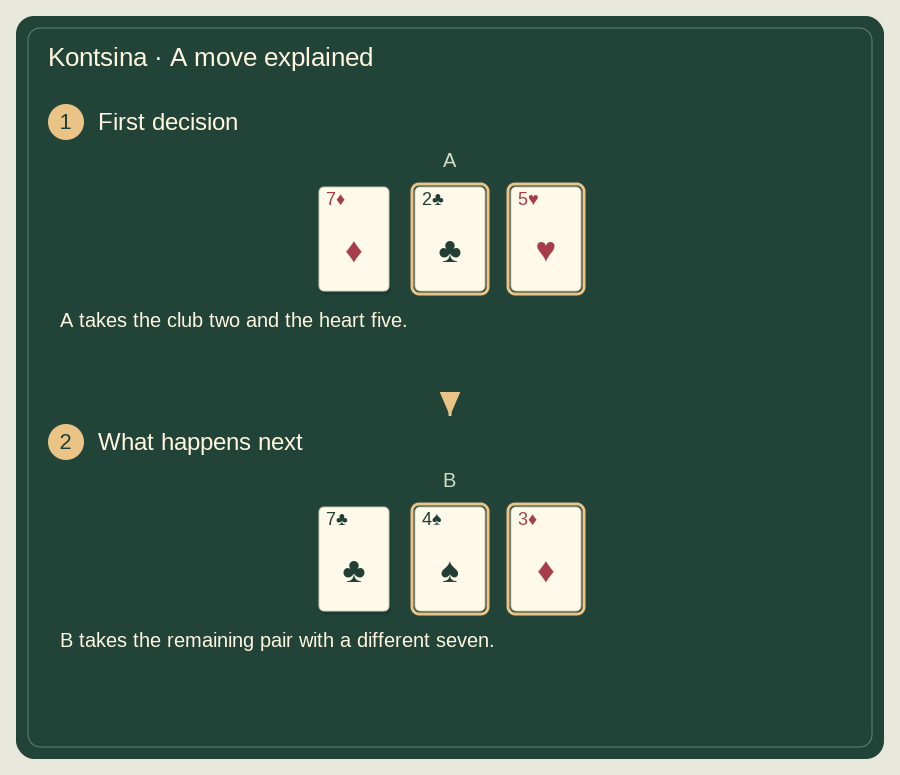
Start with 2♣, 5♥, 4♠ and 3♦ on the table. A holds 7♦. Both pairs total seven. Take 2♣ and 5♥ for the special club, leaving 4♠ and 3♦. B can now take that remaining pair with 7♣. Neither seven may take both pairs at once. For each new batch in this deal, give the first four cards of the stock to A and the next four to B.
Reveal the original deal
- A · 7♦ · A♠ · J♥ · 9♥
- B · 7♣ · K♥ · 10♦ · 4♥
- Table · 2♣ · 5♥ · 4♠ · 3♦
- Stock, top first · 8♥ · J♠ · 9♠ · 10♣ · 9♦ · 8♠ · A♣ · 6♦ · 6♥ · 6♠ · Q♠ · Q♦ · 8♣ · 10♥ · 5♠ · 7♥ · 2♠ · 8♦ · 3♣ · 4♦ · 6♣ · K♦ · 2♦ · 5♣ · 7♠ · 5♦ · A♦ · Q♥ · 10♠ · 2♥ · Q♣ · 3♥ · K♣ · A♥ · K♠ · J♣ · J♦ · 4♣ · 3♠ · 9♣
Follow every play
| Batch | Cards in play order | Cards taken |
|---|---|---|
| 1 | A 7♦ | 2♣ · 5♥ |
| 1 | B 7♣ | 4♠ · 3♦ |
| 1 | A A♠ | — |
| 1 | B K♥ | — |
| 1 | A J♥ | — |
| 1 | B 10♦ | — |
| 1 | A 9♥ | — |
| 1 | B 4♥ | — |
| 2 | A 8♥ | — |
| 2 | B 9♦ | A♠ · 8♥ |
| 2 | A J♠ | J♥ |
| 2 | B 8♠ | — |
| 2 | A 9♠ | 9♥ |
| 2 | B A♣ | — |
| 2 | A 10♣ | 10♦ |
| 2 | B 6♦ | — |
| 3 | A 6♥ | 6♦ |
| 3 | B 8♣ | 8♠ |
| 3 | A 6♠ | — |
| 3 | B 10♥ | 4♥ · 6♠ |
| 3 | A Q♠ | — |
| 3 | B 5♠ | — |
| 3 | A Q♦ | Q♠ |
| 3 | B 7♥ | — |
| 4 | A 2♠ | — |
| 4 | B 6♣ | A♣ · 5♠ |
| 4 | A 8♦ | — |
| 4 | B K♦ | K♥ |
| 4 | A 3♣ | — |
| 4 | B 2♦ | 2♠ |
| 4 | A 4♦ | — |
| 4 | B 5♣ | — |
| 5 | A 7♠ | 3♣ · 4♦ |
| 5 | B 10♠ | — |
| 5 | A 5♦ | 5♣ |
| 5 | B 2♥ | — |
| 5 | A A♦ | — |
| 5 | B Q♣ | — |
| 5 | A Q♥ | Q♣ |
| 5 | B 3♥ | 2♥ · A♦ |
| 6 | A K♣ | — |
| 6 | B J♦ | — |
| 6 | A A♥ | — |
| 6 | B 4♣ | — |
| 6 | A K♠ | K♣ |
| 6 | B 3♠ | — |
| 6 | A J♣ | J♦ |
| 6 | B 9♣ | 8♦ · A♥ |
B makes the final capture and takes the leftovers. A has 24 cards but seven clubs and both special cards. B has 28 cards and six clubs. A wins the round 3–2.
← On a small screen, scroll the diagram horizontally. →
05 /
Scoring and winning
Most cards earns 2 points, most clubs 1, the 2♣ and 10♦ another 1 each. At 26 cards apiece nobody scores the majority. For example, with 28 cards, eight clubs and the good two, A scores 4 against B’s 1 for the diamond ten. Record a round win, swap dealers and play an agreed odd number of rounds. Most round wins takes the match.
06 /
History and local practice
Κοντσίνα belongs to the Greek fishing-game tradition. Alexandros Kouridakis and Thanos Tsakonas supplied an account of play for two. At a table of four, opposite partners may pool their captures, but here each player counts a separate pile.
Common questions
Can one card take two sums?+
Choose a single group, even if two groups each match.
Can a jack take numbers?+
It only takes another jack.
Who takes the leftovers?+
The last player who captured, regardless of who played last.