← On a small screen, scroll the diagram horizontally. →
01 /
The game at a glance
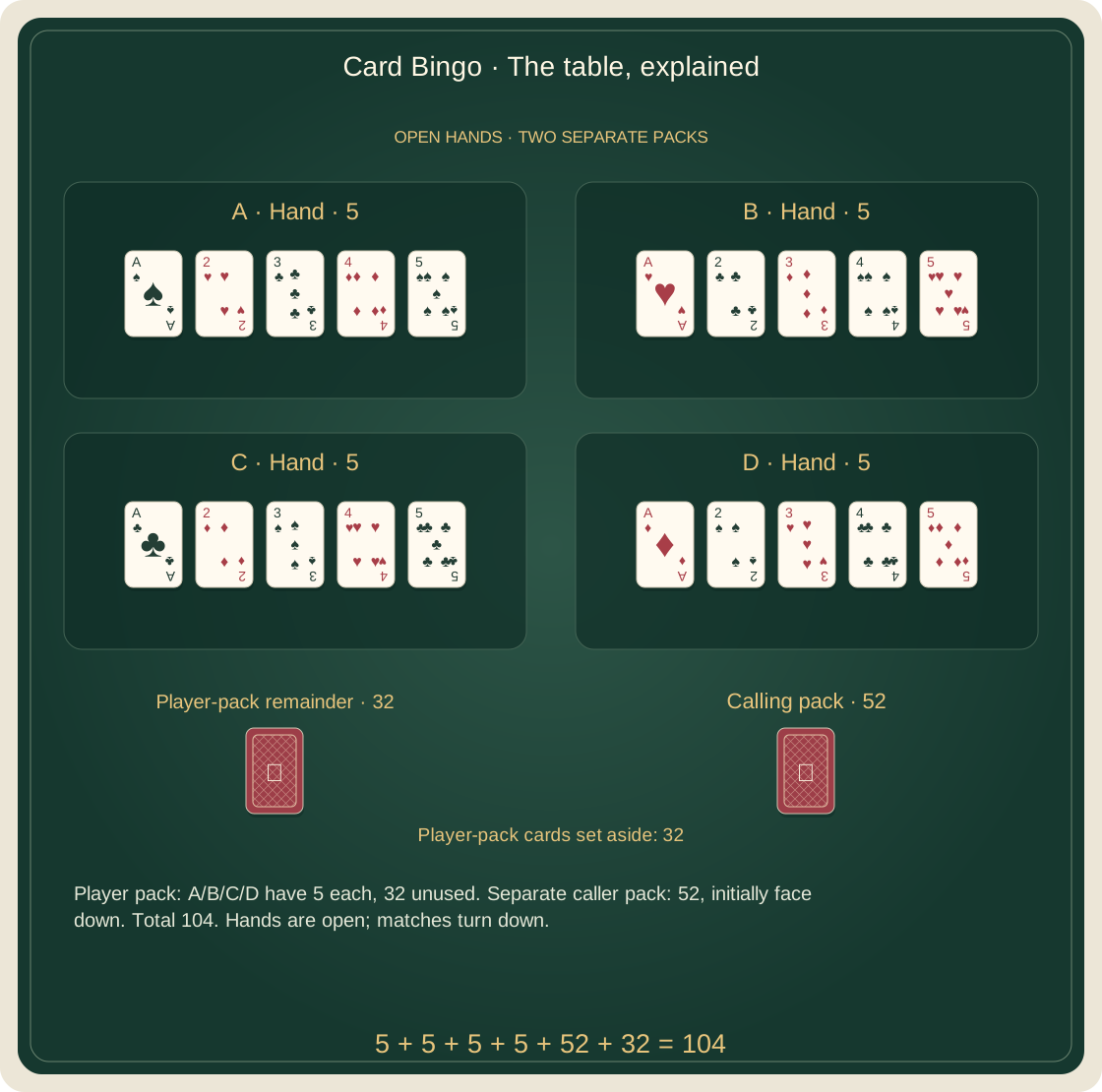
Use 2 complete ordinary packs without jokers: 104 cards. One pack supplies the players, the other supplies the calls. Up to 10 players can receive 5 cards each; an additional non-playing caller is possible. There are no high or low cards: an ace is simply another exact identity. The objective is to mark every card you were dealt, not to form a line or collect tricks.
02 /
Prepare and deal
Shuffle the packs separately and keep their roles separate throughout. Deal hands face up from the player pack; set its unused cards aside. Lay each hand in a row with space to turn cards. Shuffle the full calling pack and keep it face down by the caller. With 4 players the inventory is 20 in hands, 32 unused and 52 to call. Explain the winning shout before starting.
03 /
How play proceeds
The caller draws the top card, exposes it and says both rank and suit clearly. Anyone holding the exact match turns that card face down. A different suit of the same rank does not match. Keep called cards in a visible ordered pile so a missed call or a victory can be checked. Pause long enough for everyone to respond before drawing again. Players do not draw, exchange or discard their hand cards.
04 /
Rules that change your decision
The second pack is essential: the called copy is not taken from a player’s hand. A call matching an unused player-pack card simply changes no hand. In this basic version each exact card belongs to at most one player, so a valid call cannot complete different players simultaneously. Announce a match you missed before play continues, checking the recorded calls rather than guessing.
05 /
Finish and scoring
When your last card is called, shout Bingo, Bango or the agreed word. Stop drawing and verify every card of the claimed hand against the calls. A valid first complete hand wins the deal; no card-point calculation is required. If using a prize, agree it before the deal. For a family match, record one win per successful deal and agree the number of deals or a time limit. These match arrangements do not change the matching rule.
06 /
A worked example
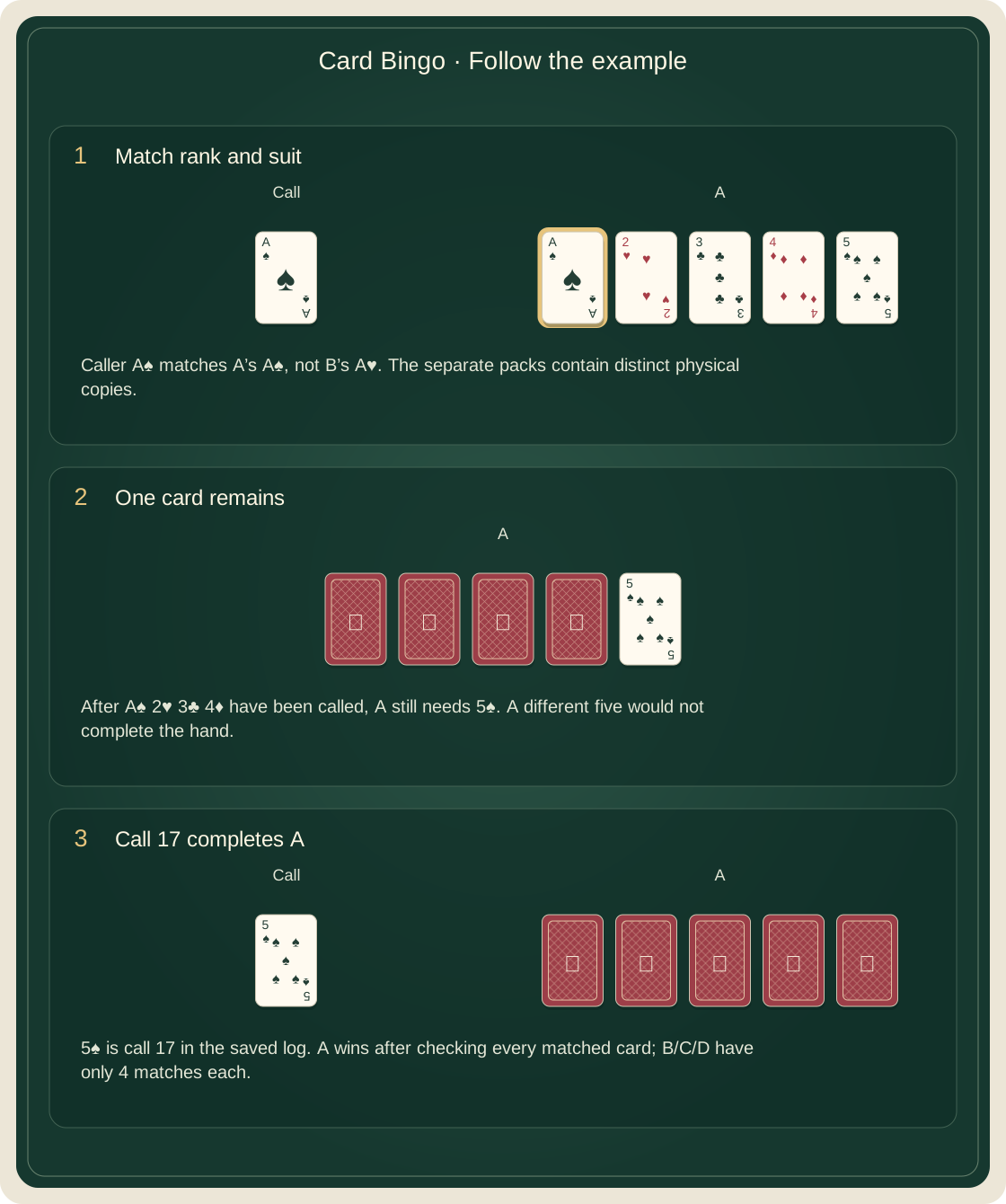
A holds A♠ 2♥ 3♣ 4♦ 5♠. The first call A♠ closes only that ace; B’s A♥ stays open. After 2♥, 3♣ and 4♦, A has only 5♠ left. In the complete call log below, 5♠ is call 17 and completes A. B, C and D have each marked 4 cards and still need their fives. The exact suits, not matching numbers, explain why A wins alone.
| Call | Card |
|---|---|
| 1 | A♠ |
| 2 | A♥ |
| 3 | A♣ |
| 4 | A♦ |
| 5 | 2♥ |
| 6 | 2♣ |
| 7 | 2♦ |
| 8 | 2♠ |
| 9 | 3♣ |
| 10 | 3♦ |
| 11 | 3♠ |
| 12 | 3♥ |
| 13 | 4♦ |
| 14 | 4♠ |
| 15 | 4♥ |
| 16 | 4♣ |
| 17 | 5♠ |
← On a small screen, scroll the diagram horizontally. →
07 /
What to watch at the table
This is a listening and checking game, not a game of strategic card selection. Arrange cards by suit or another clear pattern and turn only verified matches. The caller should show as well as name cards, especially when children or mixed-language groups play. Keep the calling history intact until the winner is confirmed. No choice of layout changes the odds once hands are dealt.
08 /
Choose the rules before starting
Larger hands, rank-only calls and jackpot or betting versions are different profiles. With rank-only calls every card of that rank is marked, which can produce simultaneous winners and needs a tie agreement. Large events may use more player packs while retaining a separate calling pack. Do not add those rules midway through this exact-card game.
09 /
History and related games
Card Bingo adapts the familiar call-and-mark structure of bingo to ordinary playing cards. Bango and Hoy are alternative winning shouts and names, not extra games on this site. Published accounts describe several community versions; they do not establish a single inventor or a precise date for the basic card adaptation.
10 /
Check your understanding
Does A♥ mark when A♠ is called?
Show answer
No. Both rank and suit must match.
Can unused cards be called?
Show answer
Yes. The calling pack remains complete; that call simply marks no player’s hand.
Common questions
Do we need a special pack?+
No. Use 2 normal packs without jokers.
Can the caller play?+
Yes, or a separate person may call without playing.
How do we verify a winner?+
Every card in the claimed hand must appear in the calling history.