← On a small screen, scroll the diagram horizontally. →
01 /
Aim and equipment
This is home seven-card stud for 2–6 players with 52 cards and no jokers. Every 3 and 9 is wild, exposed or hidden. An exposed 4 gives a free extra upcard; an extra 4 repeats the effect. Hidden 4s do nothing. This selects Pagat’s basic profile, without paid fours or compulsory payments for threes. Use nonredeemable accounting units with no cash value; balances may go negative, so there are no all-ins or side pots.
02 /
Setup and deal
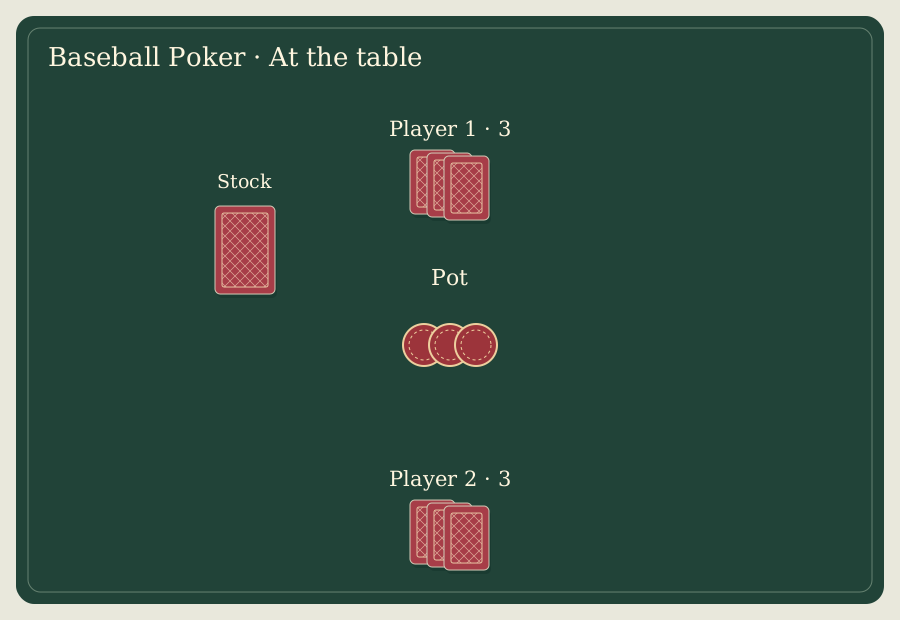
Choose a dealer randomly and rotate left. Each antes 1. Shuffle, cut on the right and deal clockwise from dealer’s left: 2 downcards then 1 upcard each. Give bonuses for exposed 4s immediately before dealing to the next player. Burn no cards. Follow with 3 further streets of 1 upcard each and a final street of 1 downcard. Bet after the first upcard and each later street: 5 rounds in all. Only the dealer distributes stock cards.
03 /
Legal actions
The best exposed hand starts each betting round; ties go to the nearest player clockwise from dealer. Wild cards count here too; suits never decide. For incomplete hands compare rank groups and remaining kickers; straights and flushes require 5 exposed cards. Our complete betting limit is a bet of 1 and at most 3 raises of 1 per round. Before a bet, check or bet; afterwards match the round’s cumulative level, raise or fold. Pay only the difference from your earlier payment. End when all survivors have matched and acted after the last raise, or everyone checks. Folders receive no more cards and cannot win the pot.
04 /
Scoring
At showdown select the best 5 from every card received; keep bonus cards from fours. A wild represents a missing card, or a fifth card of a rank for five of a kind. Order: five of a kind, straight flush, four of a kind, full house, flush, straight, trips, two pairs, pair, high card. A is high, but A–2–3–4–5 is the lowest straight; K–A–2 wrapping is forbidden. Compare five-kind, quads and trips by rank then kickers; full houses by triple then pair; two pairs by higher pair, lower pair, kicker; pairs by pair then kickers; flushes and high cards lexicographically. Compare straights by top card. Natural hands do not outrank equal wild hands; exact ties split the pot without suit priority.
05 /
Ending the game
If all but one fold, the survivor takes the pot without showing. Otherwise all survivors reveal after final betting. Split units exactly as fractions if necessary. Play 8 resolved pots, then compare net balance changes; ties share places. This session length is an agreement, not universal home-game law. Gather every card for the next shuffled deal. No Peek and Night Baseball are different profiles.
06 /
Context and variants
The special ranks evoke American baseball: three strikes, nine innings and four balls. The checked rules document a home stud variant without establishing its author or a reliable origin date. Paid fours and payments for an exposed three are genuine alternatives, agreed beforehand rather than introduced mid-deal.
07 /
Worked example
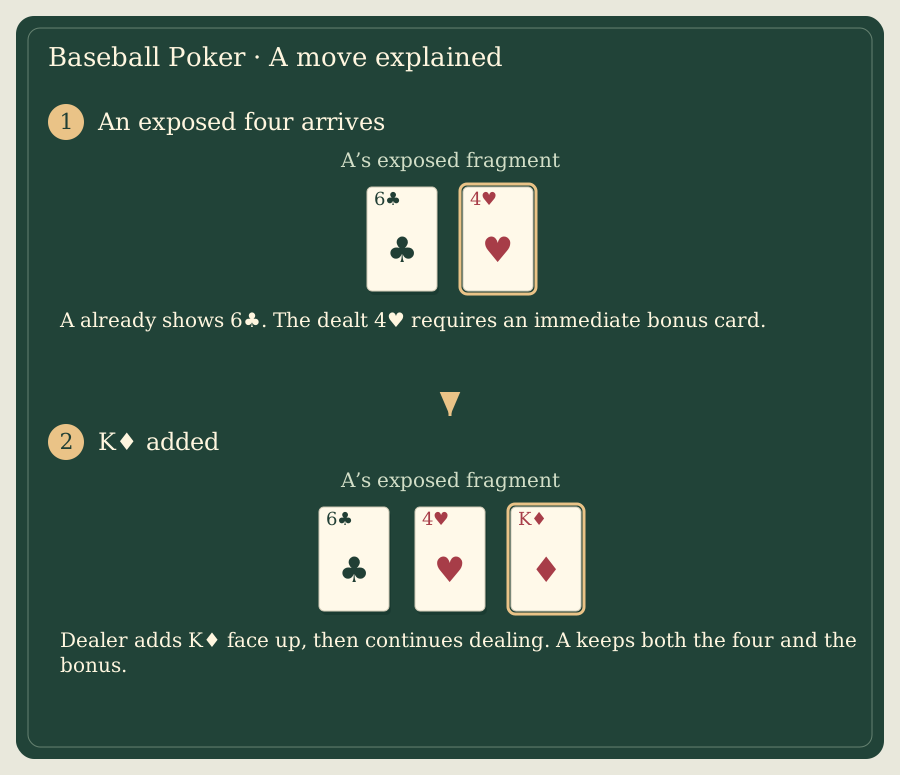
A shows 6♣. The next street brings exposed 4♥: dealer immediately adds exposed K♦ before continuing around. A keeps both without payment; a hidden four would not trigger this. In a separate showdown 8♠–8♥–8♣–8♦–3♣ makes five eights, beating even natural A♠–K♠–Q♠–J♠–10♠ straight flush. These are independent examples, not cards from one deal.
← On a small screen, scroll the diagram horizontally. →
Common questions
Is a hidden 9 wild too?+
Yes, all 3s and 9s are wild.
Must I pay for a four?+
No; in this profile an exposed four gives a free upcard.
Does five of a kind beat a straight flush?+
Yes, it is the highest wild-card category.