← On a small screen, scroll the diagram horizontally. →
01 /
The game at a glance
Use 106 cards: 2 standard packs and 2 jokers. All twos are wild; other natural ranks run from 3 to A. Play with 2 or 3 individually, or 4 individually or as opposite partners. Agree on a target: usually 150 with 2, 203 with 3, and 303 for partnerships. High cumulative score wins.
02 /
Prepare and deal
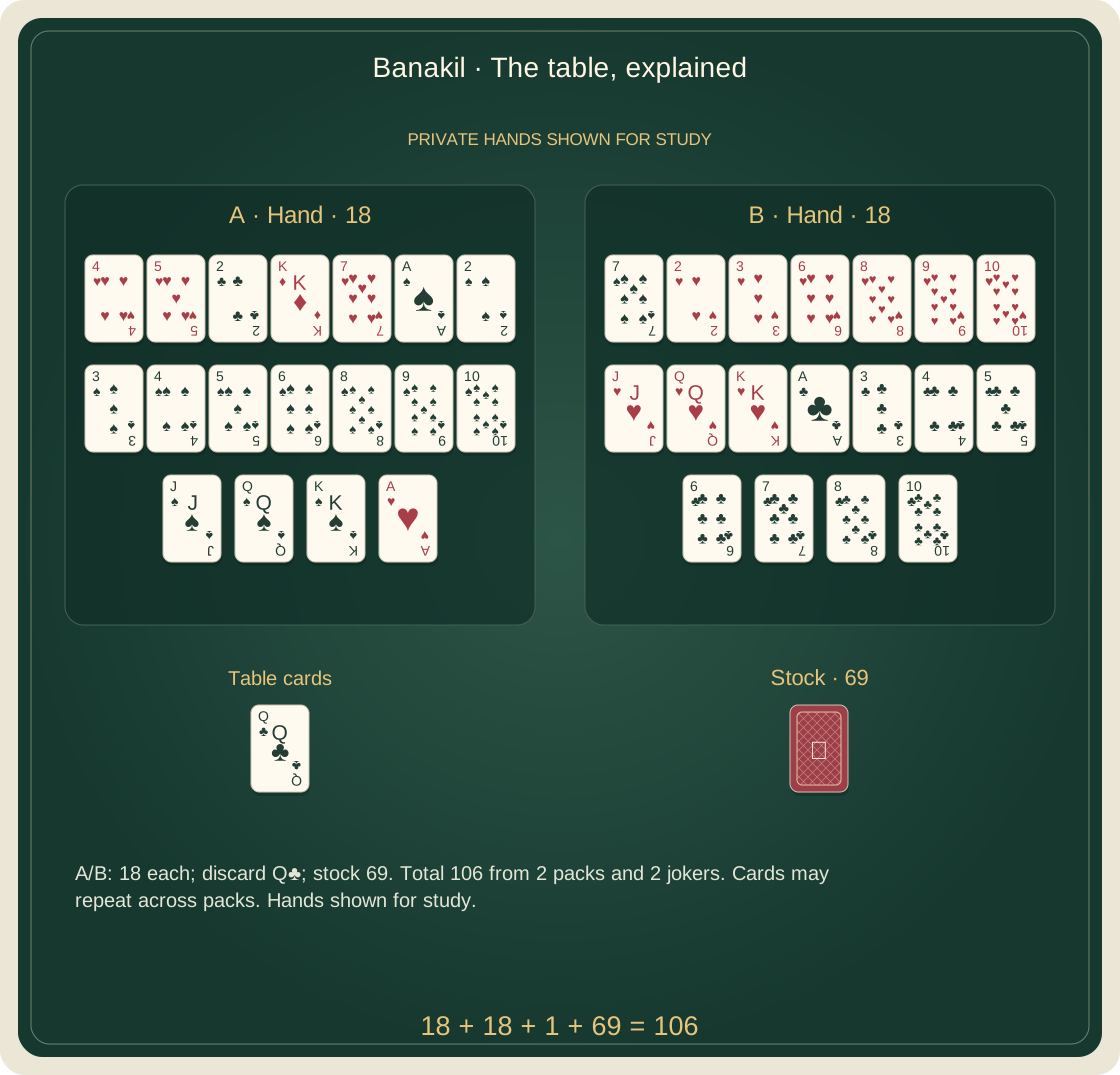
Deal and play anticlockwise. Give 18 cards each, expose a discard and stack the rest face down. The player on the dealer’s right starts. Our initial table has 18+18+1+69=106. Spread later discards so the whole pile is visible; the buried cards remain available, rather than being an inaccessible waste pile.
03 /
How play proceeds
Draw the stock’s top card or take a top portion of the discard pile, optionally meld, then discard. Taking a buried discard requires taking every card above it, with no immediate-meld requirement. Taking only the top discard forbids immediately discarding that same card; taking several allows it. You may add to your own or your partner’s melds only after making a meld in your own area. Never alter opponents’ melds.
04 /
Rules that change your decision
Runs need at least 3 consecutive suited cards, from 3 up to A, without wrapping. Each may contain at most one wild Two and one Joker. A Two stays attached, although it may move within the run; a Joker can be reclaimed with a natural replacement that leaves a valid run. Runs cannot be split. Sets are only 3 or 4 different-suit threes or aces, with at most one Joker and no Two. After a full natural run, an attached Two may remain as an extra card.
05 /
Finish and scoring
Empty your hand by melding with or without a final discard. Otherwise finish the turn drawing the final stock card; if nobody exits, no one scores. With an exit, score meld value minus hand value; add 20 for the finisher, but an unmelded player scores −20 instead. An individual who melds everything at once scores a fixed 40. Round each final score upward, including negative halves. The table lists card values.
| Cards | Value each |
|---|---|
| 3 / 4 / 5 / 6 | 0.5 |
| 7 / 8 / 9 / 10 / J / Q / K | 1 |
| A | 1.5 |
| 2 | 2 |
| Joker | 4 |
06 /
A worked example
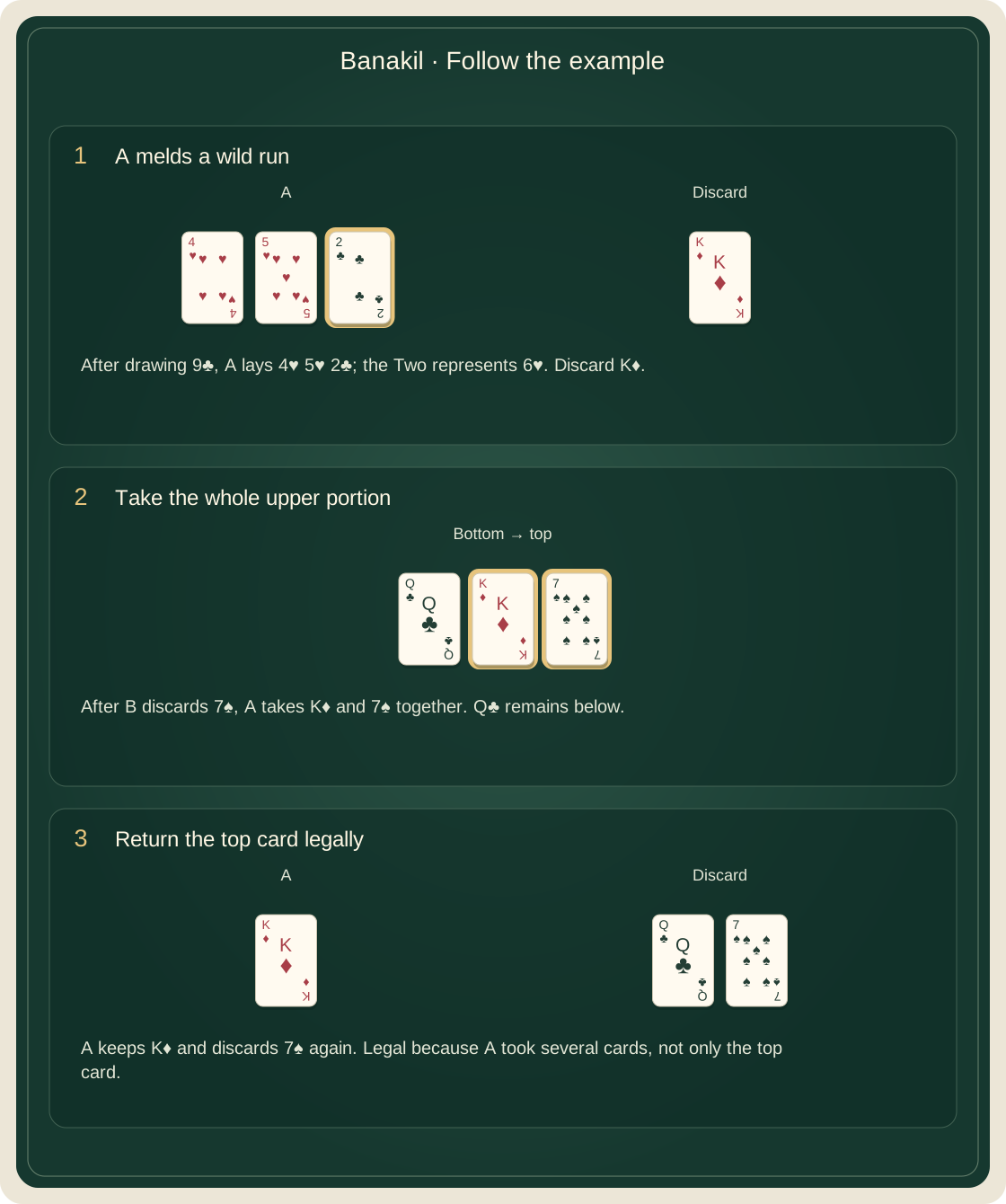
A draws 9♣, lays 4♥ 5♥ 2♣ as 4♥ 5♥ 6♥, and discards K♦. B draws and discards 7♠, so the visible pile is Q♣ K♦ 7♠ from bottom to top. A takes K♦ and 7♠ together, keeps K♦ and returns 7♠ legally. On a later turn A may extend the heart run with 7♥; the 2♣ remains attached. For an independent scoring example, earlier melds worth 22.5 and an empty hand give 22.5+20=42.5, rounded to 43. A rival with melds 5 and hand 8.5 scores −3.5, rounded to −3.
← On a small screen, scroll the diagram horizontally. →
07 /
What to watch at the table
A deep discard pickup can improve a run while filling your hand with penalties. Count the entire compulsory portion before taking it. Keep space for natural cards to free a Joker, but do not plan to reclaim a Two. Announce when only one or two cards remain, as is customary, so everyone can respond to the imminent exit.
08 /
Choose the rules before starting
Partnerships: only the finisher’s individual score goes to the winning team; opponents receive their own combined individual scores minus the finisher’s partner’s score. Round only after this calculation. The fixed 40 applies only when nobody else has melded; otherwise count cards plus the exit bonus. Set a target before individual play with 4. Different wild-card permissions are separate house variants.
09 /
History and related games
Banakil is documented in Jordan, Palestine, Syria and Lebanon. Its name refers to the wild twos. The separate meld areas and unusual partnership subtraction distinguish it from many familiar rummy games. The available account documents a regional practice rather than an established inventor or a precise creation date.
10 /
Check your understanding
Can I lay a group of kings?
Show answer
No. Equal-rank sets are restricted to threes and aces of different suits. Kings belong in suited runs.
May a drawn Joker be discarded?
Show answer
Yes. Wild cards may be discarded. A lone top-discard pickup still cannot be returned in that same turn.
Common questions
Is the ace low?+
No. Runs start at 3 and end at A.
Must I discard to go out?+
No. Melding every remaining card also ends the deal.
Is a proprietary pack needed?+
No. Use 2 ordinary packs plus 2 jokers.