← On a small screen, scroll the diagram horizontally. →
01 /
The game at a glance
Play with 2–4 people; at 4, play individually or with opposite partners. A Spanish pack has 40 cards: 1–7, sota, caballo and rey in each suit. For capturing their values are 1–7, 8, 9, 10. The printed Spanish court indices 10, 11, 12 are not their capture values. In our substitute pack A=1, J=8, Q=9, K=10.
02 /
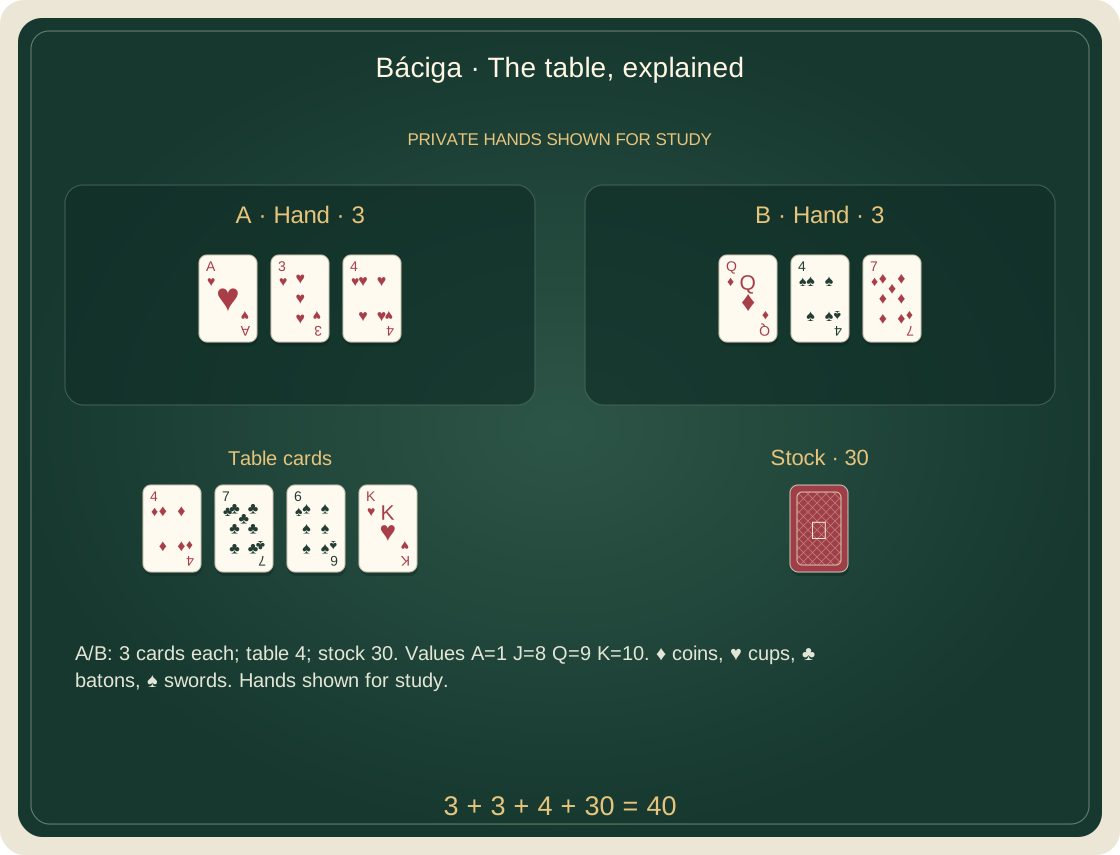
Prepare and deal
Deal anticlockwise: 3 cards each, then 4 face up on the table. Keep the remainder for later packets, not for drawing during a turn. If the initial table totals 15, the dealer collects it for 1 sweep; at 30, for 2. After each packet deal 3 more to each player, leaving the table unchanged. There are 6 packets at 2 players, 4 at 3 and 3 at 4.
03 /
How play proceeds
The player on the dealer’s right starts. Play a card and capture one chosen subset whose sum with it is 15; take your played card as well. If that card can capture, you must capture, but you need not choose a capturing card from your hand. With no capture it stays on the table. Emptying the table earns 1 escoba. Show declarations before playing your first card of each packet.
04 /
Rules that change your decision
Báciga: a hand total of 9 or less earns 2. Flor: all cards in the same suit earns 3. Escalera: consecutive capture values earns 3. Chorizo: equal ranks earns 20. Compatible declarations add; do not also score Tres de Nueve or Dos de Miseria. The cards remain in hand after showing them. A false declaration gives its value to the opposing side; a late declaration scores nothing.
05 /
Finish and scoring
After the last packet, the last capturer takes the remaining table without a sweep. Score declarations, sweeps and the table below. For setenta, select your highest number card in each captured suit and add face values; pictures count zero and an absent suit contributes zero. A tied category gives neither side its point in our individual example. First to at least 21 after a full deal wins; equal leaders continue.
| Category | Points |
|---|---|
| Most cards | 1 |
| Most coins | 1 |
| 7♦ | 1 |
| 2♣ | 4 |
| Setenta | 1 |
| Each escoba | 1 |
06 /
A worked example
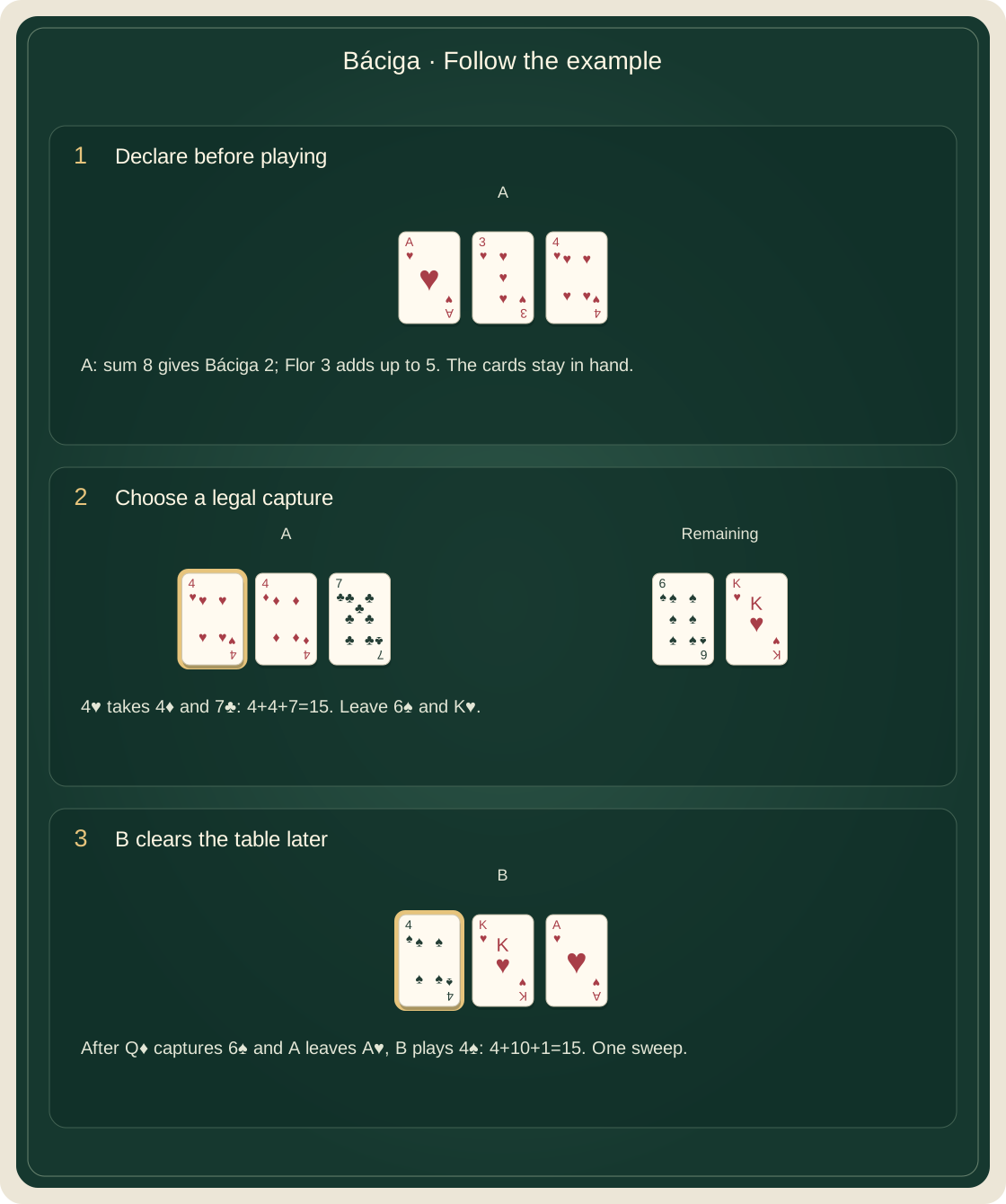
A holds A♥ 3♥ 4♥: sum 8, hence Báciga 2 plus Flor 3 gives 5. It is not an Escalera. On 4♦ 7♣ 6♠ K♥, A plays 4♥ and takes 4♦+7♣: 4+4+7=15. B plays Q♦, worth 9, and takes 6♠. A leaves A♥; B then plays 4♠ and captures K♥+A♥: 4+10+1=15 and the empty table earns 1 sweep. A leaves 3♥ and B leaves 7♦; deal another packet, keeping those table cards.
← On a small screen, scroll the diagram horizontally. →
07 /
What to watch at the table
Count possible replies before leaving an easy total. A capture that removes many cards may also expose a sweep to the opponent. Keep a separate visible record of declarations: collecting a bonus hand does not itself remove the cards. Watch coins, the seven of coins and the two of batons, rather than valuing every capture equally.
08 /
Choose the rules before starting
At 3 or 4 individual players, if some but not all tie for a category, each tied leader scores its point. Partners pool captures and scores. Agree separately on wild coins, extra special cards, Báciga y Pares, or a different setenta comparison; none operates here. These choices materially change tactics and should not be silently combined.
09 /
History and related games
Báciga belongs to the Uruguayan Escoba and Chorizo tradition. Its defining low-hand declaration also rewards a total that the neighbouring Chorizo declarations leave unrewarded. Local accounts differ, so this is a specified playable profile, not a claim that every Uruguayan table follows one national rulebook. The precise inventor and founding date are not established.
10 /
Check your understanding
Does Q count as its printed index?
Show answer
No. In the adapted diagrams Q is the horse and captures as 9. A printed Spanish horse often carries a different index.
May I keep a capturable table?
Show answer
Choose a different card if you wish. Once the played card can make 15, take a valid subset; leaving that card as a discard is illegal.
Common questions
Is a special deck required?+
A Spanish deck is traditional; an ordinary deck trimmed to 40 works with the stated mapping.
Does the last pickup earn a sweep?+
No. Only a capture that empties the table during play does.
When does the game end?+
At 21 or more after a complete deal; tied leaders play on.